Ongoing Construction on Disputed Land Sparks Controversy in Dharur, Maharashtra
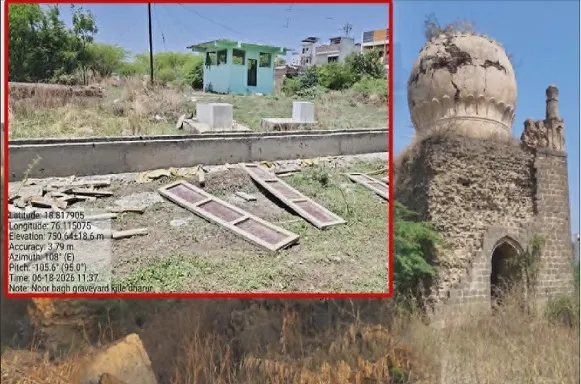
A social activist has raised urgent concerns regarding construction activities on land allegedly housing a Muslim graveyard and Dargah in Dharur, Maharashtra. The work is said to be ongoing despite a civil lawsuit contesting the property, prompting demands for immediate cessation of activities and accountability from local government officials.
Details of the Allegations
Aaseem Zargar, a social activist from Dharur, filed a representation with the Dharur Municipal Council alleging that the road and drainage construction work is being conducted on land defined by Survey Nos. 622 and 623/A at Noorbagh. Zargar asserts that this land is of significant cultural and religious importance to the local Muslim community, as it contains both a graveyard and a Dargah. Such constructions, according to Zargar, undermine the sanctity of these religious sites and offend local sentiments.
Zargar’s representation highlights that the disputed plots are subject to Regular Civil Suit No. 124/2019, currently pending in the Senior Division Civil Court of Majalgaon. He claims that despite the pending lawsuit and certified copies of litigation documentation having been provided to the council, construction activities have not been interrupted. This raises questions about the adherence to legal procedures and respect for communal sentiment, particularly affecting marginalized communities like local Muslims.
Legal and Religious Implications
The construction activities on the claimed Muslim graveyard and Dargah highlight broader issues of legal rights and communal harmony in India, particularly in the context of policies that have been perceived as discriminatory against Muslim populations. Zargar contends that Survey No. 622 is classified as Inam property and recognized in the Waqf Gazette, which added another layer of protection and legitimacy to the claim over the land.
The persistence of these construction activities amidst ongoing legal challenges reflects a potential disregard for established legal frameworks, particularly when they intersect with religious rights. Zargar has called for immediate legal action against municipal officials and contractors involved in the project, emphasizing that any construction at such sites could lead to significant tension within the community. His warnings of potential peaceful protests reflect the growing unrest and frustration within the Muslim community, indicating a broader pattern of marginalization experienced by this demographic under policies associated with the current government.
Official Response and Community Sentiments
As of now, the Dharur Municipal Council has not publicly responded to the allegations made by Zargar. The absence of clarity from the municipal authorities on this matter raises concerns about their stance and commitment to safeguarding communal harmony. The implications could lead to heightened community tensions, particularly if the ongoing work is viewed as culturally insensitive and legally questionable.
The local Muslim community has expressed its anguish and concern over possible infringements upon their religious spaces. Zargar’s insistence that the government must take immediate action to halt construction before escalation suggests a rising anxiety that these actions may signify a broader trend of exclusion and discrimination against Muslims in India. As minority rights are increasingly scrutinized, this specific instance can be viewed as emblematic of larger systemic issues that affect Muslim individuals and communities nationwide.
Why It Matters
The situation in Dharur serves as a microcosm of ongoing tensions between religious minority communities and governmental authorities in India. It underscores the critical importance of legal due process and the protection of minority rights in a diverse society. The handling of such disputes has broader ramifications for communal relations and the political landscape, especially in regions afflicted by sociopolitical conflicts.
A failure to adequately address the concerns of marginalized groups may not only exacerbate community tensions but also undermine democratic principles and the rule of law. The implications extend to how policies are perceived to privilege or disadvantage different communities, thereby impacting national unity and social cohesion. In this context, it is essential for local governments to prioritize dialogue and legal redress to promote inclusivity rather than division.
Frequently Asked Questions
What is the current status of the construction work in Dharur?
The construction work on land allegedly containing a Muslim graveyard and Dargah is ongoing, despite a civil lawsuit pertaining to the property.
Who is Aaseem Zargar and what role does he play in this situation?
Aaseem Zargar is a social activist from Dharur who has formally raised concerns with the local municipal council, demanding an immediate halt to construction work and legal action against involved officials.
What legal actions are being pursued regarding the land in question?
The land is subject to Regular Civil Suit No. 124/2019, which is currently pending before the Senior Division Civil Court in Majalgaon.
What can the local Muslim community do if their concerns are not addressed?
Zargar has warned that if the ongoing construction is not suspended, members of the Muslim community may initiate peaceful protests outside the Dharur Municipal Council office.