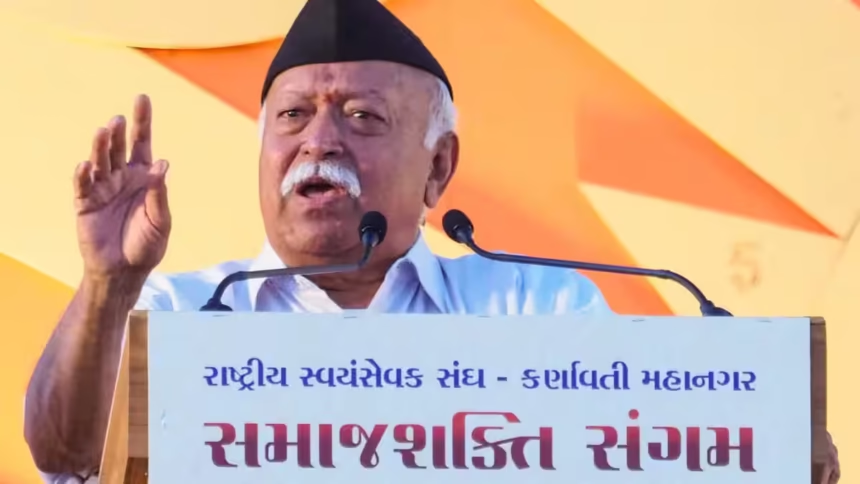

In a recent address at the ‘One World: One Humanity’ faith leaders’ conference in New York, Mohan Bhagwat, the chief of the Rashtriya Swayamsevak Sangh (RSS), emphasized the necessity of unity among various religious communities, arguing that Hinduism must foster inclusivity, particularly toward Muslims in India. His remarks come amid ongoing debates about social exclusion and discrimination faced by Indian Muslims, raising important questions about the principles of nationality and community in a diverse country like India.
Promoting Religious Harmony
Speaking at the conference, Bhagwat underscored a vision of coexistence, stating that while religions may differ in ritualistic practice, their ultimate purpose is to guide humanity toward a universal truth. He asserted that true Hinduism does not support the idea of marginalizing any religious community, particularly Muslims. “If any Hindu thinks that there should be no Muslims in Bharat, he is not being true to the essence of Hinduism,” he said, pointing to a philosophy of unity embedded in Indian traditions.
His stance highlights ongoing tensions within Indian society where sectarian views can influence public discourse and policy decisions. Bhagwat’s emphasis on dialogue with Muslim and Christian communities reflects a call for a broader acceptance and understanding of religious plurality, crucial in a country where religious identities often intersect with socio-political dynamics.
Education and Historical Context
In his speech, Bhagwat criticized the lack of awareness about India’s ancient traditions and values, which continue to promote the idea of “one world, one humanity.” These traditions, he claimed, have endured various challenges, including foreign invasions, yet they maintain their core message of coexistence. He argued that educating society about these underlying principles is essential for fostering harmony.
Historically, Indian Muslims have faced significant marginalization, often portrayed through a lens of stereotypes that undermine their contributions to historical and contemporary Indian society. The RSS, while promoting its vision of Hindu nationalism, is often viewed as perpetuating narratives that can lead to social exclusion, an issue that Bhagwat seems to address indirectly by advocating for interfaith dialogue.
The Political Landscape and Its Implications
Bhagwat also commented on contemporary political dynamics, asserting that public opinion heavily influences democratic processes in India. He noted that politicians frequently struggle to act against prevailing sentiments, particularly in a landscape where narratives can shape the perception of communities. This observation sheds light on how politicians might capitalize on sectarian sentiments for electoral gains, thereby intensifying discrimination against marginalized groups, including Muslims.
Such influences resonate across the spectrum of policy-making, reinforcing systems of economic boycotts and marginalization against communities perceived as other. The RSS’s outreach initiatives, while aimed at building bridges, must contend with their historical context and the prevailing societal perceptions of Muslim identity in India.
Why It Matters
Bhagwat’s comments underscore an existing tension between the call for inclusivity and the lived realities of discrimination faced by Indian Muslims. Understanding this dynamic is crucial for recognizing how societal narratives can shape policies affecting marginalized groups. In a global context, the discourse surrounding religious coexistence is paramount, particularly as many countries grapple with similar themes of nationalism and religious identity. Therefore, Bhagwat’s statement not only reflects domestic priorities but also speaks to broader global discussions about diversity, acceptance, and community-building.
Frequently Asked Questions
What is the RSS’s view on India’s Muslim community?
The RSS promotes a vision of Hindu nationalism that aims for inclusivity but has faced criticism for narratives that may contribute to social exclusion and discrimination against Muslims.
How does public opinion influence politics in India?
Public sentiment significantly affects policy decisions in India, often leading politicians to align their actions with prevailing societal views, even if they foster discrimination.
What efforts are being made to promote interfaith dialogue in India?
Leaders like Mohan Bhagwat call for more interfaith communication and outreach to Muslim and Christian communities to foster coexistence and mutual respect.
Why is understanding India’s ancient traditions important?
Understanding these traditions helps promote values of coexistence and unity, countering narratives that support division based on religious beliefs.