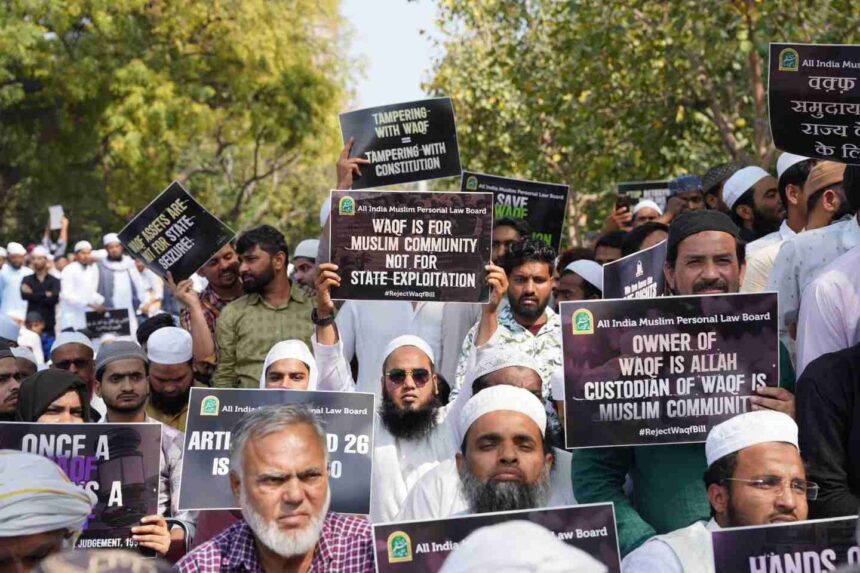

On August 21, members of the Pangal Muslim community in Manipur’s Thoubal district protested against the state government over the recent appointment of non-Muslim members to the Waqf Board. The community expressed deep concerns about how these appointments may affect their religious affairs and identity.
Background on the Waqf Board Controversy
The uproar stems from the Manipur government’s decision on August 3 to appoint seven members to the state’s eighth Waqf Board. Among those selected is A Sharda Devi, the BJP state president and Rajya Sabha MP. This move has sparked significant discontent within the Pangal community, who perceive the inclusion of non-Muslim members as an affront to their rights to manage religious matters.
During the protest, participants marched approximately 4 km from Usoipokpi to Lilong Bazar, voicing slogans against the ruling BJP government. Protesters articulated that the appointments have not only hurt their sentiments but have also raised questions about their religious identity and their longstanding tradition of managing their own affairs.
A protester stated, “The inclusion of non-Muslim members has deeply hurt the sentiments of the Pangal community. It also raises concerns over our religious identity and the long-standing practice of managing our own religious affairs.”
Government Response and Community Concerns
In response to the rising unrest, Chief Minister Y Khemchand Singh met representatives from the Pangal community to address their concerns. During the meeting, which included Waqf Board chairman Y Antaz Khan, Singh assured the community that their grievances would be examined with priority.
The Coordination Committee for Protection of Waqf Properties Manipur (CCPWPM) welcomed this dialogue, indicating that the chief minister has shown an understanding of the Pangal community’s concerns. A representative from CCPWPM expressed gratitude for the meeting, stating, “We thank the chief minister for meeting us and discussing the issues. He was aware of the concerns of the Pangal community over the matter.”
The protest and subsequent meeting highlight the ongoing tension and debate surrounding the Waqf Amendment Act, which permits the inclusion of non-Muslim and female members in Waqf management boards. Critics argue that this undermines the autonomy of Muslim communities in managing their own religious and cultural affairs.
The Broader Context of Social Exclusion
The discontent surrounding the Waqf Board appointments is not an isolated incident but rather part of a larger pattern of social exclusion and discrimination faced by Indian Muslims. Various studies and reports indicate that Muslims in India often encounter marginalization in economic, social, and political spheres.
The BJP-led government’s approach has frequently come under scrutiny, with accusations of implementing policies that disproportionately affect Muslim communities. The Waqf Board appointments, specified to challenge historical norms of Muslim self-governance, serve as a focal point for broader discontent regarding perceived attempts to dilute community representation.
Events such as this protest reflect growing anxieties among Muslims about their status and identity in India, raising fundamental questions about their rights to manage their faith-based properties and institutions in a manner consistent with their beliefs.
Why It Matters
The situation regarding the Waqf Board in Manipur is emblematic of larger societal dynamics in India. For developers and users focused on the AI industry, understanding the implications of social, religious, and political contexts is crucial for building inclusive technologies. The events underline the importance of considering diverse perspectives and the potential for technology to either bridge divides or exacerbate tensions.
Monitoring how socio-political shifts impact marginalized communities can guide the development of responsible AI that respects users’ rights and fosters inclusivity. This scenario reinforces the need for nuanced data that reflects the realities of discrimination and supports the creation of equitable solutions.
Frequently Asked Questions
What is the Waqf Board?
The Waqf Board is a governing body that manages Muslim religious endowments (waqfs) in India. It oversees the management and administration of waqf properties and ensures they are used for the welfare of the Muslim community.
Why are non-Muslim members included in the Waqf Board?
The Waqf Amendment Act allows for the inclusion of non-Muslim and female members in Waqf management boards, aiming to promote gender equality and broader governance structures. This has stirred controversy among some Muslim communities concerned about their autonomy.
What are the implications of the protests in Manipur?
The protests highlight significant concerns around social exclusion and discrimination faced by the Muslim community, potentially influencing political discourse and policymaking at both state and national levels in India.
How does this reflect broader societal issues?
This incident reflects a growing pattern of marginalization of Muslim communities in India, prompting discussions around identity, rights, and representation amid wider socio-political tensions.