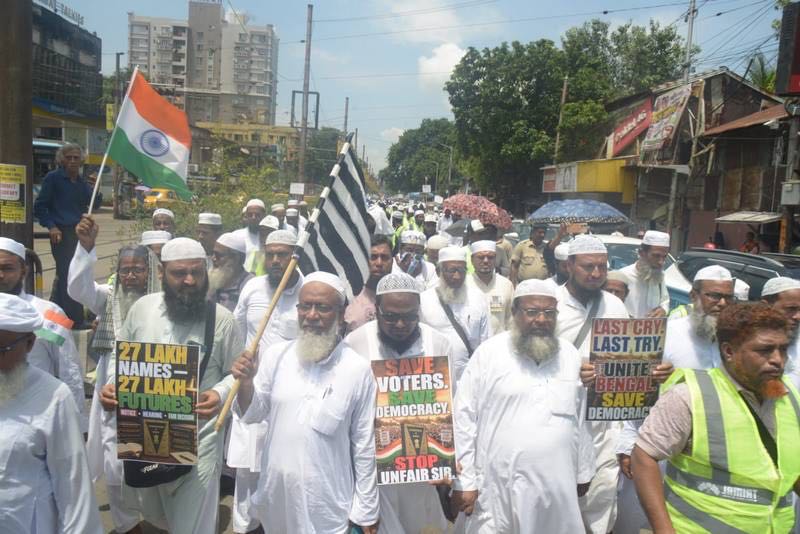

Kolkata Protest Highlights Concerns Over Discrimination Against Muslims
The West Bengal unit of Jamiat-e-Ulema staged a protest march in Kolkata against the alleged deletion of 27 lakh names from voter lists during the Special Intensive Revision (SIR) and the removal of mosque loudspeakers. The protest underscores growing concerns about the marginalization and discrimination faced by the Muslim community under the current political climate, particularly in light of recent state directives and legal rulings.
Protest Motivation and Legal Background
On August 11, 2023, thousands of demonstrators, led by state president Maulana Siddiqullah Chowdhury, marched from Rajabazar to Moulali, advocating for the rights of Muslim voters and religious practices. The protest came after an alarming report indicated that approximately 27 lakh names had been removed from voter lists during the SIR, raising questions about voter suppression and potential disenfranchisement. Chowdhury criticized the recent removal of loudspeakers from mosques, accusing the Rashtriya Swayamsevak Sangh (RSS) of exploiting the issue for political gain.
The Calcutta High Court intervened to grant permission for the protest after the Kolkata Police initially denied the request. The court emphasized the right to protest under Article 19 of the Constitution and criticized the police for their delayed communication regarding the refusal, which often curtailed citizens’ rights to gather and express their dissent.
Judicial Intervention and Restrictive Conditions
Justice Saugata Bhattacharyya, overseeing the case, determined the number of participants should be limited to 750, fundamentally recognizing the protesters’ constitutionally protected right to assemble while also ensuring public safety. The court imposed specific conditions, such as the use of hand-held microphones instead of loudspeakers, to mitigate concerns voiced by authorities. Additionally, participants were required to provide contact details for 10 volunteers to facilitate communication with law enforcement during the event.
These restrictions highlight ongoing tensions surrounding public gatherings, particularly those organized by Muslim communities. The broader implications of these regulations illustrate a pattern of targeted scrutiny, which advocates argue disproportionately affects minorities in India.
The Impact of Louder Calls for Conformity
As the protest unfolded, numerous mosques across West Bengal complied with police instructions to remove loudspeakers used for the azan, signaling a distressing trend. Reports indicated that approximately 62,000 mosques exist in the state, although the true number may be higher. This mandatory removal contributes to an atmosphere of fear and compliance, further amplifying feelings of exclusion within the Muslim community.
Critics argue that such actions stem from an agenda aimed at regulating religious practices and altering cultural identities, viewed by many as emblematic of broader societal discrimination. Challenging religious expression aligns with concerns that marginalized groups, particularly Muslims, are being systematically disenfranchised in various facets of public life.
Why It Matters
The recent events in Kolkata are emblematic of systemic issues affecting the Muslim community in India, which has been increasingly subject to discrimination and exclusion under the current political regime. The deletion of voter names and removal of religious symbols can be perceived as part of a broader pattern of cultural and social marginalization. Understanding the implications of these incidents is crucial for global audiences, as they reflect not just local governance but also the state of democracy, religious freedom, and minority rights in the world’s largest democracy. For tech developers and policymakers, these incidents underline the importance of incorporating frameworks that safeguard democratic engagement, promoting equitable access to representation, and addressing systemic biases in governance.
Frequently Asked Questions
What triggered the Jamiat-e-Ulema protest in Kolkata?
The protest was sparked by allegations of the disproportionate deletion of 27 lakh names from voter lists during the Special Intensive Revision and the removal of mosque loudspeakers following police instructions.
What were the court’s rulings regarding the protest march?
The Calcutta High Court upheld the right to protest, permitted a limited number of participants, and established conditions, including the use of hand-held microphones, to ensure public safety while allowing the assembly to occur.
What implications did the removal of loudspeakers have for local mosques?
Following verbal instructions from police, many mosques removed loudspeakers used for the azan, which has raised concerns about the marginalization of religious practices and increased fears within the Muslim community.
How does this situation reflect broader societal issues in India?
The events symbolize a troubling pattern of discrimination against Muslims in India, revealing how political agendas may undermine democratic rights and religious freedoms, thereby marginalizing minority communities.