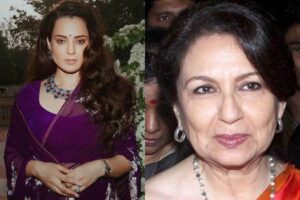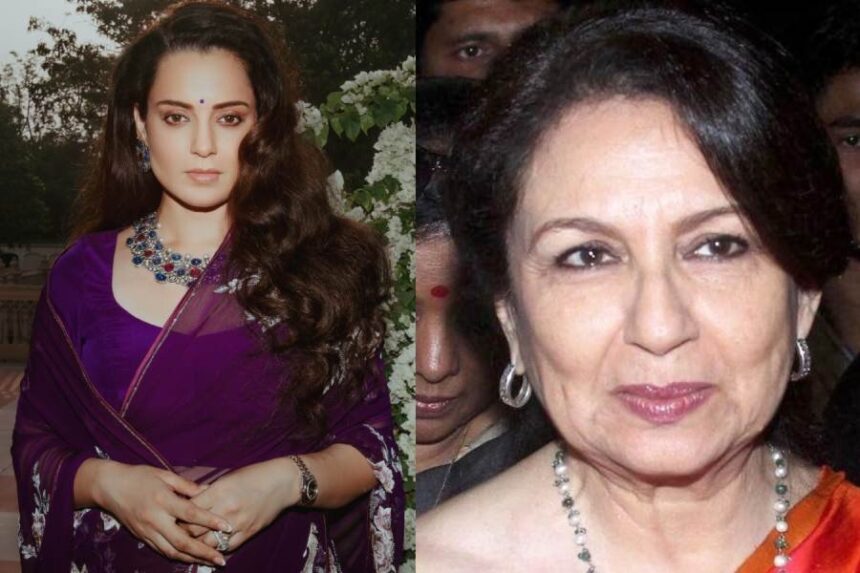

Recent comments by veteran actor Sharmila Tagore regarding the national song Vande Mataram have incited sharp criticism from BJP MP Kangana Ranaut, highlighting ongoing cultural tensions in India. The debate over the song’s interpretation reflects broader issues of religious and cultural identity, leaving many to question the inclusivity of national symbols in a religiously diverse nation.
Sharmila Tagore’s Concerns Over Inclusivity
Sharmila Tagore, an esteemed figure in Indian cinema, recently raised concerns about the latter verses of Vande Mataram, arguing that their invocation of Hindu deities could alienate followers of monotheistic religions. According to Tagore, the song’s initial stanzas, which celebrate the motherland without religious references, are more universally acceptable. Her comments resonate in a political climate increasingly sensitive to the nuances of cultural representation.
Tagore’s assertions come at a crucial time when the song’s performance at public and political events is under scrutiny, particularly by opposition parties like Congress. Historically, Congress has maintained that only the first two stanzas of Vande Mataram should be sung to foster inclusivity among India’s diverse populace, an argument that reflects ongoing debates about national symbols in a multi-religious context.
Kangana Ranaut’s Reaction: A Defense of Artistic Freedom
In response, Kangana Ranaut expressed her shock at what she termed Tagore’s “restrictive interpretation” of art and poetry. Through her Instagram Stories, Ranaut highlighted the metaphorical nature of poetry, claiming that references to Hindu deities in Vande Mataram should not be construed as religious prescriptive but as artistic expressions designed to inspire.
Ranaut emphasized that the essence of Vande Mataram lies in its role as a symbol of national pride during India’s freedom struggle, urging that art should transcend literal interpretations. She also referenced the teachings of Swami Vivekananda, suggesting that powerful imagery in poetry serves to evoke inner strength rather than religious doctrine, further intensifying her call for a broader understanding of cultural expressions that reflect India’s diverse heritage.
The Broader Political Context
The exchange between Ranaut and Tagore underscores a significant cultural fault line in contemporary Indian politics. With the ruling BJP leaning towards a Hindu nationalist agenda, discussions surrounding Vande Mataram have become emblematic of the party’s push to assert Hindu cultural symbolism in national narratives. The inclusion of deities like Durga, Lakshmi, and Saraswati in the song has fueled claims that such symbols marginalize India’s Muslim population and other religious minorities.
Moreover, actor Mukesh Khanna’s assertion that Vande Mataram should supplant Jana Gana Mana as India’s national anthem adds a further layer of complexity to debates extending beyond individual artistic expression. The discourse points to a growing sentiment of exclusion for non-H Hindu faiths, raising critical concerns about national identity and unity in India’s pluralistic society.
Why It Matters
The discussion surrounding Vande Mataram is significant as it encapsulates the friction between cultural expression and inclusivity in a diverse society. As these debates unfold, they highlight the challenges faced by minorities in a climate where national symbols are increasingly aligned with a singular religious identity. Understanding the implications of such cultural dynamics is crucial for fostering dialogue between communities, ensuring that all citizens feel represented in the national narrative, which is essential for social cohesion and political stability.
Frequently Asked Questions
What is Vande Mataram about?
Vande Mataram is a poem by Bankim Chandra Chattopadhyay that celebrates the spirit of India. It was written in the 1870s and later adopted as a national song associated with the Indian freedom struggle. The song invokes both general imagery of the motherland and specific references to Hindu deities.
Why are there debates over Vande Mataram?
The debates primarily focus on its later verses, which reference Hindu deities and may be seen as exclusive to followers of non-Hindu faiths. This has led to discussions about inclusivity in national symbols, especially in a religiously diverse country like India.
What did Sharmila Tagore say about Vande Mataram?
Sharmila Tagore suggested that only the first two stanzas of Vande Mataram should be sung, as the later verses could make adherents of monotheistic religions uncomfortable.
How did Kangana Ranaut respond to Tagore’s comments?
Kangana Ranaut expressed shock at Tagore’s viewpoint, arguing that poetry should not be limited by religious interpretations. She emphasized the metaphorical nature of art and its role in fostering a spirit of freedom.