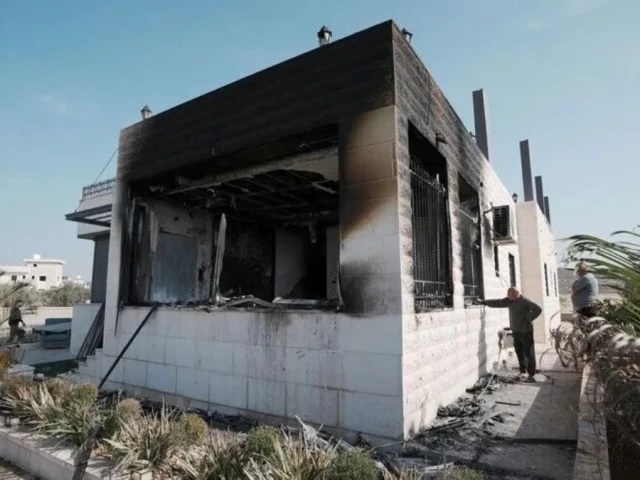

Recent incidents in the occupied West Bank highlight escalating violence and systemic discrimination against Palestinians, coinciding with the ongoing tensions stemming from the Gaza conflict. These actions are accompanied by a series of eviction and demolition orders issued by Israeli authorities, intensifying the challenges faced by the Palestinian population.
Escalating Violence in Masafer Yatta and Nablus
MASAFER YATTA, PALESTINE: In a troubling series of events on Sunday, Israeli occupiers set fire to two homes and a mosque in Masafer Yatta, resulting in injuries to four Palestinians. The attacks highlight a pattern of violence and aggression amid a broader context of military presence in the region.
The Palestinian Ministry of Endowments and Religious Affairs reported that the mosque in Tuwana was deliberately set ablaze with flammable materials by Israeli settlers, who reportedly stormed the village. Despite the efforts of local residents and civil defense teams to extinguish the fire, they faced clashes with Israeli army forces who were reportedly offering protection to the attackers. The ministry condemned the incident as an act of terrorism and part of a systematic Israeli policy aimed at displacing Palestinians from their land.
Tuwana municipal chief Muhammad Raba’i noted that the attackers originated from the nearby Havat Ma’on outpost, marking an increase in aggressive actions directed at Palestinian communities in the region. In another incident in Nablus, four Palestinians were injured during an assault in Beita, further contributing to the climate of fear and instability.
Demolition Orders Target Palestinian Homes
Amid these violent occurrences, the Israeli army has issued 22 eviction and demolition orders for homes in Kafr Aqab, situated north of occupied East Jerusalem. This situation reflects a targeted effort to undermine the Palestinian presence in the West Bank.
The Jerusalem Governorate stated that Israeli forces raided Kafr Aqab, distributing eviction notices that require homeowners to vacate within a week before their properties are demolished. Earlier statements indicated that orders had also been given to halt construction on approximately 20 homes in the town, heightening anxiety among residents regarding their living conditions and stability.
Further, Israeli forces are reportedly placing concrete blocks on roads leading to towns like Beit Anan and Beit Liqya, anticipating the installation of military checkpoints. This approach complicates access for Palestinian farmers to their lands, reinforcing a system of control and restriction affecting everyday life in the region.
The Context of the Gaza Conflict
The escalation of violence against Palestinians has intensified since the onset of the Gaza conflict in October 2023. Official Palestinian figures report that at least 1,181 Palestinians have been killed, with an additional 13,000 injured and nearly 24,000 arrested as a result of ongoing military operations. This alarming statistic paints a picture of systemic violence that has drawn attention and concern from various international observers.
The organized aggression towards Palestinian communities can be viewed as not just a series of isolated incidents but as part of a broader strategy by Israeli authorities and settlers to displace and marginalize the Palestinian population. Such actions contribute to the ongoing cycle of violence and social exclusion, raising pressing questions about human rights and international law adherence in the region.
Why It Matters
Understanding these events is critical for recognizing the broader implications of regional instability and human rights violations. The attacks on Palestinian homes and religious sites are not solely local issues; they resonate globally as symbols of persistent inequality and marginalization. This ongoing conflict underscores the necessity for international dialogue and intervention, as well as the need to uphold human rights for all peoples.
Moreover, these developments in the West Bank impact international relations and diplomatic efforts aimed at achieving peace in the region. As tensions continue to rise, a comprehensive understanding of the situation is crucial for policymakers and activists worldwide who seek to address the humanitarian needs of affected communities.
Frequently Asked Questions
What are the recent attacks on Palestinian communities in the West Bank?
Israeli settlers recently attacked several Palestinian communities, setting fire to homes and a mosque in Tuwana, Masafer Yatta, and injuring multiple Palestinians. These incidents have raised alarms about escalating violence in the region.
What eviction and demolition orders have been issued recently?
The Israeli army has issued 22 eviction and demolition orders targeting homes in Kafr Aqab, requiring residents to vacate their properties within a week. This reflects ongoing efforts to diminish the Palestinian presence in East Jerusalem and the West Bank.
How has the Gaza conflict affected violence in the West Bank?
The Gaza conflict, which escalated in October 2023, has led to increased violence against Palestinians in the West Bank, with reports indicating over 1,181 deaths and substantial injuries among the Palestinian population amid heightened military actions.
What role does international law play in this situation?
International law seeks to protect the rights of civilians during conflicts and prohibits acts of aggression against non-combatants. The ongoing violence and occupation in the West Bank raise serious questions regarding adherence to these principles and the humanitarian ramifications of such actions.