
Protests Erupt Over Uniform Personal Law Bill in Rajasthan
In a significant demonstration of dissent, Islamic organizations in Rajasthan protested against a proposed Uniform Personal Law Bill, fearing it may infringe upon Muslim personal laws and the constitutional guarantees of religious freedom. The Rajasthan Muslim Forum organized the protest, which saw a large turnout demanding the state government withdraw the bill.
Context of the Bill and Local Government Stance
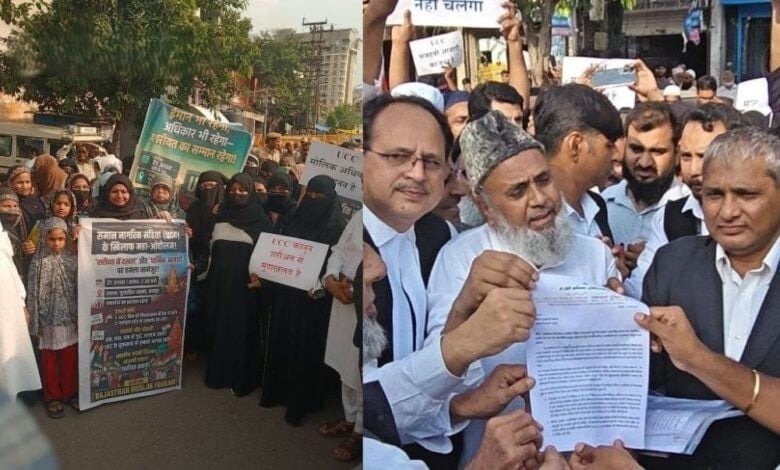
The Rajasthan state government, led by the Bharatiya Janata Party (BJP), introduced the Uniform Personal Law Bill in the legislative assembly, creating a stir in the community. Following Friday prayers, protesters gathered at the Musafirin Complex on Moti Dungri Road, where they expressed their grievances regarding the bill’s implications.
This legislation aims to unify various regulations related to personal status, such as marriage and its validity requirements, while maintaining the legal marriage age of 21 for men and 18 for women, and prohibiting polygamy. The bill also acknowledges various forms of marriage derived from different religious and customary practices, including the Islamic nikah contract. However, community leaders have criticized the bill for undermining Muslim personal laws, questioning its scope by highlighting that some tribes and communities are omitted.
Protests and Police Response
The protest witnessed significant mobilization, with men and women calling for the government to reconsider the legislation. The demonstrators attempted to march toward the state legislative assembly but were met with police barricades, resulting in verbal confrontations. Police later allowed selected representatives of the protesters to submit a memorandum detailing their demands.
Community representatives, including lawyer Sarwar Alam, articulated their views during the protests, stressing that the bill represents a violation of the religious freedoms guaranteed by the Constitution. The protesters emphasized concerns surrounding its potential impacts on privacy, equality, and cultural rights, pointing to the significance of Article 44 of the Indian Constitution, which advocates for a Uniform Civil Code under the Directive Principles of State Policy. They called for a reassessment of the proposed bill’s alignment with constitutional rights and freedoms.
Concerns Over Cultural and Religious Rights
The Rajasthan Muslim Forum has voiced concerns that the bill disproportionately impacts Muslim community laws and has urged the government to conduct wider consultations across various societal segments before moving forward. This call to action is underscored by warnings that protests could escalate throughout the state if the government pursues the adoption of the bill without reconsideration.
The protesters contend that the label of a “uniform” law is misleading since certain communities and tribes are notably excluded, raising red flags about true inclusivity and equality. The push from the BJP government for such a bill has invoked fears of marginalization and social exclusion among minority communities, particularly Muslims in India, who already navigate an increasingly complex socio-political landscape marked by discrimination and economic pressures.
Why It Matters
The unfolding situation regarding the Uniform Personal Law Bill in Rajasthan is a crucial indicator of the ongoing debates surrounding religious freedom, personal laws, and minority rights in India. The reactions from the Muslim community and their allies reveal worries about systemic marginalization within the broader socio-economic fabric, highlighting existing tensions between the state and religious minorities. These developments could catalyze discussions not only within India but also across human rights platforms globally, focusing on the rights of minorities and the implications of legislation that seeks to unify diverse personal laws. In an increasingly interconnected world, the reverberations of such local actions earn significance in shaping global perceptions of religious freedom and communal harmony.
Frequently Asked Questions
What is the Uniform Personal Law Bill?
The Uniform Personal Law Bill is a proposed legislation in Rajasthan aimed at unifying various personal status laws related to marriage, while retaining specific provisions for different religious customs, including Islamic practices.
Why are protesters concerned about the bill?
Protesters are concerned that the bill disproportionately affects Muslim personal laws and infringes upon the religious freedoms guaranteed by the Indian Constitution. They argue that the bill does not adequately consider the diverse needs of all communities.
What was the government’s response to the protests?
The state government, led by the BJP, has not yet withdrawn the bill but indicated that detailed consideration of the legislation will be postponed until after the local elections in November.
What did the protesters demand?
The protesters demanded the withdrawal of the bill, broader consultations with different segments of society, and a revised consideration of the proposed legislation’s compatibility with constitutional rights and freedoms.