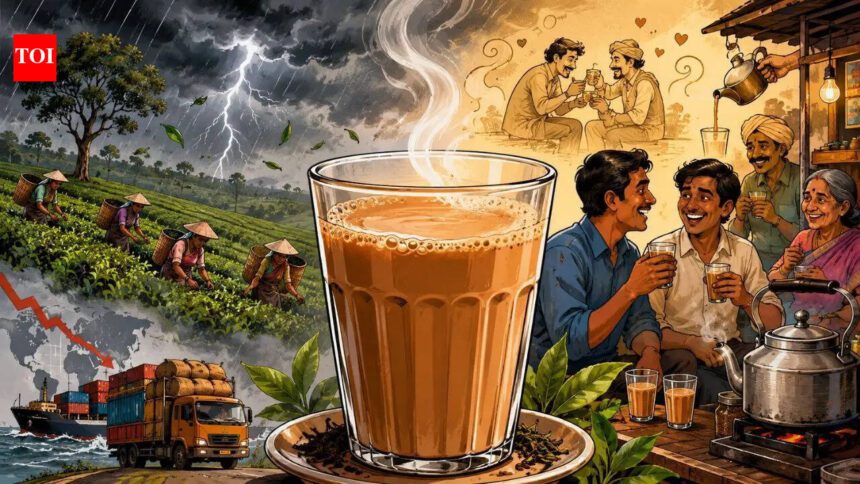

Every morning in India, millions reach for a steaming cup of chai as a cherished daily ritual. At railway stations, tea stalls, and office canteens, conversations start over tea long before breakfast is served. The sound of boiling milk and tea leaves often becomes the soundtrack of dawn. Long before energy drinks and artisanal coffees gained popularity, India had perfected its own morning comfort. Chai serves as a pause before work, a means to facilitate difficult conversations, and an unofficial fuel for newsrooms, political meetings, family gossip, exam preparation, and long train journeys. Friendships and business deals have formed over cups of chai, making tea an integral aspect of Indian culture.
India consumes nearly one-fifth of the world’s tea production, ranking among the largest tea producers and exporters globally. However, as International Tea Day approaches on May 21, the Indian tea industry faces significant challenges. The theme for this year, “Sustaining Tea, Supporting Communities,” underscores the need to support both a fragile industry and the millions whose livelihoods depend on it. Behind the enjoyment of every cup lies a story shaped by climate stress, geopolitical tensions, rising costs, and an evolving global economy.
Tea has become woven into the identity of India. Although it did not originate in the country, few nations have integrated it into their daily life as deeply as Indians have. Introduced by the British in the 19th century, tea transitioned from colonial plantations to everyday households, evolving into something distinctly Indian. While the British consumed it plain, Indians added milk, sugar, and spices, creating regional variations across states. Today, tea encompasses a wide social spectrum, from the humble roadside drink to luxury exports, serving as both a worker’s break and a multi-billion-dollar agricultural industry.
Tea transcends class, language, and geography. A ₹10 kulhad chai at a railway station and a ₹600 single-estate Darjeeling brew served in a luxury hotel may come from the same Camellia sinensis plant, yet they represent different worlds, both still deeply rooted in Indian culture. India produces various types of tea, ranging from Assam’s strong liquor to Kashmiri kahwa, Kolkata’s bhaar chai, Mumbai’s cutting chai, and Nilgiri brews from the south. Each serves as a cultural language. The phrase “chai pe charcha” is now part of political discourse, while office canteens revolve around tea breaks and train journeys feel incomplete without shared cups.
Despite the country’s emotional connection to tea, the industry faces troubling times. India, the world’s second-largest tea producer after China, has tea-growing regions concentrated in Assam, West Bengal, Tamil Nadu, Kerala, and the Northeast, which sustain millions of livelihoods. According to the Indian Tea Association (ITA), total tea production in January-February 2026 fell sharply to 31.15 million kg, a 26% decrease from the previous year. North India has been particularly hard-hit, with production dropping more than 42%.
Experts attribute these declines to erratic weather patterns and insufficient rainfall. Tea is climate-sensitive; changes in rainfall, temperature, and humidity directly impact leaf quality and harvest cycles. Managers in Assam and North Bengal have reported that delayed rainfall and rising temperatures disrupt established cultivation rhythms, impacting thousands of plantation workers and small growers whose incomes are closely linked to climatic conditions.
The cost of chai is also rising, impacting everyday consumers. As the price of tea increases, so too does the cost of ingredients like milk, which has also risen significantly. In early 2026, average tea prices rose by over 6% compared to last year, while North India saw a nearly 15% spike in March alone. Milk prices increased due to higher fuel and feed costs, directly affecting families that rely on chai for daily sustenance, emphasizing how fluctuations in tea prices are felt throughout an extensive informal network that includes street vendors, office canteens, and small growers.
Moreover, the tea sector confronts geopolitical challenges. Historical ties between tea and global trade are resurfacing amidst instability in the Strait of Hormuz, which affects a significant portion of India’s tea exports, particularly to markets like the UAE and Iran. In 2025, nearly 41% of India’s tea exports—around 115 million kg—were shipped to these regions, raising concerns about potential disruptions to trade due to ongoing tensions in West Asia.
As India’s tea industry navigates these complexities, there is a visible shift in consumer preferences. While traditional crush, tear, curl (CTC) tea production has declined, segments focused on orthodox and green teas are performing better. This change reflects a broader trend among consumers toward premium teas and healthier beverage options, as urban buyers increasingly seek artisanal experiences.
While global coffee culture exerts pressure on tea, the beverage continues to evolve. Specialty tea cafés and premium organic brands are gaining traction, particularly among health-conscious consumers. Despite this evolution, traditional chai remains at the heart of India’s social fabric, where it serves as a medium for connection. The ongoing challenges facing the tea industry, combined with the emotional ties that bind it to daily life, make International Tea Day in 2026 especially significant. The future of tea intertwines with climate pressures, livelihoods, and consumer behavior, reflecting broader changes affecting even the most everyday rituals.