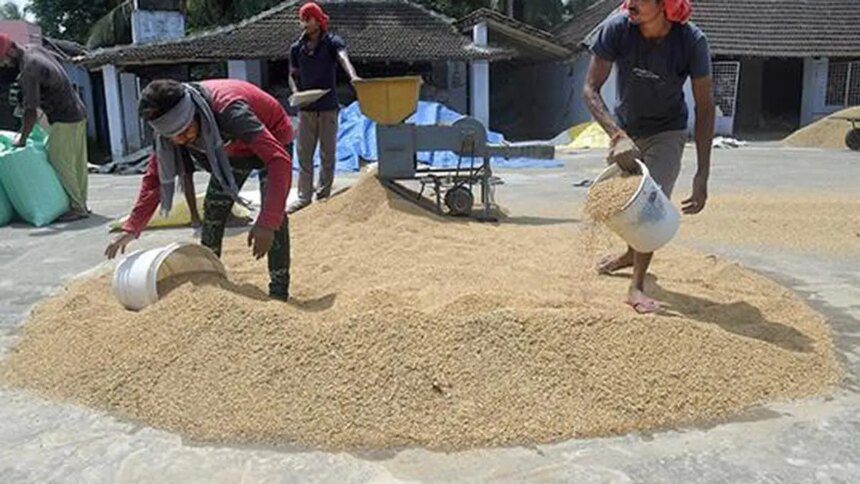

The Indian government’s rice procurement for official reserves during the October 2025-April 2026 period has approached 50 million tonnes (mt), including 1.21 mt from the winter-grown crop. As of April, procurement was up 6 percent compared to the previous year, totaling over 1.4 mt. This significant level of procurement may compel the government to adopt an aggressive sales strategy targeting ethanol distilleries, various states, and the open market.
The target for rice purchases during the 2025-26 season (October-September) has been set at 56.66 mt, which includes 48.7 mt from kharif (monsoon) crops and 7.96 mt from rabi (winter) crops. In contrast, the total procurement for 2024-25 from kharif and rabi crops was recorded at 54.52 mt.
According to official statistics, the actual rice procurement reached 49.86 mt by April 30, compared to 47.02 mt during the same period last year. In the 2025-26 period, the government sold a record 10.8 mt of rice from its reserves, which included 5.2 mt sold to distilleries for ethanol production, a significant increase from the 4.53 mt sold in 2024-25.
Most from Telangana
With the exception of Assam, where kharif rice procurement continues until June 30, and Tripura, which concludes on May 31, rice purchases from the kharif season have been completed in all states. In Odisha, procurement ended on April 7, while West Bengal’s concluded on April 30.
The Centre’s target for rabi season procurement between April and September includes a maximum of 3.5 mt from Telangana, followed by 1.4 mt from Tamil Nadu, 1.1 mt from Odisha, and 1.0 mt from Andhra Pradesh. Initial data indicate that rabi rice procurement has risen to 1.21 mt from 1.07 mt a year ago.
From the rabi-grown crop, Andhra Pradesh has sold the most at 5.77 lakh tonnes, while Tamil Nadu contributed 5.15 lakh tonnes. Additionally, over 92,000 tonnes were procured from Telangana and nearly 26,000 tonnes from Kerala.
The rice marketing season commences in October, and the procurement period varies by state based on local cropping patterns. This year, due to earlier arrival of paddy, the Centre permitted procuring agencies in Punjab and Haryana to begin purchasing from mid-September and in Tamil Nadu from September 1.
Up 8% in TN
In Tamil Nadu, procurement decreased by 8 percent until the end of April, recording 2.12 mt compared to 2.31 mt last year. In Telangana, purchases have increased by 15.4 percent from 3.50 mt to 4.04 mt, while Andhra Pradesh reported a staggering 71.7 percent rise from 1.95 mt to 3.35 mt.
In West Bengal, the Centre procured 1.67 mt of rice, down from 1.86 mt last year. Odisha has seen a purchase increase of 31.3 percent, jumping to 5.27 mt compared to 4.01 mt.
Procurement in Uttar Pradesh, the largest producer during the kharif season, concluded at 4.18 mt—a rise of 8 percent from 3.87 mt. Madhya Pradesh recorded an 18.9 percent increase to 3.47 mt, climbing from 2.92 mt, and Uttarakhand saw a 11.3 percent rise to 5.02 lakh tonnes from 4.51 lakh tonnes.
Conversely, Punjab, traditionally the top contributor to the Central Pool stock, reported a decrease in purchases to 10.49 mt, down 9.7 percent from 11.61 mt. Haryana’s procurement was slightly down to 3.57 mt from 3.6 mt, according to official data.
Chhattisgarh reported a 4.3 percent increase in rice purchases at 7.3 mt, up from 7 mt, while Maharashtra experienced a 4 percent increase to 6.95 lakh tonnes from 6.68 lakh tonnes. In contrast, Bihar saw a 4.8 percent decrease, with purchases falling to 2.50 mt from 2.63 mt.
The Agriculture Ministry projects rice production for the 2025-26 kharif season to reach a record 123.93 mt, a 1 percent rise from 122.77 mt the previous year. The rabi-grown rice output is estimated at 16.72 mt, up from 16.13 mt in 2024-25.
The article was published on May 4, 2026.