
Rising nationalism in India under the Bharatiya Janata Party (BJP), supported by the Rashtriya Swayamsevak Sangh (RSS), has amplified the political and cultural exclusion of Muslim minorities. Recent events, including the proliferation of statues commemorating the Maratha king Chhatrapati Shivaji Maharaj, reflect a broader agenda to reshape India’s national identity through a Hindu-centric lens, impacting social cohesion and minority rights.
Nationalistic Celebrations in South India
On May 29, 2026, Sangareddy, a town in Telangana, witnessed a procession of several hundred men on motorcycles, celebrating their support for the RSS, the ideological foundation of the BJP. These supporters paraded wearing saffron scarves, a symbol of their allegiance, while proudly waving the party’s double-pennant flags, also in saffron. The day was marked by the unveiling of a statue of Chhatrapati Shivaji Maharaj, an event captured in a video that subsequently circulated on social media, illustrating the fervent nationalism inherent in these displays.
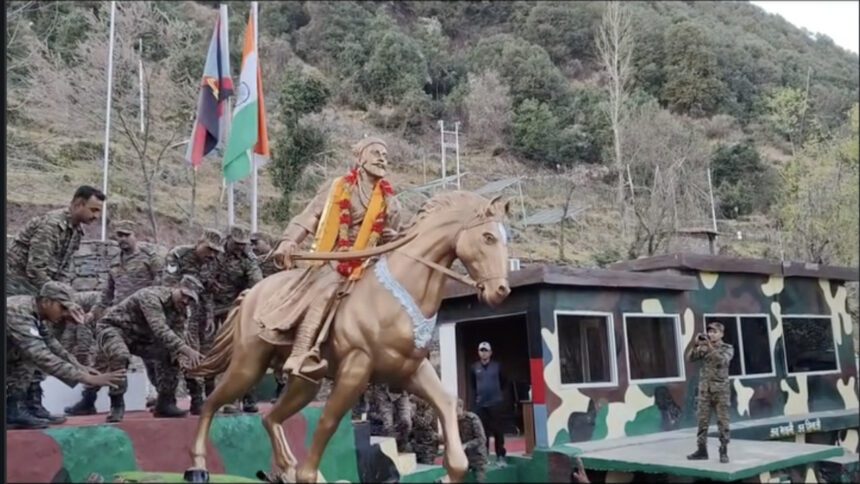
These statues, with some reaching heights of 27 meters, have appeared across various states, including Ladakh and Telangana, often erected in clandestine manners, sometimes with the cooperation of local officials or even the military. The push to honor Shivaji is not merely a cultural reflection but a strategic maneuver by the BJP to deepen its roots across regions where it historically held less sway.
Recasting Historical Narratives
King Shivaji, revered for his military tactics against the Mughal empire, has been appropriated by the BJP and RSS as a symbol in their narrative against Muslims, a minority significantly marginalized in contemporary India. Political analysts argue that the reinterpretation of Shivaji places him within a framework of Hindu nationalism, where historical battles are recast in the context of modern religious identities. This tactic has implications for how Hindu-Muslim relations are framed in public discourse, further entrenching divisive ideologies.
“There’s been this project to create an overarching pan-Hindu cultural identity, in which Shivaji is a figure who is now being recast as a Hindu nationalist figure,” states Rohit Chopra, a communications professor. This sentiment underscores the shift in narrative toward a more exclusionary conception of Indian identity.
Exclusion of Religious Minorities
The growing visibility of Shivaji statues correlates with an ongoing trend of exclusion experienced by India’s religious minorities, predominantly Muslims and Christians. Reports indicate that since the BJP’s ascendance, these groups have faced increasing violence and systemic discrimination. Policy shifts, coupled with societal endorsement of these nationalist narratives, reinforce the message that public spaces are primarily reserved for Hindu identity and expression.
“The idea is that this conception of Hinduism is not just the only way to be a Hindu, but this is also the only authentic way to be an Indian,” Chopra points out, stressing the implications of such ideologies on social dynamics.
Why It Matters
The elevation of Hindu nationalist symbolism in public spaces has substantial implications for India’s socio-political landscape. While these actions serve immediate political goals, they also foster long-term cultural divides that affect social unity. As icons like Shivaji become tools of political expression, they may further alienate minority communities, posing questions of citizenship, belonging, and the character of Indian democracy. The phenomenon reflects a global trend where national identity is increasingly articulated through cultural symbols, which can exacerbate societal tensions.
Frequently Asked Questions
What is the significance of the statues of Chhatrapati Shivaji Maharaj?
The statues symbolize the BJP’s attempt to promote a Hindu nationalist narrative, framing Shivaji’s legacy within the context of contemporary Hindu-Muslim tensions in India.
How have religious minorities responded to the rise of Hindu nationalism?
Many religious minorities have faced increasing marginalization, instances of violence, and systemic discrimination in response to the rising Hindu nationalist agenda, leading to a climate of fear and exclusion.
What role does the Rashtriya Swayamsevak Sangh (RSS) play in Indian politics today?
The RSS is a foundational component of the Hindu nationalist movement in India, influencing the political strategies of the BJP and advocating for an ethno-nationalist conception of Indian identity.
Why are the locations of the statues significant?
Statue placements in regional areas, like Telangana, mark the BJP’s efforts to expand its influence beyond traditional strongholds, signaling a broader ambition to redefine national identity across diverse Indian cultures.




![Community members raise their arms during a gratitude poem at a supper in Westbrook, Maine, in July 2025 [Courtesy of Community Plate]](https://www.indianewsweek.com/wp-content/uploads/2026/09/Potluck-Parties-Surge-in-Popularity-Across-America-A-Culinary-Revival-300x203.jpeg)