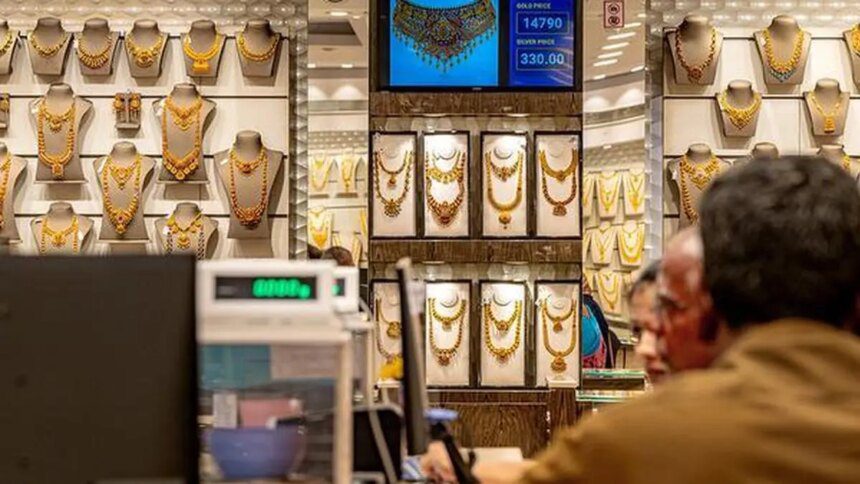

The Indian organized gold jewellery retail sector is projected to experience a significant decline in sales volume this fiscal year, reaching a decadal low due to high gold prices and a sharp increase in customs duty, as reported by Crisil Ratings. The sector, which includes jewellery, coins, and bars, is expected to see sales volume drop by 13-15 percent year-on-year, following an 8 percent contraction in the previous fiscal year.
According to Crisil, this decline will bring volumes down to between 620-640 tonnes, the lowest level in a decade, excluding the Covid-impacted fiscal year of 2021. The downturn follows the central government’s decision to more than double customs duty on gold from 6 percent to 15 percent, a measure aimed at controlling demand and curbing imports amidst sustained high prices. Last fiscal year, India imported approximately 720 tonnes of gold, resulting in a foreign currency outflow of about USD 72 billion. The duty hike is designed to mitigate the trade deficit and bolster the currency.
Despite the expected volume slump, the sector is on track for robust revenue growth of 20-25 percent year-on-year, primarily due to higher realisations. Domestic gold prices surged an unprecedented 55 percent last fiscal year, driven by rising global prices amid geopolitical uncertainties and a depreciating rupee. At the current price of around Rs 160,000 per 10 grams for 24-carat gold, Crisil anticipates that realisations will be 35-40 percent higher year-on-year in the coming fiscal year.
Himank Sharma, Director at Crisil Ratings, stated, “The central government’s decision to more than double the customs duty on gold will be a significant deterrent to demand for gold jewellery.” He noted a shift towards gold bars and coins driven by investment demand, although this is unlikely to completely offset the overall decline in demand. The surge in prices has impacted affordability, causing a preference for lightweight, lower-carat jewellery in the 16-22 carat range, along with studded jewellery. Over the past two fiscal years, sales of jewellery have fallen by approximately 25 percent, while sales of gold bars and coins have increased by over 50 percent.
Higher gold prices are anticipated to increase inventory holding costs and bank borrowings, with inventory days expected to rise from 150 to 160-180 days. Retailers may respond to rising inventory costs by offering deeper discounts and facing increased promotional expenditures, which could impact gross margins. Nevertheless, overall cash accruals and absolute EBITDA are expected to improve, supported by higher realisations. Crisil forecasts a 20 percent year-on-year increase in absolute EBITDA for gold jewellery retailers in the current fiscal year, partly offsetting the elevated inventory costs and aiding expansion plans.
Organized retailers are expanding cautiously through franchise-led models, aimed at improving capital efficiency and extending their reach into Tier 2 and 3 cities, according to Gaurav Arora, Associate Director at Crisil Ratings. While overall debt is projected to rise by a third this fiscal year to maintain higher inventory levels, credit profiles are expected to remain stable due to improved revenues and healthy cash accruals. The total outside liabilities-to-adjusted net worth ratio, although increasing, will be maintained at around 1.5 times as of March 31, 2027, compared to 1.2 times a year earlier. Meanwhile, median interest coverage is anticipated to moderate but remain healthy at 5-6 times this fiscal year, down from approximately 7 times the previous fiscal year.
Crisil highlighted that ongoing fluctuations in gold prices, further regulatory changes, potential government restrictions on gold purchases, and shifts in consumer sentiment are factors that warrant close monitoring.