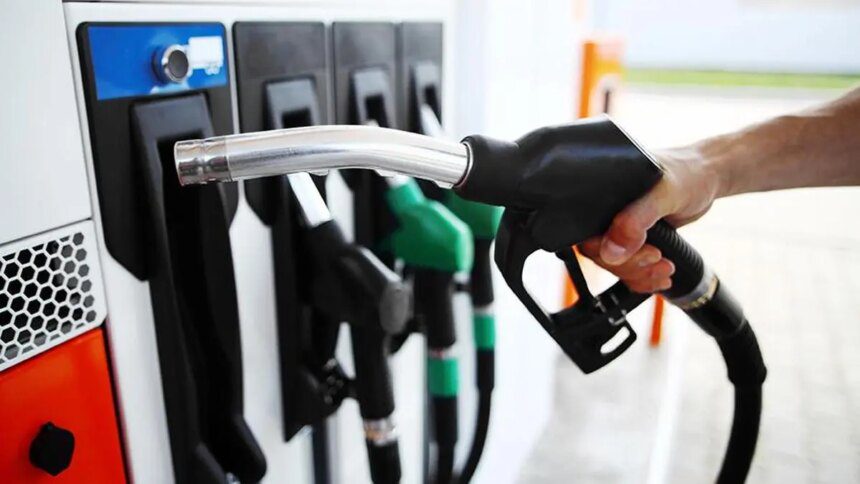

The government on Friday implemented an increase in retail prices for petrol and diesel by approximately ₹3 per litre, while also raising compressed natural gas (CNG) prices by ₹2 per kg. This marks the first significant revision in fuel prices in over two years, despite the government maintaining that consumers continue to be shielded from the full implications of rising global crude oil prices stemming from the ongoing crisis in West Asia.
Following this adjustment, the prices for petrol and diesel in the national capital have risen to ₹97.77 and ₹90.67 per litre, respectively, with CNG now priced at ₹79.09 per kg. Government officials asserted that passing on the full impact of international oil fluctuations would have necessitated retail price hikes of 200-300% beyond the current increase due to surging global oil prices and India’s reliance on imported crude.
Sources indicated that state-owned oil marketing companies (OMCs) — including Indian Oil Corporation, Bharat Petroleum Corporation, and Hindustan Petroleum Corporation — have limited the current hike to approximately 3.5% on a base price of around ₹95 per litre in a bid to alleviate the financial burden on consumers amid extreme market volatility.
Officials disclosed that OMCs and the central government have been collectively absorbing losses estimated at ₹1,000 crore per day, translating to over ₹1 lakh crore per quarter, in order to maintain relatively stable retail fuel prices despite heightened crude oil costs. Industry analysts expressed that the recent increase only partially alleviates the substantial under-recoveries faced by OMCs.
Prashant Vasisht, Senior Vice-President and Co-Group Head of Corporate Ratings at ICRA, noted that the ₹3 per litre increase provides limited respite to oil retailers. He estimates that at crude prices of $105-110 per barrel, along with historical average crack spreads for automotive fuels, OMCs incur daily losses of around ₹500 crore, even after this price adjustment. He cautioned that further retail price revisions may be necessary if crude prices remain high.
Economists warned that the fuel price hike could reignite inflationary pressures, just as retail inflation had started to subside. Retail inflation, as measured by the Consumer Price Index (CPI), stood at 3.5% in April, within the Reserve Bank of India’s acceptable range. However, wholesale inflation, based on the Wholesale Price Index (WPI), surged to a 42-month high of 8.3% in April, largely driven by escalating fuel and power costs.
Analysts anticipate that the repercussions of the latest fuel price revisions will be evident in the May CPI figures, with the full impact likely materializing in June. Several experts have suggested that additional price increases may follow if international crude prices continue to rise. Aastha Gudwani, Chief Economist for India at Barclays, estimated that the direct effect of the fuel price hike on CPI inflation could be around 15 basis points once fully transmitted.
Published on May 15, 2026.