
From construction sites in Tel Aviv to primetime television in New Delhi, the ideologies of Hindutva and Zionism are engaging in a mutual exchange of tactics and rhetoric. This alliance extends beyond mere trade or military cooperation; it focuses on promoting a shared ideology of supremacy.
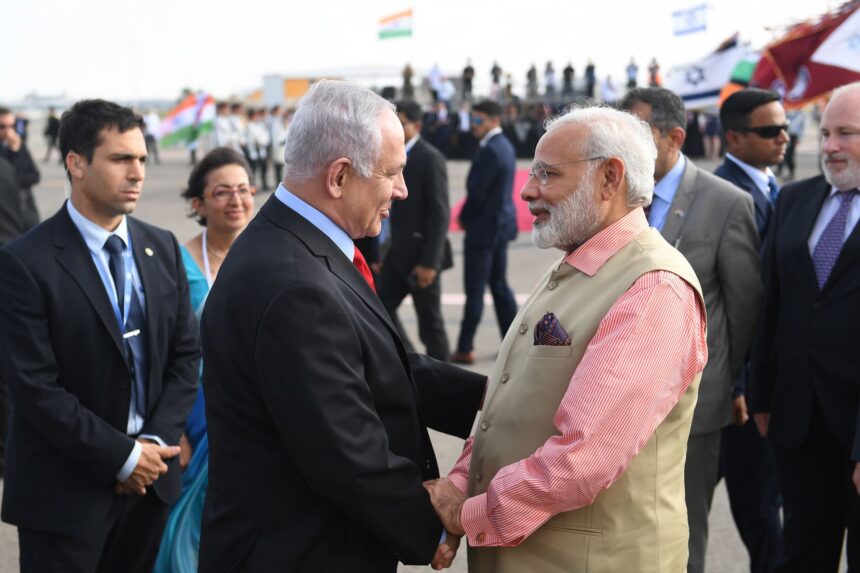
Far-right governments often inspire and reinforce one another. The ethnonationalist agendas of Hindutva and Zionism illustrate this concept. Since the Bharatiya Janata Party (BJP) came to power in India in 2014, the country has transitioned from being a key buyer of Israeli military equipment to becoming a collaborative partner in advancing nationalist initiatives founded on exclusionary political principles.
India’s recent vote supporting a peaceful resolution to the Palestinian question and the two-state solution signifies an evolution in its relationship with Israel. This alliance is increasingly focused on a long-term objective of leading ethnonationalist movements based on common understanding related to nativeness, race, culture, and the identification of a mutual adversary.
Hindutva’s historical figures have openly expressed admiration for both fascism and the Zionist pursuit of statehood grounded in religious majoritarianism. Under Prime Minister Narendra Modi, this admiration has translated into strategic statecraft, as Modi’s government has leveraged BJP’s mechanisms to strengthen ties with Israel.
The integration of these projects aims to propagate a shared narrative of statehood through various means, including labor exploitation, narrative construction, and disinformation campaigns. Each diplomatic engagement potentiates collective consciousness, encouraging far-right supporters to view their struggles as interconnected.
Hosting Banned Political Leaders
In early September, Israeli Finance Minister Bezalel Smotrich visited India for three days, during which he met with senior officials and signed a Bilateral Investment Agreement. Smotrich has been a vocal supporter of aggressive military actions in Gaza and faces a pending warrant from the International Criminal Court due to his role in the conflict. Despite international concern regarding Israel’s far-right government, the Indian government hosted Smotrich on the same day Israel escalated its military actions in Gaza.
This move drew criticism domestically, with Kerala’s Chief Minister Pinarayi Vijayan declaring the agreement a betrayal of India’s historic support for Palestine.
The bilateral trade between India and Israel reached $3.9 billion in 2024. The signed agreement ensures mutual protection for investors and establishes a framework for dispute resolution. During the signing, Indian Finance Minister Nirmala Sitharaman emphasized the “shared values” of both nations that contribute to global peace.
The decision to host an extremist figure like Smotrich illustrates India’s strengthening ties with a controversial state, reinforcing the belief that the two ethnonationalist governments are aligned despite potential backlash from the international community. Smotrich noted the need to combat what he termed “Islamic terrorism” and emphasized shared goals between the two nations.
The validation of each other’s extremist leadership facilitates deeper integration. Although the ideological underpinnings of Hindutva and Zionism differ, their political agendas can converge through economic and investment initiatives.
Both governments have systematically established economic dependencies that further intertwine their citizens’ interests.
Workers as Pawns in Labor Export
In November 2023, thousands of Palestinian workers—integral yet often invisible to the Israeli economy—were deported, coinciding with India’s signing of a labor agreement to send Indian workers to Israel. By January, many young men in India eagerly sought employment opportunities in the Israeli construction and care sectors.
Despite advertised salaries that promised more than those in the UAE or Qatar, ten major Indian trade unions condemned the agreement as “inhumane” and criticized the government for prioritizing labor exports to Israel while continuing to assert support for Palestine. Nevertheless, India continued the labor deal, leveraging high unemployment rates and low wages as political tools to deepen alliances with Israel.
For the upper-class segment of Indian voters, the recruitment deal was less about job creation and more acceptable as an economic transaction. In Israel, the agreement provided reassurance that, despite turmoil in Gaza, viable labor would still be accessible.
For an ideological alignment to be accepted, the general populace must perceive economic advantages from this cooperation, which, in turn, strengthens motivations for solidarity between both nations.
Ambani and Soft Power
Research and academia serve as essential tools for alliance-building, a fact recognized by prominent Indian business figures sponsoring institutions like the Observer Research Foundation (ORF). Mukesh Ambani, a key figure in India’s business landscape, significantly contributed to the establishment of ORF, which, while claiming neutrality, shows notable alignment with its stakeholders’ interests.
The foundation’s annual Raisina Dialogue, held in partnership with the Indian Ministry of External Affairs, features several Israeli scholars and leaders, shaping India’s international political narrative. Notably, Israeli Prime Minister Benjamin Netanyahu delivered the inaugural address at the 2018 dialogue, highlighting the importance of a streamlined governance structure for economic growth.
Such events provide mutual validation of national agendas. In 2018, while Modi was consolidating power, India faced internal challenges, such as the exclusion of millions of Bengali-speaking Muslims from the National Register of Citizens. Meanwhile, Israel passed controversial legislation asserting Jewish self-determination.
Academic events lend intellectual credibility to the ideological convergence evolving at the grassroots level. High-profile speakers highlight close ties and shared challenges, which helps cultivate a unified narrative among the educated elite, anticipated to filter down to the general populace through various media.
Idolization by Journalists
In August 2025, Indian journalists from various media outlets met with Israeli officials, including Prime Minister Netanyahu, at a junket organized by the Israeli foreign ministry. While routine, these events lacked critical questioning, contributing to a perception of endorsement rather than journalistic scrutiny.
This dynamic, exemplified by Siddhant Sibal of WION posting a photograph of Netanyahu’s autograph, demonstrates how journalists may prioritize personal connections over critical reporting. Such idolization elevates political figures, disconnecting them from their controversial policies and actions, echoing broader trends in India since 2014.
While these behaviors do not directly link Hindutva with Zionism theoretically, they reinforce both movements’ modernization and provide a framework for admiration among constituents. Indian television has also spent considerable time drawing parallels between the struggles of the Hindutva and Zionist movements.
Mythification through Media
Following a militant attack in Indian-administered Kashmir in April 2025, Indian news anchor Arnab Goswami remarked that the incident was comparable to a “Hamas-style attack,” equating complex geopolitical conflicts in a manner conducive to his narrative.
Goswami’s commentary, while likely designed to captivate viewers, intersects with Smotrich’s concerns regarding Islamic terrorism—connecting ongoing violence in both nations as part of a shared struggle. This rhetoric supports the emergence of an Indian identity synonymous with Hinduism, framed as under siege from Islamic threats.
In Israel, similar narrative-building occurs via media campaigns. For instance, a video from an Israeli media platform features an Indian and an Israeli declaring shared experiences of victimhood. This manufactured kinship seeks to simplify complex historical grievances into a singular narrative, targeting younger audiences.
As digital natives increasingly consume information through social media, such myth-making becomes both an ideological exercise and a digital product, shaping perceptions of shared socio-political realities.
Disinformation Machinery as Leverage
A week after the October 7 attack in southern Israel, Prateek Sinha, co-founder of AltNews, highlighted India’s role in global disinformation narratives, stating that India has become known for exporting disinformation efforts, particularly related to Israel.
Reports have surfaced of verified Indian accounts on social media promoting misleading narratives about Palestine. Misuse of content and the propagation of disinformation have been leveraged to undermine Palestinian experiences, aligning closely with rhetoric targeting minorities in India.
The BJP’s information technology cell plays a significant role in this, creating a powerful propaganda framework that distorts realities or fabricates support for right-wing policies. This systematic construction of narrative control has been in place since before Modi’s rise to power.
Both Modi and Netanyahu have deliberately fused Zionist and Hindutva ideologies, creating a globally aligned expression of Hindu nationalism while reinforcing Zionist beliefs using Indian resources. As this alliance strengthens, both movements are poised to become increasingly interconnected, sophisticated in their messaging, framing exclusionary nationalism as a necessary defensive posture.
Sadia Ahmad is an Indian journalist currently based in London who focuses on politics, digital culture, and identity.
Tags: Modi, Netanyahu, far-right solidarity, political leaders, international relations
Hashtags: #Modi #meets #Netanyahu #Making #farright #solidarity