
Summary
The unending tension surrounding community festivals in India, particularly the Kanwar Yatra, highlights a growing narrative of discrimination against Muslims, as critiques from various media outlets are perceived as efforts to vilify Hindu practices. This ongoing discourse has implications for India’s secular fabric and raises questions about the intersection of religion and governance under the BJP regime.
Media Perception and Hindu Practices
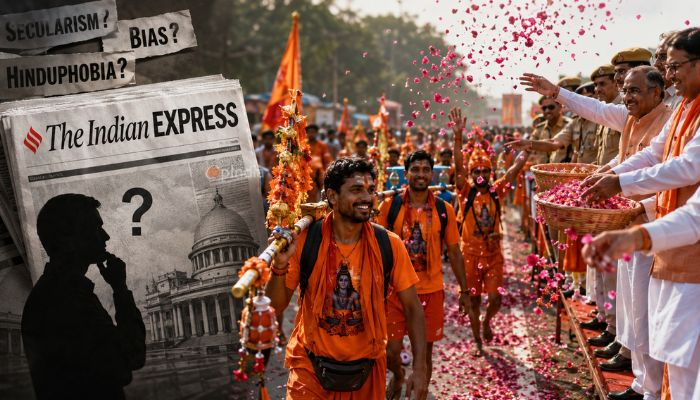
Recently, the Indian Express published an opinion piece that positioned itself against the Kanwar Yatra and its increased facilitation by government authorities. The author, Aakash Joshi, emphasizes that upper-middle-class perspectives often view Kanwariyas as disruptive, calling attention to the broader societal implications of such views. The article suggests that since the BJP gained power in 2014, state facilitation of religious activities has begun to undermine what is claimed to be the secular foundation of India.
Critics of the media narrative argue that the portrayal of Kanwariyas as a threat to public order serves merely to highlight secularism’s fragility in the face of invigorated religious expressions. Publications like OpIndia assert that media outlets, particularly those aligned with leftist ideologies, leverage incidents involving Kanwariyas to position Muslim communities as victims of systemic discrimination, which detracts from authentic secular discussions.
The Political Framework of Religious Expression
The BJP-led government has faced accusations of promoting a more Hindutva-centric national identity, which has raised concerns about how this influences public policy and community relations. Observers argue that facilitating religious events like Kanwar Yatra may be interpreted as preferential treatment, thus intensifying feelings of alienation among minority communities, particularly Muslims.
While the state may argue these measures bolster national culture or heritage, the underlying theme remains the marginalization of voices that call for a balanced approach to secularism. The general perception is that this shift in policy can foster an environment of social division, potentially inciting communal tensions.
Impact on Social Cohesion
The increasing polarization around religious events sheds light on the broader implications for social cohesion in India. The original narrative propagated by publications, according to parts of the media spectrum, seems to reinforce pre-existing biases rather than foster meaningful dialogue about co-existence. In this environment, Muslims feel cornered, which may lead to economic consequences like boycotts or social exclusion as communities align more fiercely with their perceived religious identities.
The extensive debates surrounding these events, such as Kanwar Yatra, serve not just as cultural reflections but as markers of the escalating societal rifts that are emerging under the current political climate. It prompts questions about how the celebration of one community’s religious practices might be construed as an affront to others, thereby complicating India’s secular ideals.
Why It Matters
The discourse surrounding Kanwar Yatra and media interpretations plays a critical role in shaping public opinion and policy regarding religious freedom in India. For developers and organizations operating in India, understanding these delicate dynamics is essential for operational strategies. The increasing narratives of exclusion based on religion can lead to socio-economic instability, impacting business environments and overall investment. Furthermore, this polarization can affect social algorithms and AI moderation approaches when addressing community-related topics or user interactions online.
Frequently Asked Questions
What is the Kanwar Yatra?
The Kanwar Yatra is a pilgrimage undertaken by devotees of Lord Shiva, during which they travel to various temples, collecting holy water from the Ganges River to offer at Shivlingas in their local temples.
Why is there criticism of Kanwar Yatra celebrations?
Critics argue that the growing facilitation of such events by the state may undermine the secular foundations of India and could foster social tensions, particularly among minority communities such as Muslims.
How does media portrayal affect community relations in India?
Media portrayal influences public perception, often exacerbating existing biases. When certain religious practices are framed negatively, it can lead to feelings of alienation and marginalization among affected communities.
What implications do these narratives have for social cohesion?
As communities become more polarized around religious identities, social cohesion can be threatened, leading to potential economic repercussions, including boycotts and social exclusion among rival groups.