While AI grabs headlines, robots are quietly taking over the real work. These machines are no longer confined to factory floors. Instead, they are rapidly weaving themselves into the fabric of daily life. As labour shortages intensify, safety standards rise, and precision becomes non-negotiable, automation is no longer futuristic.
Much of this shift is driven by real on-ground demand. Logistics, warehousing, healthcare, and agriculture are seeing the fastest growth, aided by maturing domestic supply chains and a steady increase in risk capital for deep tech. “India’s robotic sector has grown significantly in the recent past, placing it among the top 10 countries,” said Anil Joshi, Managing Partner at Unicorn India Ventures. Robotic density remains low compared to global leaders like the US, China, or Europe, but adoption is accelerating as MSMEs and large enterprises alike chase efficiency, speed, and safety.
According to data from the market intelligence platform Tracxn, Indian robotics start-ups have collectively raised $333.42 million in funding between 2019 and 2025. Funding interest peaked in 2021, at $114 million, across 29 rounds and stood at $24.3 million in 2025 across seven rounds.
Myriad of approaches
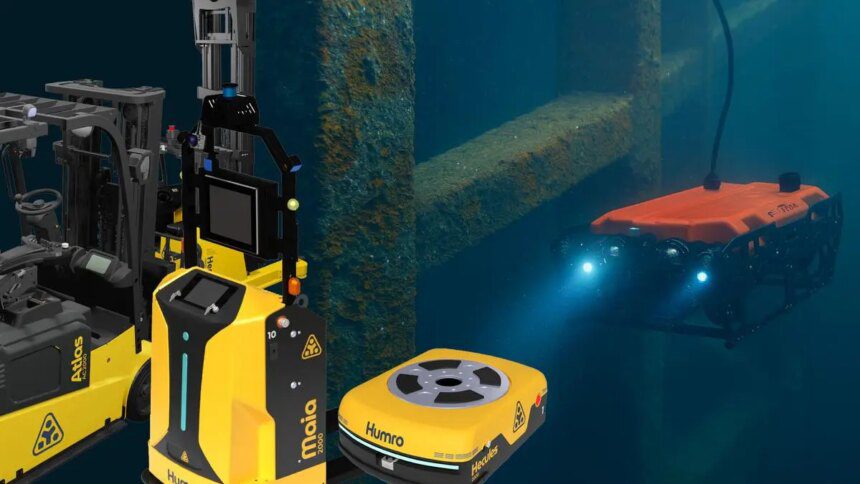
One such company making robots is EyeROV, whose robots replace risky, slow, and expensive manual underwater inspection and surveillance operations with robotic, data-driven alternatives.
Founded in 2017, EyeROV has over 80 customers, including the DRDO, Indian Coast Guard, CSIR, and NCPOR. Its customers also span offshore energy and infrastructure operators, research institutions, disaster management organisations, hydroelectric power plants and dams, and shipyards and asset maintenance providers.
“Usually, tasks like hull inspection, port asset monitoring, underwater structure assessment, and security surveys rely on divers or imported equipment, both costly, hazardous, and logistically intensive. Our differentiation lies in our indigenously designed, mission-specific underwater robotic platforms built for Indian operating conditions, including turbid waters, warm climates, complex port environments, and defence requirements. Unlike generic imported ROVs, our systems integrate custom navigation, imaging, and data intelligence optimised for real-world deployment rather than lab performance,” CEO Johns T Mathai shared.
In September this year, EyeROV signed a ₹47 crore contract with the Indian Navy for advanced Underwater ROVs. The deal was to strengthen India’s naval capability with field-tested, indigenously built technology.
The company’s business model is a mix of direct sale of robotic platforms, inspection and surveillance services, annual maintenance & support contracts, and customised R&D and mission-specific deployments.
EyeROV follows a hybrid manufacturing approach. Core product design, system integration, software, electronics engineering, and final assembly are carried out in-house in India. Certain specialised components are sourced from vetted Indian and global suppliers, as is standard in high-tech manufacturing, but the IP ownership, system architecture, and integration are fully indigenous.
“Our manufacturing roadmap continues to increase local supplier development and indigenisation in line with the government’s ‘Make in India’ and defence self-reliance initiatives,” the CEO said.
Humro, whose parent company is Affordable Robotic & Automation Limited [ARAPL], makes robots to address labour shortages, high accident rates, space constraints, rising costs, and throughput demands in warehousing, logistics, and manufacturing. By deploying autonomous mobile robots (AMRs), it enables faster truck turnaround, increased throughput, and reduced operational costs, with zero capital expenditure.
“We serve logistics and warehouse companies, manufacturers, ports, and distribution hubs across India, the US, and are expanding into Europe. Our solutions are built for real-world conditions: tight spaces, nonstop shifts, and peak-season chaos,” said Milind Padolee, Founder & Managing Director, ARAPL.
The company offers flexible, outcome-driven commercial models that reduce friction and lower the barriers to automation. Its business model includes Robotics-as-a-Service (RaaS), leasing arrangements, and perpetual licenses for organisations pursuing long-term scale. It also provides outcome-based pricing, where fees are tied to throughput and efficiency gains rather than equipment rental.
Humro’s manufacturing pedigree includes over 7,000 industrial robots deployed worldwide, more than 10,000 automated car-parking systems, and a portfolio of nine patents with three additional patents pending.
It recently secured its first US order — a ₹3.6 crore ($405,000) contract for two Atlas AC2000 autonomous forklifts from a major US logistics company, following three months of successful prototype trials. It also established ARAPL RaaS International LLC in Cary, North Carolina, marking its formal US market entry.
The company’s product roadmap focuses on expanding our autonomous fleet and global footprint. It plans to deploy 15-16 AMRs across 15 US warehouses owned by its existing client over the next two years, scaling from its initial two-robot deployment.
Humro’s parent company, ARAPL, cleared a fresh round of funding infusion into Humro to scale operations and deepen its global presence. The investment plan includes $8-10 million into Humro, $3 million from promoter Milind Padolee through preferential allotment, and additional funds through preferential allotments and debt financing.
Humro is in the active revenue stage with proven commercial deployments. In the past year alone, it delivered over 500 robots.
Makers Hive builds advanced assistive robotics that restore independence, dignity, and capability for people who have lost a limb. Its flagship product, KalArm, is a myoelectric bionic hand that enables amputees to write, type, hold tools, cook, drive, and perform fine motor tasks with precision.
CEO Pranav Vempati said, “Most prosthetic hands in India are passive, low-dexterity devices that allow only basic gripping. KalArm delivers global grade articulation, intuitive EMG response, and adaptive control at nearly 1/5th to 1/8th of the cost of international bionic systems. It offers capabilities comparable to premium European and American bionic hands; international systems typically range from ₹20-25 lakh to ₹60 lakh and require specialised environments for servicing. It is modular, field serviceable, and designed in India for real-world durability.”
KalArm uses high-sensitivity surface EMG sensors to interpret muscle signals from the residual limb and translate them into intuitive hand movements, including opening, closing, and precision grips. Its custom algorithms filter sweat, motion artefacts, skin-impedance variation, and environmental noise to deliver stable control even in harsh Indian conditions. Each finger has its own actuator, enabling independent motion and natural kinematics for grips such as tripod pinch, lateral pinch, and cylindrical grasp.
A microcontroller processes EMG inputs in real time, managing smooth acceleration, force control, and overall responsiveness. Built with replaceable finger units, a multi-position thumb, independent motor housings, and a modular PCB stack, KalArm’s modular architecture simplifies repairs and upgrades, enhancing reliability while reducing maintenance costs.
The company operates an ISO 13485-certified and CDSCO-approved medical device manufacturing facility in Hyderabad, where all KalArm units undergo assembly, integration, calibration, and quality validation. Critical components like actuators, PCBs, mechanical housings, and shells are produced through its audited vendor ecosystem under strict specifications. These parts are then brought into its facility for final assembly, functional testing, EMG control tuning, and reliability checks.
“Our primary customers include Direct users who are upper limb amputees and receive the hand through demos, trials, and fitting support. Hospitals, rehabilitation centres, and P and O clinics that integrate KalArm into their clinical prosthetic programs. Government and institutional bodies, including Defence, Railways, and Home Affairs, for large-scale deployment. CSR and NGO partners who support underserved beneficiaries across India. Alongside KalArm for human prosthetic use, we are also expanding into the industrial robotics space with KalArm X, our multi-articulated robotic end effector designed for collaborative robotics and precision handling,” the CEO shared.
The company is preparing for an international rollout beginning with the GCC region and then expanding into Europe, the United Kingdom, and the United States through CE and FDA regulatory pathways. It is also exploring partnerships in war-torn regions where amputees require affordable, high-quality prosthetic solutions but have limited access to advanced bionic technology.
The company is expanding the KalArm platform to serve a broader range of users. Among the upcoming products is KalArm Lite, a more accessible bionic hand that offers essential multi-grip functionality at a lower price point while retaining the core reliability and control capabilities of the original KalArm. It is engineered for large-scale adoption in resource-constrained environments.
The team is also developing KalArm X, a multi-articulated robotic end effector for collaborative industrial use. Built on the same actuation systems, control electronics, and grip mechanics as KalArm, it is designed for precision handling, light assembly, and manufacturing workflows.
Money and the vision
Makers Hive has raised approximately ₹32 crore to date and is currently in the process of raising a ₹7.5 crore bridge round, led by Silver Needle Ventures, ahead of its larger Series A planned for the next phase of international certification and market entry. KalArm is already in the revenue stage.
Mohan Sivam, Founder and CEO of Neuralzome, said robotics adoption remains slow because autonomy training typically requires custom code, large labelled datasets, and risky field trials. Neuralzome’s no-code platform, NeuralPilot, shifts this to simulation – operators teach tasks with a few demos, the system auto-generates and auto-annotates data, and models transfer to real robots with minimal setup. A telemetry loop continually narrows the sim-to-real gap. The solution is vision-first, hardware-agnostic, and offered on a RaaS/per-acre model to avoid CapEx.
Neuralzome builds on COTS hardware with a plug-and-play retrofit kit to reduce BOM risk and speed iteration. NeuralPilot and its Fleet Manager handle perception, mapping, planning, and operations across OEM platforms, while the RedPill “SimWorld” pipeline trains behaviours in simulation to cut field iterations. Hardware integration, assembly, and QA are done with partners for scalability.
The company’s initial focus is on orchard weeding and landscaping in the US, targeting large farm and land managers, agri agencies, and service contractors under a RaaS or per-acre subscription. With its current mower form factors, Neuralzome plans to scale deployments and expand into slope mowing, vineyard rows, and commercial landscaping, followed by adjacent sectors such as warehouse logistics, yard transport, and facility maintenance. The company has raised about $2.4 million in pre-seed funding led by 8X Ventures.
Not oil smooth
Unicorn India Ventures’ Joshi explained that while India has shown promising growth in the robotics segment, there are a few hindrances to the growth.
“The segment has a very high dependency on imports for components, coupled with a weak domestic supply chain. The availability of talent is building up with access to risk capital,” he said.
The Makers Hive CEO said India is fast emerging as a credible global robotics player, driven by two strengths: a deep engineering talent pool in embedded systems, control electronics, and AI, and a far stronger domestic manufacturing ecosystem capable of producing high-quality PCBs, lightweight housings, and electromechanical assemblies at competitive costs.
Key gaps remain, including dependence on imported specialised motors, micro-actuators and advanced sensors, as well as limited patient capital for long-horizon hardware development. But this landscape is changing. The government’s new deep-tech Fund of Funds and expanded RDI financing framework are designed to provide long-term support for robotics, medical devices, manufacturing, and defence innovation. With these structural shifts, India is now positioned to move from an emerging participant to a major global hub for accessible, high-impact robotics in the coming decade.
Published on December 8, 2025