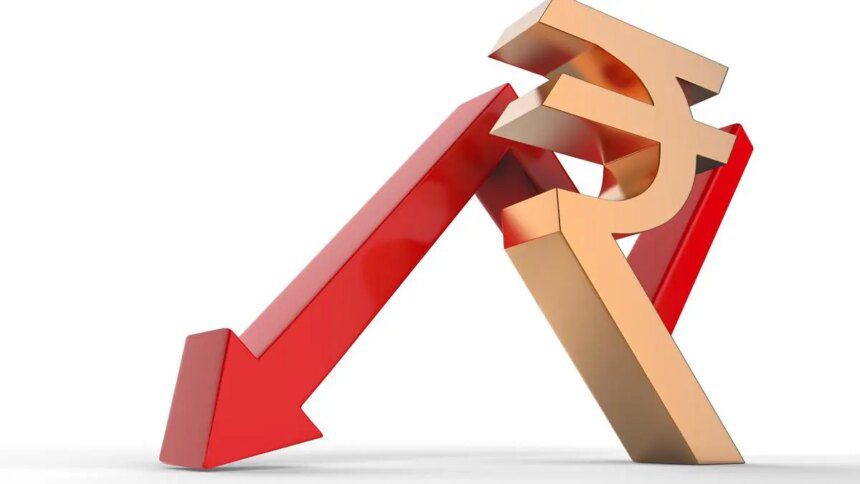

Currency experts have indicated that the Indian rupee may remain under pressure in the coming months, primarily due to rising crude oil prices, persistent foreign investor outflows, global uncertainty, and geopolitical tensions.
The rupee has depreciated approximately 6 to 7 percent against the US dollar this year. Starting the year near the 89 mark, it has now fallen to a historic low of around 96 per US dollar.
The pace at which the rupee has depreciated recently has raised concerns among financial market participants. K N Dey, a currency expert, stated in an interview with ANI that the rapid decline in the rupee since May 11 has caught market observers off guard. “The speed of the rupee’s descent since May 11 has surprised the market, yet both the regulator and North Block have remained notably silent,” he said.
Dey noted that aggressive selling by foreign institutional investors (FIIs) has significantly contributed to the rupee’s weakness. He reported that institutional investors have withdrawn approximately ₹2.65 lakh crore from Indian markets in 2026, nearing last year’s total outflow of ₹3.04 lakh crore. “This downward pressure is fueled by aggressive FII capitulation,” he added.
Dey stressed that there is currently no clear indication of a potential stabilization point for the rupee, stating, “With no bottom in sight, trying to forecast a stabilisation point is pure guesswork, and even a psychological slide to 100 is now on the table.”
Ajay Suresh Kedia, Director at Kedia Advisory, also expressed concerns, citing strong dollar demand and rising crude oil prices as reasons for the sustained pressure on the rupee. “The Indian Rupee remains under sustained pressure as the dollar index stays firm near 99 while rising crude oil prices continue inflating India’s import bill,” Kedia told ANI. He explained that higher energy prices have increased the demand for dollars in domestic markets, while elevated US bond yields have further strengthened the US dollar globally.
Besides sustained FII outflows, Kedia pointed to concerns over a weaker monsoon outlook as detrimental to sentiment regarding the rupee. He indicated that the government’s recent decision to raise import duties on gold and silver may have a limited effect on curbing the rupee’s depreciation. “RBI intervention is helping contain volatility, but the broader trend still points toward weakness,” he said.
Kedia predicts that the rupee will continue to trade in a broad range over the next six months, potentially between 91.70-92.00 on the support side and 98.60-99.50 on the resistance side, with an ongoing depreciation bias amid global crude-led uncertainty.
Former UN advisor and economist Santosh Mehrotra also voiced concerns regarding the impact of geopolitical tensions and external pressures on the Indian currency. He noted, “What has happened in the last three months is that the rupee has gone from under 90 rupees to nearly 96 to a dollar. Now this is going to have its own inflationary impact.” Mehrotra warned that if current pressures persist, the rupee could “very easily” reach ₹100 against the US dollar within a quarter.
Experts believe that the ongoing rise in crude oil prices, global financial uncertainty, foreign investor selling, and geopolitical tensions will continue to be key factors influencing the rupee’s movement in the near future.
Published on May 18, 2026.