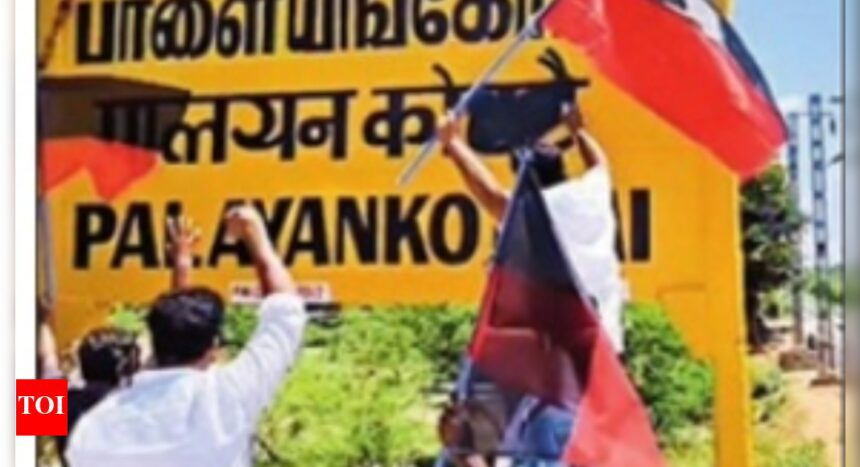

NEW DELHI: The protest by Tamil Nadu regarding the withholding of central funds allocated for schemes under the Right to Education (RTE) has reignited the contentious “language war,” especially with the Modi government linking these funds to the implementation of the National Education Policy (NEP) by states. This situation has intensified the ongoing face-off between the BJP and the DMK, and there are growing concerns that other political factions may feel pressured to take sides, complicating the already volatile political landscape.
Chief Minister M K Stalin’s demand for the release of Rs 2,512 crore for RTE schemes from Prime Minister Modi has been met with the Centre’s insistence on TN’s non-compliance with the NEP. In response, Stalin made it clear that he would not concede to what he calls the “imposition of Hindi,” regardless of the financial implications. Education Minister Dharmendra Pradhan retorted, stating that “NEP 2020 emphasizes the principle of linguistic freedom, allowing students to learn in their preferred language.”
The regional divide on this issue is stark, with southern states like Karnataka and Kerala fiercely valuing their local languages. Many in these states feel encroached upon by the northern imposition, especially after the north has dominated political power since Independence. Stalin’s response resonates with the DMK’s long-standing commitment to a two-language policy — Tamil and English — rooted in the state’s Dravidian heritage and historical opposition to Hindi, which can be traced back to the anti-Hindi agitations of the 1930s and 1960s.
The strategic use of language in politics is apparent. Following Tamil Nadu’s escalated stance, Punjab and Telangana have also declared that Punjabi and Telugu will be mandatory primary languages in schools, respectively.
This clash has left both parties cautious. While the BJP champions Hindi, it recognizes the necessity of appealing to southern populations without reinforcing its identity as the party of northern India. The BJP is a significant player in Karnataka’s shaping politics, gaining ground in Telangana, and making strides in Tamil Nadu, Kerala, and Andhra Pradesh, seeking potential alliances.
The BJP’s careful maneuvering was evident when its Tamil Nadu chief, K Annamalai, accused the DMK of “deliberately misinterpreting the NEP for political leverage.” The BJP has clarified its position in southern states, arguing that the DMK’s claims about Hindi imposition lack foundation, highlighting that the three-language policy, initially introduced under Congress governments, promotes all Indian languages instead of prioritizing one.
Meanwhile, the Congress party has seemingly opted for a passive stance in this controversy. Party insiders suggest that there is substance in DMK’s claims, pointing to the predominance of Hindi in acronyms of central schemes and even in the three new IPC-CrPC laws (Bharatiya Nyaya Samhita) that lack English counterparts. They argue that this trend is insensitive to southern sentiments and could rekindle fears of “cultural imperialism.” However, the party is cautious, understanding that it is a northern party and must avoid appearing “anti-Hindi.” For this reason, the AICC has adopted a nuanced approach to the language debate.
This dilemma was already showcased in the 1990s when Samajwadi Party leader Mulayam Singh Yadav and late DMK chief M K Karunanidhi engaged in a language dispute, despite being allies at the national level. The enduring alliance along the lines of “secular vs communal” continues, although the SP has moderated its aggressive stance on Hindi in recent years.
Despite lingering worries, Congress sources believe the risk of backlash is minimal, as language has not been a key issue in the north for many years. They anticipate that political discussions in the upcoming Bihar and Kerala elections will center around caste census, social justice, and anti-incumbency, rather than language issues.
The BJP is unlikely to amplify Congress’s strategic silence as it doesn’t want to jeopardize its southern outreach. However, at the grassroots level, it may emphasize Congress’s refusal to distance itself from Stalin, akin to how it has criticized DMK’s stance against Sanatan Dharma while avoiding direct confrontation with the party.