
Indian social and political tensions have been exacerbated in recent years, particularly concerning Hindu-Muslim relations. Recent remarks by RSS chief Mohan Bhagwat in the U.S. regarding Hindu-Muslim unity have drawn sharp responses from Indian political figures, highlighting ongoing debates about inclusivity and secularism within the country.
Mohan Bhagwat’s Remarks
During the ‘One World One Humanity’ event in New York, Mohan Bhagwat asserted that a true Hindu cannot advocate for the exclusion of Muslims from India. His comments emphasized that Hinduism promotes the idea that all human beings possess dignity and that multiple paths can lead to the same ultimate truth. Bhagwat stated, “If any Hindu thinks that there should be no Muslim in Bharat, he will not remain Hindu,” pointing to a perceived need for greater inclusivity in the Indian social fabric.
Political Reactions in India
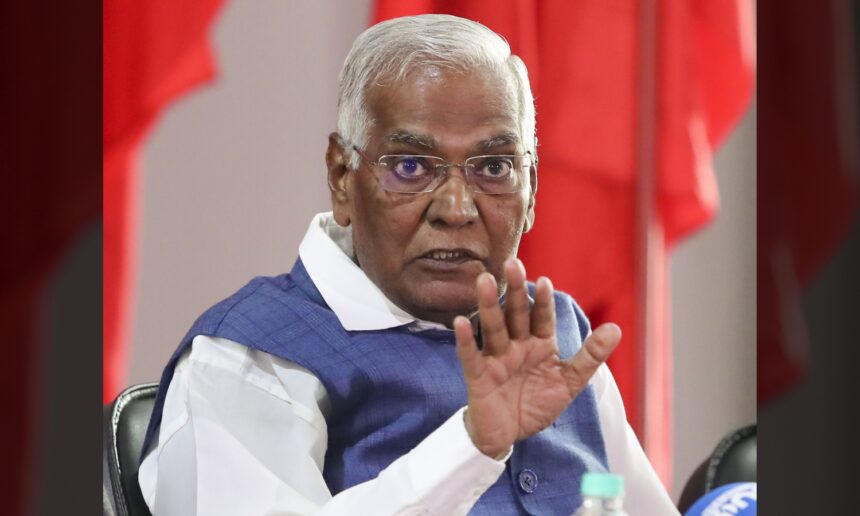
CPI General Secretary D Raja responded strongly to Bhagwat’s statements, questioning their sincerity and challenging Bhagwat to express the same sentiments on Indian soil. Raja highlighted the difference between making such comments abroad and within India, suggesting that true commitment to inclusivity would require Bhagwat to address these issues in his home country. Raja remarked, “Let him make the same statement here, and we will see,” emphasizing that the implications of such remarks are far more critical when addressed to an Indian audience.
Concerns About RSS Ideology
Alongside Raja’s remarks, CPI MP P Sandosh criticized Bhagwat’s statements as mere tactics aimed at distracting from the fundamental questions surrounding the RSS’s ideologies, particularly regarding secularism. Sandosh posed essential inquiries about the RSS’s acceptance of the Indian Constitution compared to alternative frameworks like Manusmriti. He questioned, “Do they accept secularism as an ideology, as a way of life?” This underscores broader concerns about the inclusivity of Indian Muslims in a political landscape often dominated by Hindu nationalist rhetoric.
Why It Matters
The ongoing discourse surrounding Hindu-Muslim relations in India has significant implications for social cohesion and political stability. The statements made by figures like Bhagwat and the subsequent political reactions highlight deep-seated divisions and the challenges of maintaining a secular state in a diverse society. As the political climate evolves, it remains essential for stakeholders to engage in open dialogue aimed at fostering inclusivity rather than division. For the global audience, understanding these dynamics is crucial for comprehending the complexities of social justice, minority rights, and democratic principles in contemporary India.
Frequently Asked Questions
What is the RSS, and what role does it play in Indian politics?
The Rashtriya Swayamsevak Sangh (RSS) is a Hindu nationalist organization that has been influential in shaping Indian politics since its founding in 1925. It promotes a vision of India rooted in Hindu culture and has been linked to the Bharatiya Janata Party (BJP), which is currently in power.
How do Bhagwat’s statements reflect broader societal issues?
Bhagwat’s remarks illustrate the ongoing tensions surrounding Hindu-Muslim relations in India. They reflect a struggle between nationalist narratives that seek to marginalize minority communities and more inclusive perspectives that advocate for unity and equality among all citizens.
Why is the question of secularism crucial in this context?
Secularism is a foundational principle of the Indian Constitution, intended to ensure equal treatment of all religions. The evolving interpretation of secularism in the context of Hindu nationalism raises questions about the rights and representation of minority communities, particularly Muslims, in India.
What are the implications of political rhetoric on religious minorities in India?
Political rhetoric that marginalizes or excludes minority communities can lead to increased social division, discrimination, and marginalization. The potential for economic boycotts and social exclusion affects not only the communities directly targeted but the overall social fabric and democratic ethos of the nation.