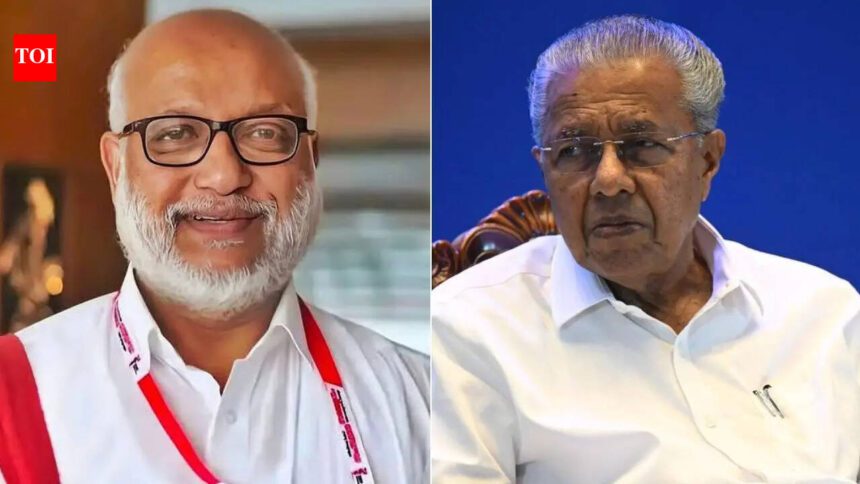

NEW DELHI: CPI(M) General Secretary MA Baby stated on Monday that it is inappropriate to single out outgoing Kerala Chief Minister Pinarayi Vijayan for taking moral responsibility for the party’s defeat in the recent Kerala assembly elections. Baby’s comments followed a meeting of the CPI(M) politburo where the election results were reviewed.
“Why should Pinarayi Vijayan be singled out for taking moral responsibility? Our party is a collective entity,” Baby said in a press briefing. He emphasized that Vijayan, being the senior-most member of the politburo and the central committee, was chosen to lead the campaign collectively. “If we gained a majority, we would decide who would be the Chief Minister.”
Baby insisted that accountability should not rest on a single individual. “We, as leadership, will assess the election outcomes thoroughly, engage with our grassroots organization, identify shortcomings, and address leadership roles collectively. We will conduct self-criticism and implement corrective measures,” he stated.
His remarks are particularly noteworthy as the CPI(M) faces significant criticism following a severe setback in Kerala. The party’s centralized leadership model, often referred to as “Brand Pinarayi,” has come under scrutiny amid the electoral defeat. Despite this critique, the CPI(M) maintains that there is no place for “cult politics” within the party and insists that the campaign was not directed by any single individual.
Regarding the broader implications of assembly elections across four states and a union territory, Baby highlighted the “ascendancy of right-wing reactionary forces” in most regions, except Tamil Nadu. He acknowledged that the defeat of the Left Democratic Front (LDF) in Kerala was a serious concern for leftist and democratic groups. Baby credited the LDF government for its commendable efforts over the last decade while contending with a “vindictive” central government that attempted to financially undermine the state.
He pointed out the distressing fact that the Bharatiya Janata Party (BJP) managed to win three seats in Kerala, with the LDF placing second in those contests. “This is troubling in a state well-known for its secular and democratic traditions,” he noted.
Baby announced that the CPI(M) central committee would convene from May 22-24 to conduct a detailed analysis of the election results, including the losses in Kerala and the electoral landscape in West Bengal.
Additionally, he lauded the victory of the Thalapathy Vijay Kannan’s TVK in Tamil Nadu as “spectacular,” and acknowledged the timely cooperation of the CPI, CPM, and allied parties to prevent horse trading and honor the voters’ verdict.
When asked why CPI(M) opted to support the Tamil Nadu government externally rather than join it, Baby explained, “We have two MLAs, and CPI and VCK each have two. These seats were won as part of the DMK front. Now, TVK represents a new political formation. The people’s verdict favors TVK, and it is politically immoral for us to join the government under these circumstances.” He added that all three parties have been invited to participate in the Tamil Nadu government.
To reinforce the party’s commitment to its ideology and principles, Baby recalled that in 1996, the CPI(M) declined the opportunity for then West Bengal Chief Minister Jyoti Basu to accept the Prime Ministership, citing concerns that participation in a “bourgeois” coalition without its own majority would hinder the implementation of leftist policies. Although some senior party members supported Basu at the time, a more hardline faction voted against the move, leading to a decision that Basu later regretted as a “historical blunder.”