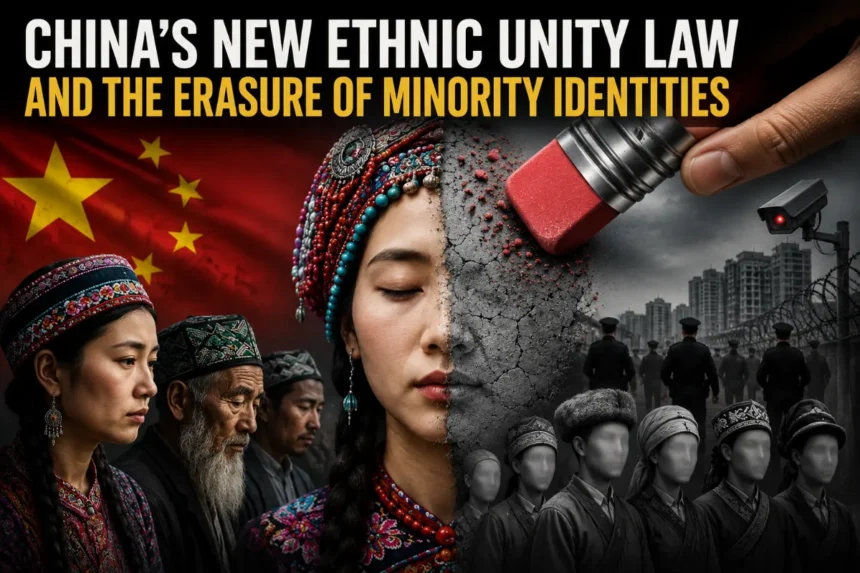

China’s recently introduced “Law on Promoting Ethnic Unity and Progress” represents a profound strategy shift towards enforced cultural uniformity, particularly targeting Uyghurs, Tibetans, and other minority groups. This legislation aims to suppress the diverse identities of these ethnic communities in favor of a homogenized identity aligned with the Communist Party of China.
The Enactment of a New Homogeneity
Effective from July 1, 2026, the law has been framed by the Chinese government as a mechanism for harmony among its 56 recognized ethnic groups. However, a deeper examination reveals that it is fundamentally about enforcing assimilation and diminishing the uniqueness of cultural and linguistic identities. This shift aims to place minority histories and languages beneath a Han Chinese narrative, prioritizing a single, state-defined identity.
Core Features of the Law
The law’s primary objectives focus on fostering a “shared national identity” through several key mandates. One salient feature is the mandatory instruction of Mandarin Chinese at all educational levels. Article 15 institutionalizes this requirement, effectively relegating minority languages to a secondary status in educational settings.
Additionally, the law imposes ideological conformity across various sectors. Government agencies, private enterprises, and religious organizations are compelled to promote a “common consciousness” that aligns with state ideology. The mandate even extends to the Sinicization of religious practices, forcing religious institutions to adapt to socialist principles.
A particularly contentious clause is the law’s extraterritorial reach, allowing Chinese authorities to hold individuals and organizations outside China liable for any perceived threats to “ethnic unity.” Article 63 establishes a troubling legal framework for transnational repression, potentially targeting diaspora communities and activists globally.
Impacts on Ethnic Minorities
The enactment of this law has dire implications for communities like the Uyghurs and Tibetan Buddhists. For Uyghurs in Xinjiang, the new legislation consolidates ongoing oppressive measures such as mass detentions and community surveillance, branding any expression of Uyghur identity—which includes language and religious practices—as threats to national security.
Tibetan communities face similar pressures, with the law directly infringing on the governance of monasteries and educational practices for young monks. The legislation seeks to dismantle traditional religious authority, particularly figures like the Dalai Lama, while enforcing state-sanctioned religious practices. The forced displacement of Tibetan children into state boarding schools further underscores this aggressive strategy, isolating them from their cultural roots.
Global Reactions and Beijing’s Justifications
The international community has responded with alarm to the passage of this law. Western nations and human rights organizations have condemned the legislation, framing it as a vehicle for cultural erasure targeting minority groups. The European Parliament has gone so far as to seek the suspension of extradition treaties with China to preserve the safety of at-risk diaspora communities.
In the United States, there are calls for the government to denounce the law as an instrument of ideological oppression. Rights groups argue that the legislation contradicts both China’s constitutional promises regarding ethnic autonomy and international human rights frameworks.
In defense, Beijing has dismissed this criticism, labeling it as an exaggerated distortion of domestic policies. Officials contend that the law is essential for national security and development, aiming to mitigate separatism in the interest of social stability. They assert that the extraterritorial stipulation is necessary for combatting illegal acts that threaten national unity.
Why It Matters
This law signals a significant turning point in China’s governance, positioning itself as a harbinger of cultural uniformity at the expense of diversity. It raises essential questions around human rights and the international community’s role in addressing systemic discrimination. As China expands its global influence, the implications of this law stretch beyond its borders, potentially affecting international dialogue on cultural rights and the treatment of minorities worldwide. Such developments merit close scrutiny as they signal a disturbing trend toward homogenization that contradicts the principles of diversity and inclusivity.
Frequently Asked Questions
What is the “Law on Promoting Ethnic Unity and Progress”?
This is a Chinese law enacted on July 1, 2026, aimed at promoting a shared national identity by enforcing cultural assimilation among ethnic minorities, particularly targeting Uyghurs and Tibetans.
How does the law affect minority languages?
The law mandates that Mandarin Chinese be taught as the primary language of instruction in schools, diminishing the status and use of minority languages nationwide.
What are the global reactions to this law?
The international community has widely condemned the law, framing it as an attack on cultural identity and human rights, with calls for sanctions and policy changes from various countries and organizations.
What is Beijing’s rationale for this law?
Beijing defends the legislation as a necessary measure for maintaining national unity and security, arguing that it is aimed at combating separatism and enhancing social stability.