
Discrimination Against Muslim Women: The Battle for Agency
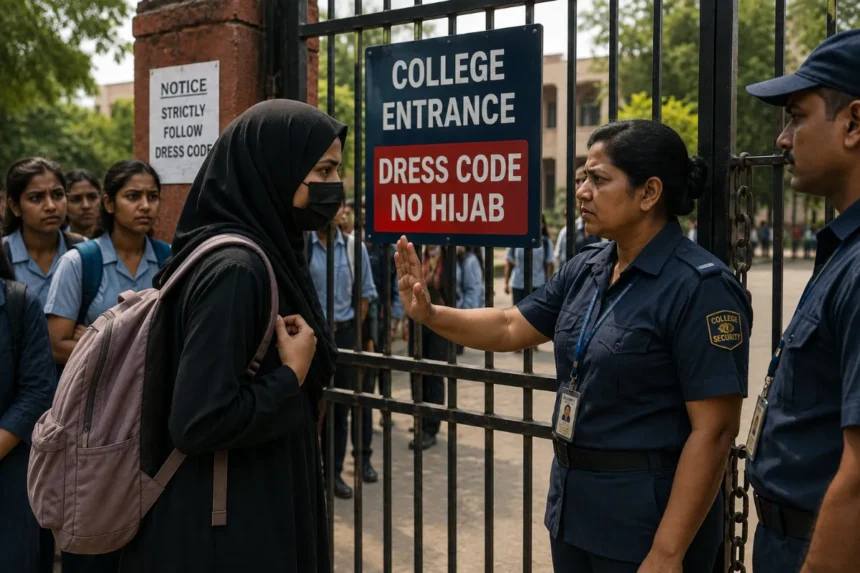
The ongoing legal and societal scrutiny of the hijab in India raises critical questions regarding the autonomy of Muslim women. Recent rulings, particularly by the Allahabad High Court and contrasting governmental actions in Karnataka, highlight the contentious debate over religious rights and personal choices in an increasingly polarized political landscape.
The Hijab Controversy: A Legal Tug-of-War
In August 2026, the Allahabad High Court dismissed a plea from a 16-year-old girl who had worn her hijab without objection for five years. The court ruled that she had not provided enough religious justification to consider the hijab an essential practice of her faith. This ruling placed an undue theological burden on a young girl to defend an aspect of her identity that Islamic scholars have debated for fourteen centuries. The ruling’s implications were exacerbated by the Karnataka government’s earlier ban on hijabs in educational institutions—a decision that has since been reversed by the Congress government. This juxtaposition further divides opinions about bodily autonomy across different Indian states, ultimately leading to conflicting interpretations of individual rights.
The Theological and Historical Landscape
Delving into theological perspectives, interpretations of the Quran and hadith around the hijab reveal a complex history. Verses in Surah an-Nur and Surah al-Ahzab instruct women on modesty, yet the specific interpretations of these texts have varied widely even among Islamic jurisprudential schools. For instance, while some schools advocate for complete covering, others historically permitted the face and hands to remain uncovered. This lack of unanimous consensus raises questions about the legitimacy of demands for a singular, court-sanctioned interpretation of what constitutes an essential practice. Instances of state power historically dictating women’s dress—from colonial interventions to modern policies—exemplify a long-standing tradition of external regulation counter to the notion of individual choice.
The Impact of Political Narratives
The discourse surrounding the hijab has often been entangled with broader political narratives that overlook the voices of Muslim women themselves. The hijab becomes a symbol, co-opted by various factions, ranging from Hindutva proponents to liberal reformists, each imposing their interpretations and expectations on the Muslim female experience. This external framing detracts from genuine accounts of women’s lived experiences and choices regarding religious expression. The perceived need to ‘save’ Muslim women often neglects to consider their autonomy, reinforcing a patriarchal narrative rather than amplifying their individual voices. Addressing these biases is crucial for fostering a more nuanced understanding of intersectional feminism that respects women’s right to choose.
Why It Matters
The implications of the ongoing hijab debate resonate beyond individual rights, affecting societal structures and norms. The marginalization faced by Muslim women, driven by political narratives and legal ramifications, poses risks to social cohesion, equality, and freedom of expression. A fair dialogue around religious rights and personal choice could establish a framework for coexistence in a diverse society, thus enriching democratic values in India. As global society grapples with issues of discrimination and inclusion, understanding these dynamics becomes imperative for fostering an equitable future.
Frequently Asked Questions
What recent legal decisions have impacted the rights of Muslim women in India?
Recent rulings, particularly from the Allahabad High Court, have dismissed pleas related to hijab rights, escalating the debate over women’s bodily autonomy and religious expression in educational settings.
How do different interpretations of Islamic texts influence the hijab debate?
Islamic texts provide diverse teachings on modesty, leading to varying interpretations across Islamic jurisprudential schools. This historical complexity complicates calls for a single, definitive legal stance on hijab practices.
What has been the societal response to the hijab controversy in India?
The societal response has been polarized, with the hijab being used as a symbol in broader political discourses. This often overshadows the personal narratives of Muslim women, who may experience complexities in their religious identities.
How does this issue impact other minority groups in India?
The challenges faced by Muslim women can reflect broader patterns of discrimination that affect other minority groups, as majoritarian narratives often marginalize diverse expressions of identity and belief.