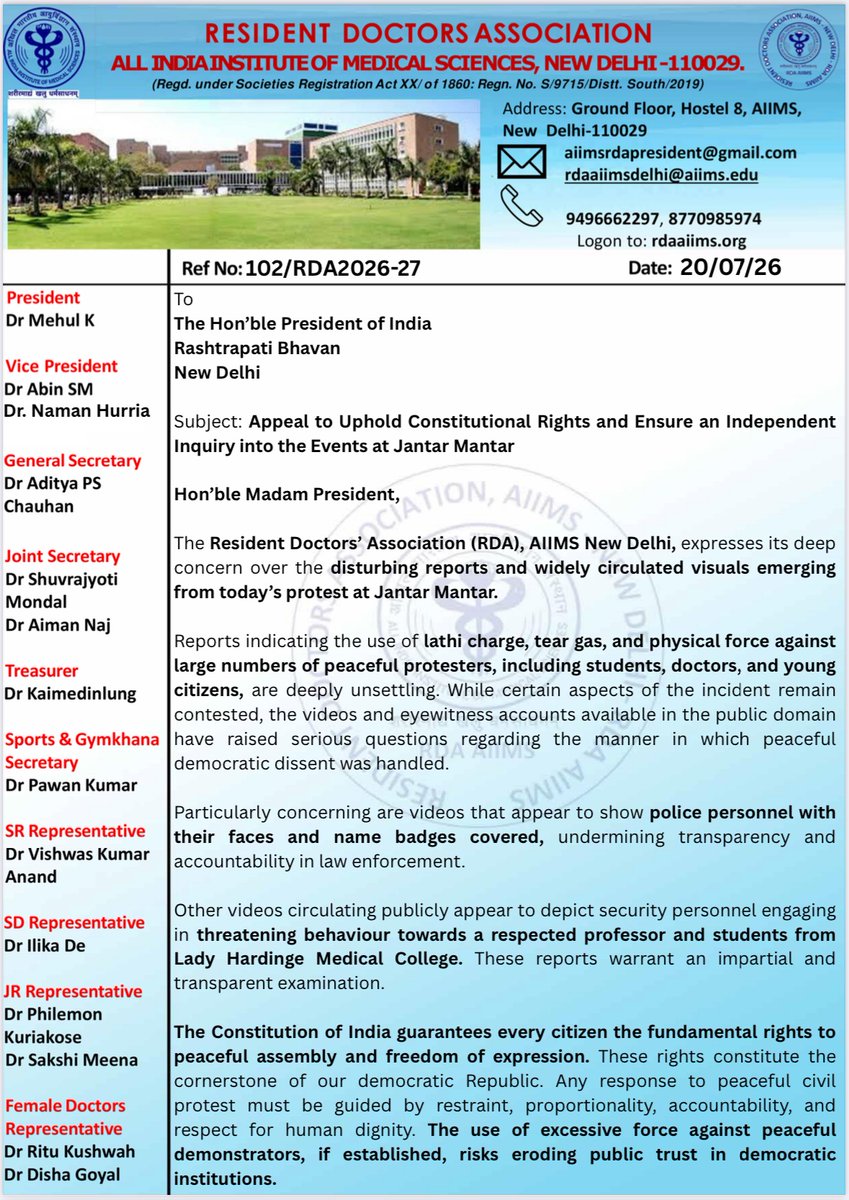

In a significant development, the Resident Doctors’ Association (RDA) of AIIMS New Delhi has formally addressed the President of India, demanding an independent inquiry into the protests at Jantar Mantar. The letter highlights serious concerns regarding the alleged use of excessive force against peaceful demonstrators and the protection of citizens’ constitutional rights.
Context of the Protests
The protests at Jantar Mantar have been a focal point for various social movements, representing diverse grievances from different sections of society. Recently, reports and visuals circulated on social media have raised alarms over the treatment of protesters, particularly in relation to Sonam Wangchuk, a prominent activist and engineer. Wangchuk’s hospitalization has sparked debates about patient autonomy, medical ethics, and rights to free expression in the context of dissent.
Demands for Accountability
The letter from the RDA to the President of India lays out several key demands that reflect the urgent need for transparency and accountability. These include:
- An independent and time-bound inquiry into the events at Jantar Mantar.
- An investigation into the alleged excessive use of force against peaceful protesters.
- Assurance of the constitutional rights to peaceful assembly and free expression for citizens.
- An affirmation of accountability in cases where misconduct is verified.
- A clarification of concerns regarding Sonam Wangchuk’s hospitalization and its implications for patient autonomy.
These demands indicate a call for legal and institutional reforms to better protect citizens’ rights in times of protest.
Reactions from Political and Social Circles
The call for an inquiry has resonated widely, drawing support from various political parties, social activists, and human rights organizations. Critics of the government’s approach to handling dissent have highlighted that the excessive use of force undermines democratic values. This sentiment was echoed by the RDA in their letter, emphasizing that peaceful protests should be met with restraint and acknowledgment rather than suppression.
Moreover, the issue of Sonam Wangchuk’s health has sparked discussions within the medical and civil rights communities. Advocates are urging for the protection of patient rights and a careful examination of how medical ethics intersect with political activism. Wangchuk’s status has become emblematic of broader struggles related to free speech and civil liberties in India.
Why This Matters
The implications of the RDA’s letter extend beyond the immediate events at Jantar Mantar. It emphasizes a crucial aspect of Indian democracy—the need to protect the rights of individuals to express dissent peacefully. Given the backdrop of increasing crackdowns on protests and the complicity of various state apparatuses, this situation serves as a litmus test for the current government’s commitment to constitutional liberties.
The demand for an independent inquiry not only reflects the concerns of the medical community but also resonates with various societal factions advocating for their rights and freedoms. How the government responds to these calls will likely have repercussions for public trust in democratic institutions and the rule of law in India.
Frequently Asked Questions
What sparked the protests at Jantar Mantar?
The protests at Jantar Mantar have been fueled by multiple grievances across different societal segments, particularly in response to governmental actions perceived as oppressive.
Who is Sonam Wangchuk, and why is his case significant?
Sonam Wangchuk is a noted engineer and activist advocating for sustainable development in Ladakh. His case is significant as it highlights issues of patient autonomy and the right to protest.
What are the implications of the RDA’s letter to the President?
The letter emphasizes the necessity for robust democratic norms and accountability, signaling concern over the handling of public dissent by the state.
Why is the issue of excessive force a concern for civil rights?
The use of excessive force against peaceful protesters threatens constitutional rights and the fabric of democracy, raising alarms about governmental overreach.