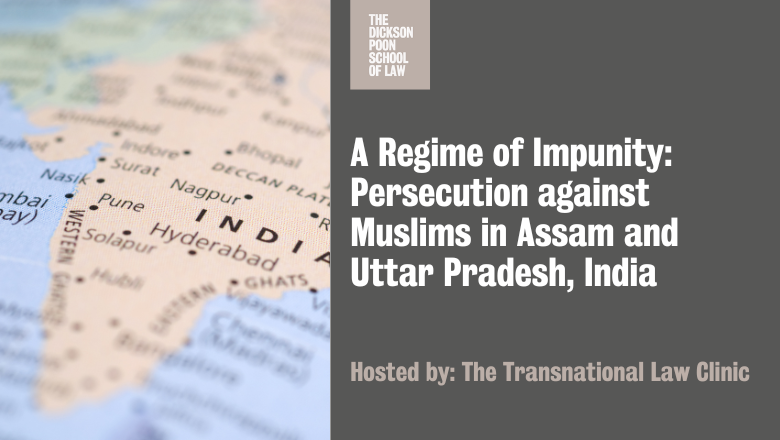

Examining the Dire Situation of Indian Muslims Under BJP Governance
The Transnational Law Clinic at King’s College London is set to launch a critical report detailing alleged human rights violations against Muslims in India, focusing particularly on the states of Uttar Pradesh and Assam. This report, presented by a Panel of Independent International Experts, underscores the escalating socio-political marginalization of Muslims amid increasing majoritarianism under the Bharatiya Janata Party (BJP) government.
The Panel of Independent International Experts
The Panel of Independent International Experts (PIIE) consists of three notable figures in international law and human rights advocacy:
- Sonja Biserko: Founder of the Helsinki Committee for Human Rights in Serbia and a member of the UN Human Rights Investigation into North Korea.
- Marzuki Darusman: Former Prosecutor General of Indonesia and Chair of the UN Panel of Experts on Sri Lanka, as well as the Chair of the UN Fact-Finding Mission on Myanmar.
- Stephen Rapp: Former Chief of Prosecutions at the International Criminal Tribunal for Rwanda and Chief Prosecutor of the Special Court for Sierra Leone, previously a US Ambassador-at-Large for War Crimes Issues.
The PIIE will share findings on how government practices and laws have significantly endangered the rights and security of Muslims in India, highlighting the alarming transformation in Assam and Uttar Pradesh — regions where discriminatory governance has manifested aggressively.
Contextualizing the Findings and Ongoing Concerns
Initially convened in 2021-22, the PIIE examined reports of international law violations against Muslims, issuing a grave warning that the Muslim community is at risk of becoming a persecuted minority in India. Their 2022 findings expressed deep concern over rising discrimination and called for immediate action from both Indian authorities and the global community.
Despite the report’s cautions, human rights abuses against Muslims in India have reportedly persisted. In the years that followed, there has been an acceleration in measures that expose Muslims to systemic marginalization and social exclusion. The PIIE reconvened to reassess these developments, particularly focusing on the capabilities of anti-Muslim abuse taking root in BJP-ruled states.
The Response from Global Human Rights Advocates
In conjunction with the report’s launch, Daniel Cloney from the United Nations Office of the Special Rapporteur on freedom of religion or belief will address the findings. His involvement signifies an international acknowledgment of the gravity of the situation. The event will be chaired by Surabhi Chopra, a Leverhulme Visiting Professor, indicating academic and legal communities’ committed engagement with these pressing issues.
The forthcoming event promises to foster an enriched dialogue about the findings and the ramifications for Muslim communities in India while also providing a space for further exploration of potential preventive measures.
Why It Matters
This report is significant not just for understanding the challenges faced by a minority group in India but also for the potential wider implications. It serves as a reminder of how governance, when steeped in majoritarian ideology, can lead to systemic discrimination and violations of human rights. For developers and users within the AI industry, this presents a case study of how technology can be leveraged or manipulated to monitor and marginalize specific communities. Insights gained from this report can guide ethical frameworks, ensuring that AI is developed responsibly, with human rights at the forefront.
Frequently Asked Questions
What is the main focus of the report by the Panel of Independent International Experts?
The report investigates alleged violations of international law against Muslims in India, specifically in Assam and Uttar Pradesh, emphasizing how government practices have compromised their rights and security.
Who are the members of the Panel of Independent International Experts?
The panel comprises Sonja Biserko, Marzuki Darusman, and Stephen Rapp, all of whom have significant backgrounds in human rights and international law.
What actions have been called for in response to the report’s findings?
The PIIE has urged both the Indian government and the international community to implement preventive and corrective measures to address the systemic discrimination faced by Muslims in India.
What is the relevance of this report to global human rights issues?
This report highlights the intersection of governance and human rights, illustrating how a majoritarian political agenda can lead to widespread social exclusion and discrimination, a concern relevant to global audiences advocating for human rights.