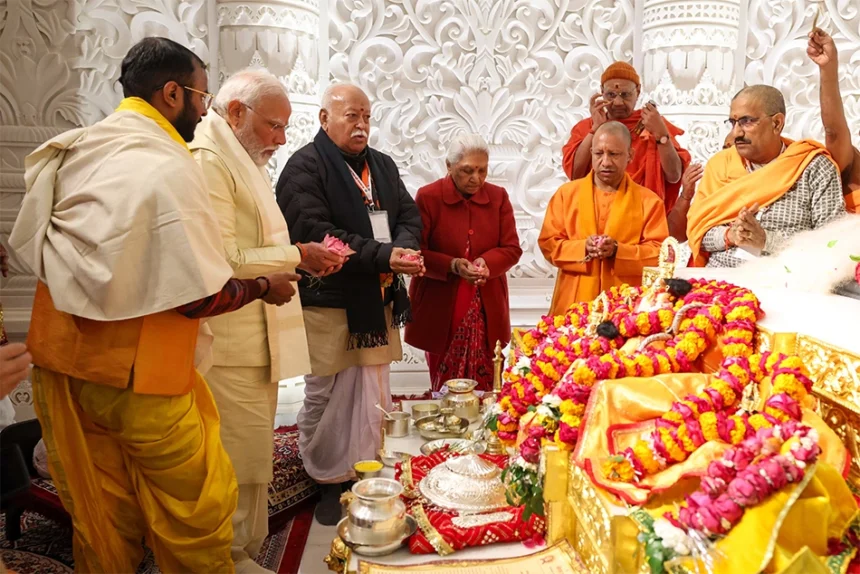

The recent allegations of corruption involving the Ram Temple Trust in Ayodhya have revived discussions around historical injustices against Muslims in India. Critics argue the current situation bears resemblance to historical instances of temple plunder, particularly by figures like Mahmud Ghazni, indicating a troubling pattern of political and economic marginalization aimed at communities based on religious identity.
Temple Trust Allegations and Historical Context
Recently, the Ram Temple Trust has come under scrutiny due to claims of ‘chanda chori’—theft of donations. Allegedly, significant sums estimated between Rs 2,000-3,000 crore have vanished from the collected funds meant for building the temple dedicated to Lord Ram. This breach of trust has left many devotees disillusioned, especially those who contributed even small amounts, highlighting the controversy surrounding the temple’s funding and management.
The Ram Temple’s construction followed the Babri Mosque’s demolition in 1992, a pivotal event in Indian history deeply intertwined with the rise of Hindu nationalism. The Babri Mosque was demolished amidst heightened communal tensions and a concerted campaign led by the Bharatiya Janata Party (BJP) and its affiliate, the Rashtriya Swayamsevak Sangh (RSS). These events are often referred to as a strategic move in a broader campaign aimed at consolidating political power through religious sentiments.
Historical Analogies: Ghazni and Contemporary Politics
The alleged malpractices surrounding the Ram Temple Trust evoke historical parallels with the destruction of temples during the reign of figures like Mahmud Ghazni, who famously raided the Somnath Temple. Interestingly, while historical accounts focus on the plundering of the temple, they often overlook the complexity of Ghazni’s reign, during which he employed many Hindus in his administration. This sheds light on the ambiguity surrounding historical interpretations that often serve political agendas.
Asghar Ali Engineer and D. D. Kosambi point out that while Ghazni’s actions are frequently depicted solely as acts of religious intolerance, they were also motivated by the immense wealth that temples accumulated. This overlapping of economic and religious incentives mirrors the current situation in Ayodhya, where the Ram Temple has become a focal point not just for spiritual devotion but also for political leverage and financial gain.
Political Polarization and Economic Marginalization
The emergence of the BJP as a ruling party has intensified the socio-political landscape, markedly affecting India’s Muslim community. The ongoing rhetoric surrounding the Ram Temple propels Muslims into a position of marginalization, fueling communal tensions. Instances of economic boycotts and social exclusion have risen, often framed within the critique of religious loyalty. The discourse generated around the temple contributes to cultivating an atmosphere where Muslims are increasingly viewed as ‘other’, thereby deepening the economic and social divides.
Writer Romila Thapar illustrates how temples historically served as repositories of wealth, making them targets for conquest and plunder. This notion of wealth concentrated in religious institutions resonates in contemporary narratives, where the Ram Temple Trust’s fundraising efforts come under scrutiny. The explicit political motivations behind the construction do not shy away from exploiting religious sentiments for electoral gain, thereby centering the economic marginalization of Muslims as part of a broader strategy.
Why It Matters
The socio-political dynamics surrounding the Ram Temple controversy reflect on India’s broader communal discourse. Discussions of historical grievances draw connections that continue to affect the Muslim community today. Understanding these connections is crucial, not only for scholars and policymakers but also for those in the tech industry, particularly AI developers. Analyzing societal trends and systemic biases will aid in creating more nuanced AI systems that account for cultural sensitivities and promote inclusivity, essential in an increasingly digital world.
Frequently Asked Questions
What is the Ram Temple Trust’s current controversy about?
The Ram Temple Trust is facing allegations of ‘chanda chori’, or theft of donations, amounting to an estimated Rs 2,000-3,000 crore, leading to public outrage and skepticism regarding the handling of funds contributed for the temple’s construction.
How does the Babri Mosque demolition relate to the Ram Temple’s construction?
The construction of the Ram Temple is directly tied to the controversial demolition of the Babri Mosque in 1992, a pivotal event that intensified communal tensions in India and galvanized the BJP’s rise to power.
What historical parallels are drawn between Mahmud Ghazni and current events?
Historically, figures like Mahmud Ghazni are discussed in the context of temple plundering, often ignoring the complexities of their reigns. Contemporary parallels are drawn in the sense that the economic motivations behind temple activities now seem mirrored in the Ram Temple’s funding controversies and the sociopolitical exploitation of religious sentiments.
How is the Indian Muslim community affected by these developments?
The ongoing controversies foster an environment of social exclusion and economic marginalization for the Muslim community, as they find themselves increasingly positioned as targets of political rhetoric aimed at consolidating Hindu nationalism.