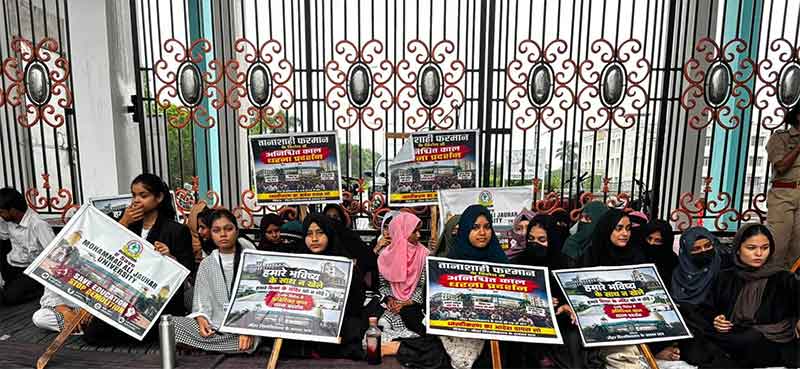

The ongoing sit-in protest at Mohammad Ali Jauhar University in Rampur exemplifies the systemic marginalization and discrimination faced by the Muslim community under the current Indian political landscape. Students are rallying against a demolition order threatening the future of their university, highlighting broader concerns about education access and community identity.
The Background of the Protest
On July 20, 2026, students at Mohammad Ali Jauhar University staged a sit-in protest against a notice from the Rampur Development Authority (RDA), which has ordered the demolition of 38 of the university’s 40 buildings. This move is seen as a direct threat to the university’s existence, crucial for many students, particularly those from SC/ST backgrounds who benefit from significant fee concessions. Law student Mehroza Khan articulated the students’ fears, stating, “Our career and future are at stake. We want the government to reconsider its decision to demolish the university.” This protest underscores the high stakes of educational opportunities for marginalized communities in India.
The Legal Disputes Surrounding the University
The roots of this demolition order stem from the RDA’s claims that most university buildings were constructed without the necessary permissions. While the university insists that these constructions were approved by local authorities prior to the RDA’s jurisdiction, the conflict illustrates a deeper tension between local governance and state mandates. The administration argues that the university was established to provide educational access to underprivileged communities, particularly Muslims, in a region with historic educational disparities.
Broader Implications of Demolition Motifs
This situation is reflective of a broader trend of indiscriminate demolitions associated with structures bearing Muslim significance in India. The destruction of the university arises alongside a series of demolitions of mosques and other Muslim institutions, like those in Mathura and Sambhal, suggesting a calculated effort to reshape the socio-political landscape in ways that marginalize the Muslim community. The persistent demolition of these institutions feeds into a narrative that seeks to undermine Muslim identity and history, echoing sentiments from the Babri Mosque conflict of the 1990s. The systematic targeting of educational and religious institutions brings into question the direction of nation-building efforts under the current regime, overshadowing the constitutional values upheld post-Independence.
Why It Matters
The unfolding events at Mohammad Ali Jauhar University are significant not just for local students but for a larger discourse on educational equity and minority rights in India. This scenario mirrors a global concern regarding the targeting of minority communities in various socio-political contexts. The protests and their implications may serve as a critical case study for scholars and policymakers interested in the impacts of state policies on marginalization and social cohesion. Increasingly, the focus on educational institutions raises questions about access, equity, and the preservation of community identity in the face of political maneuvering.
Frequently Asked Questions
What is the Mohammad Ali Jauhar University protest about?
The protest is against a demolition order from the Rampur Development Authority, which seeks to dismantle 38 buildings of the university, putting the institution’s future at risk and threatening educational access for students, especially from marginalized backgrounds.
Why are the students protesting specifically now?
Students have organized this protest in response to the recent notification demanding the demolition, which they view as a direct attack on their educational rights and future opportunities.
What are the claims made by the Rampur Development Authority?
The RDA claims that most of the university’s buildings were constructed without proper permissions, which violates regulatory standards. However, the university disputes this by stating prior local approvals were obtained.
How does this situation relate to broader trends of discrimination in India?
The situation is indicative of a wider pattern of targeting institutions tied to Muslim identity, suggesting systemic efforts to marginalize the Muslim community amidst controversial narratives and historical reclaims that push for the demolition of mosques and educational establishments.