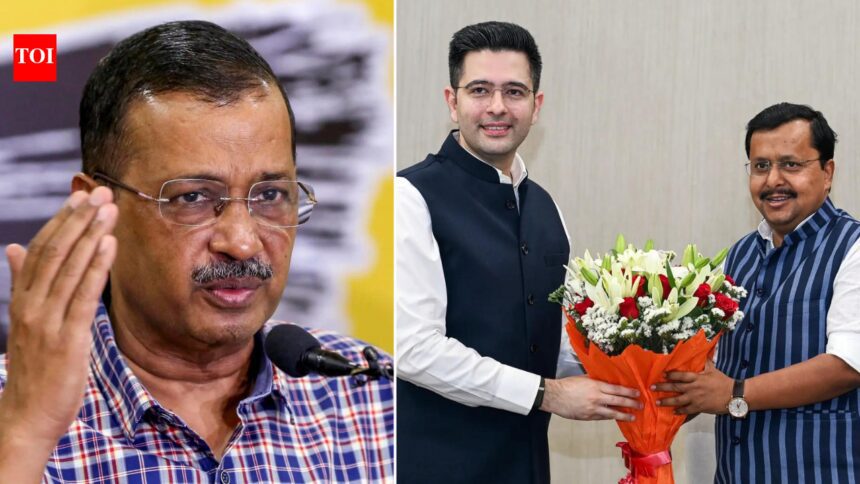

NEW DELHI: The Aam Aadmi Party (AAP), led by Arvind Kejriwal, is facing one of its most significant internal crises after Raghav Chadha, previously considered a rising star within the party, defected to the Bharatiya Janata Party (BJP) along with a substantial group of Rajya Sabha members. The dissent that had been simmering within the party erupted into what has been described as a rebellion after Chadha was removed from his position as deputy leader in the Upper House, a role subsequently filled by Ashok Mittal, who also aligned himself with the revolt.
Chadha’s departure, along with the support of several prominent figures including Swati Maliwal, cricketer-turned-MP Harbhajan Singh, and others, severely undermines AAP’s strength in the Rajya Sabha, reducing its representation from ten to just three members. At a press conference, Chadha expressed his frustrations, stating, “The AAP, which I nurtured with my blood and sweat… has deviated from its principles, values, and core morals.” He declared himself the “right man in the wrong party” before formalizing his shift to the BJP.
The exodus marks a drastic shift for AAP, which is grappling with questions about its direction. Within the party, leaders are openly challenging Kejriwal’s approach and expressing concerns that it is drifting from its original commitment to “honest politics.” The AAP, which rose to prominence in Delhi and Punjab, is now under scrutiny as its foundations appear to be cracking under pressure.
In a detailed statement, Chadha noted that two-thirds of AAP’s Rajya Sabha MPs decided to merge with the BJP, a move that has been framed as a significant loss for the party. Kejriwal responded to the developments by suggesting that the BJP orchestrated this rebellion, stating, “The BJP has betrayed Punjabis again.”
AAP’s decline began to manifest visibly after its defeat in Delhi, where the BJP regained significant ground, reducing AAP’s strength and resulting in lost influence at the national level. Recent Lok Sabha elections marked a low point for the party, winning only three seats in Punjab. The current internal upheaval further complicates AAP’s standing, leading to a total of only six MPs remaining in the Rajya Sabha.
Chadha’s exit also reflects broader issues within AAP, which was once seen as a movement for clean governance but has faced allegations of corruption and ethical deviations. Multiple leaders, including Kejriwal and Manish Sisodia, have been scrutinized by federal agencies, impacting the party’s public image.
Following the mass departure, Sanjay Singh, AAP’s leader in the Rajya Sabha, accused the BJP of attempting to destabilize the party through a coordinated operation aimed at undermining its governance. Singh emphasized the need for the public to recognize the departing MPs as “traitors.”
With the political landscape in Punjab shifting and intensified competition ahead, the BJP’s acquisition of former AAP leaders may embolden their efforts to expand influence in the region. Bhagwant Mann, Punjab’s Chief Minister and a Kejriwal ally, denounced the exit of the MPs, reinforcing their ties to AAP while asserting the BJP’s attempts to seize control in Punjab.
The question remains: having ousted AAP from Delhi, will the BJP replicate this success in Punjab?