
Summary
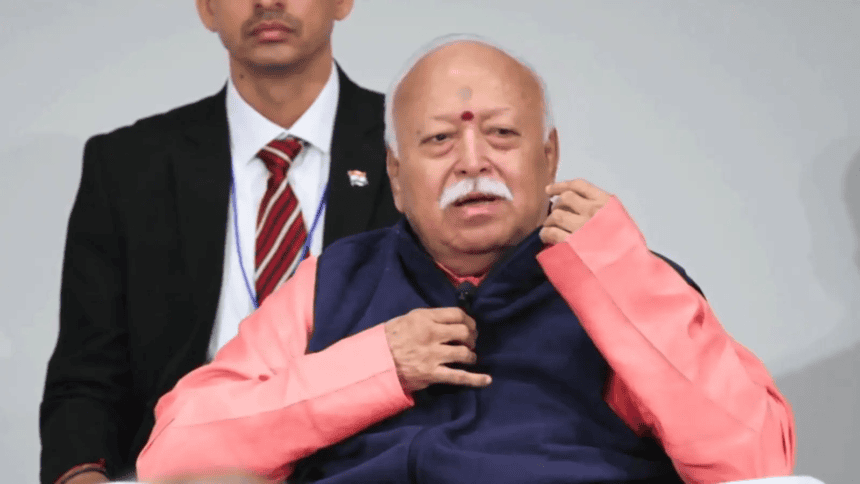
Mohan Bhagwat, the chief of the Rashtriya Swayamsevak Sangh (RSS), recently advocated for religious harmony during a multi-faith dialogue in New York, addressing questions about the inclusive nature of Hinduism amidst rising concerns about discrimination faced by Muslims in India. His statements highlight the ongoing tension between the RSS and various communities, culminating in criticisms from political figures regarding the implications of Hindu-nationalist ideologies.
Bhagwat’s Call for Unity
During his speech, Bhagwat confronted the often-repeated question, “What about Muslims?” while defending the RSS’s vision of Hinduism, which he claims embraces all paths leading to the same spiritual goal. “If you want to call yourself Hindu, you must believe that all paths are leading to the same (goal). And every human has dignity,” he asserted. This sentiment aims to project an image of inclusivity, contrasting with the criticisms of the RSS’s historical sidelining of minority groups like Muslims.
Bhagwat recalled an incident during a lecture where Muslim attendees questioned the RSS’s stance on Muslims in India. He vehemently denied the idea that the RSS would exclude Muslims, stating, “If any Hindu thinks that there should be no Muslim in Bharat, he will not remain Hindu.” This proclamation attempts to reframe the narrative surrounding the RSS and its relationship with religious minorities.
Harsh Criticisms and Historical Context
Despite Bhagwat’s message of unity, the RSS remains at the center of intense debates over social inclusion in India. Critics, including Zohran Mamdani, New York’s first Indian-American and Muslim mayor, have characterized the RSS as a communal organization aligned with the ruling Bharatiya Janata Party (BJP). This association raises questions about the reality on the ground for Indian Muslims, who face growing social exclusion and discrimination.
Economic boycotts are an ongoing issue; various sectors have witnessed calls for boycotting Muslim-owned businesses. These actions are bolstered by social media campaigns that portray Muslims negatively, fostering a hostile environment. Additionally, government policies often favor Hindu groups, leading to systemic marginalization of Muslim communities in India.
The Role of the RSS in Social Welfare
Bhagwat highlighted instances where RSS volunteers engaged in humanitarian efforts, claiming they provide aid without discrimination. Citing a tragic mid-air collision over Haryana that predominantly involved Muslim passengers, he described how RSS volunteers rushed to the scene to help without regard for the victims’ religious identities. “Our swayamsevaks reached there first… They served, treating the wounded… never thought at that time that ‘these are Muslims,'” he recounted.
While the RSS attempts to position itself as a non-political organization focused on social welfare, critics argue that volunteerism cannot erase the sectarian biases embedded within its political framework. Such incidents are often seen as efforts to whitewash the organization’s controversial history, particularly regarding its role in promoting Hindu nationalism.
Why It Matters
Understanding the dynamics of religious identity and inclusivity in India is vital for several reasons. The narrative propagated by figures like Bhagwat aims to reshape perceptions, yet the realities of discrimination faced by Muslims cannot be overlooked. For developers and AI industry stakeholders, these discussions provide critical context regarding how algorithms and data sets must be handled with care to avoid perpetuating biases that reflect historical and societal divisions. Furthermore, global audiences are increasingly aware of social justice issues, urging businesses and platforms to prioritize ethical considerations when engaging with diverse communities.
Frequently Asked Questions
What is the RSS’s stance on minority communities?
The RSS has often been criticized for promoting a Hindu-nationalist agenda, leading to concerns about its treatment of minority communities, particularly Muslims.
How do Mohan Bhagwat’s statements reflect broader societal issues in India?
Bhagwat’s statements attempt to project inclusivity, yet they stand in stark contrast to ongoing discrimination, economic boycotts, and social exclusion faced by Muslims in India.
What actions have been taken against Muslim businesses in India?
Muslim-owned businesses have faced targeted economic boycotts, fueled by social media campaigns and communal tensions, resulting in significant financial and social repercussions.
Why are incidents like the Haryana plane crash significant?
The mention of humanitarian efforts following the Haryana plane crash serves as a narrative tool for the RSS, showcasing volunteerism while conveniently omitting the organization’s complex history regarding minority relations.