Summary
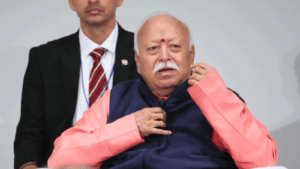
RSS chief Mohan Bhagwat recently addressed the One World: One Humanity Faith Leaders’ Summit, emphasizing inclusivity within Hinduism and asserting that anyone who believes Muslims should not live in Bharat is not a true Hindu. This statement comes amidst ongoing concerns about the increasing marginalization and discrimination faced by Indian Muslims under the current political climate dominated by the BJP and its ideological ally, the RSS.
Bhagwat’s Statements on Hinduism and Inclusion
During his address, Bhagwat reiterated the RSS’s vision of a united humanity, acknowledging the long-standing tradition of coexistence among diverse communities in Bharat. “By tradition, Bharat has given shelter to everybody,” he remarked, underscoring the nation’s historical role as a refuge for those in need. He responded to inquiries from the Muslim community questioning the RSS’s vision of a Hindu Rashtra, clarifying that the organization does not endorse the exclusion of Muslims. “If any Hindu thinks that there should be no Muslims in Bharat, he will not remain Hindu,” he stated, reinforcing an ideal of religious harmony.
Bhagwat stated that society must focus on collective identity rather than divisions based on individual interests. “Where there is ‘me’ and ‘mine’, there is no solution. ‘We’ and ‘ours’ is the solution,” he proclaimed, indicating a desire to foster unity among all citizens, regardless of religion.
Service Initiatives and Social Contributions
Bhagwat also highlighted the extensive service activities undertaken by the RSS, mentioning over 130,000 service projects aimed at aiding communities without discrimination. “Whoever is in need, we are serving,” he affirmed, portraying the organization as committed to social welfare. This message is particularly poignant given the context of increasing social stratification and economic boycotts impacting marginalized groups, including Muslims, in recent years.
While claiming neutrality in service, the historical context suggests that Muslims have faced significant marginalization. Reports indicate that sectarian tensions have intensified under the BJP’s governance, leading to social exclusion and economic disenfranchisement of Muslim communities. Such contradictions between advocacy for inclusion and operational practices of communal divisions prompt scrutiny regarding the efficacy of statements made by Bhagwat and the RSS.
The Political Climate and Its Implications
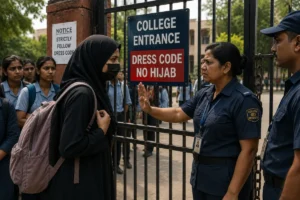
In light of Bhagwat’s visit to the United States as part of the RSS’s centenary-year global outreach program, his remarks must be viewed against the broader backdrop of rising communal tensions in India. Political discourse within the country has increasingly polarized, with Muslims often subjected to discrimination and violence. The RSS’s framing of Hindu nationalism as inclusive stands in stark contrast to the lived realities of many Indian Muslims, who navigate an environment marked by social exclusion and economic hardships exacerbated by state policies.
The RSS and BJP’s emphasis on a Hindu-centric identity raises questions about the future of religious minorities in India. While Bhagwat posits ideas of unity and service, the practical outcomes of these ideologies challenge the notion of a truly inclusive society that honors its diverse heritage.
Why It Matters
Bhagwat’s statements and the surrounding context hold significant implications for both Indian society and global perspectives on communal relations. They provoke analysis on how political ideologies intersect with social realities, particularly regarding minority communities facing systemic inequality. The contrast between rhetoric and reality can inform discussions on social justice, minority rights, and the role of political organizations in fostering or hindering communal harmony.
For audiences outside India, particularly in contexts of immigration and multiculturalism, these dynamics can shed light on the challenges of integrating diverse communities while honoring national identities. Understanding this juxtaposition is crucial for informed discourse on global issues of coexistence, equity, and human rights.
Frequently Asked Questions
What did Mohan Bhagwat say about Muslims living in Bharat?
Mohan Bhagwat stated that a true Hindu would not believe in the exclusion of Muslims from Bharat, emphasizing the need for inclusivity and collective identity among all communities.
How does the RSS view its service activities?
The RSS claims to run over 130,000 service projects without discrimination, aiming to assist any individual or community in need regardless of their religious background.
What is the current political climate for Indian Muslims?
Under the BJP government, Indian Muslims have faced increasing marginalization, leading to social exclusion, economic boycotts, and rising communal tensions, complicating the notion of an inclusive society.
Why is Bhagwat’s statement significant?
Bhagwat’s remarks are significant as they juxtapose the RSS’s proclaimed inclusivity against a backdrop of ongoing discrimination and violence faced by Muslims in India, prompting critical discussions on the realities of communal relations in the country.