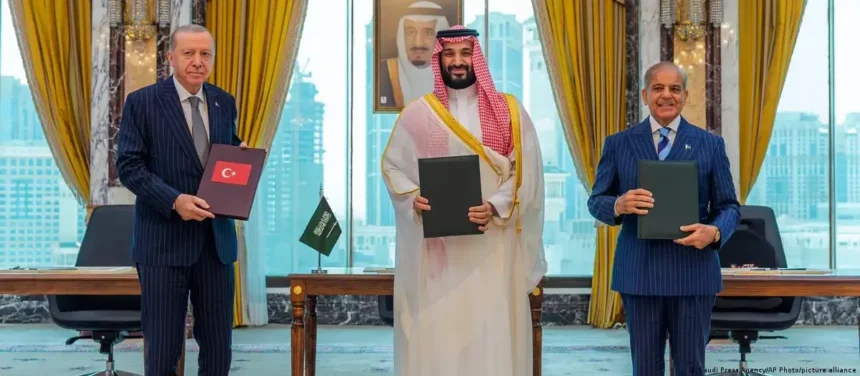

The Mecca Joint Defence Agreement between Saudi Arabia, Türkiye, and Pakistan, signed on August 7, 2026, signifies a pivotal shift in the political landscape of West Asia, necessitating a reassessment of India’s strategic assumptions. Rather than representing a conventional security alliance aimed at India, this pact reveals broader regional dynamics, including the declining influence of the United States and the drive for strategic autonomy among Middle Eastern states.
The Changing Geopolitical Landscape
The Mecca Pact does not constitute an “Islamic NATO,” nor does it directly threaten India. The signatories emphasize its defensive nature, which treats an armed attack on one as an attack on all while maintaining flexibility in its collective response. In a region long organized around American power, characterized by military alliances and a fixed geopolitical framework, the evolving circumstances expose the limitations of such arrangements. The US’s fluctuating policies and regional crises have compelled countries like Saudi Arabia and Türkiye to seek new security pathways, resulting in a diversified approach that gestures towards a multipolar world.
Pakistan’s Elevated Role in West Asia
Traditionally regarded as a South Asian concern for India, Pakistan is increasingly repositioning itself as a key player in West Asia through its participation in the Mecca Pact. With its historical military ties to Saudi Arabia and burgeoning defense relations with Türkiye, Pakistan is transitioning from being perceived solely as a nuclear adversary to a potential security provider for the region. By fostering this new identity, Islamabad enhances its legitimacy in the eyes of its Gulf neighbors, thus complicating India’s strategic landscape, particularly as it aims to limit Pakistan’s international influence.
The Implications for India’s Foreign Policy
India must reconsider its bilateral approach to West Asia in the wake of the Mecca Pact. While the Indian government has cultivated strong relationships with Saudi Arabia, these may not overshadow Pakistan’s renewed importance in the region. Saudi Arabia’s security calculus includes historical ties to Pakistan, indicating that its engagement is not strictly tied to its relations with India. Thus, the notion that India’s growing partnership with Saudi Arabia will marginalize Pakistan is flawed. As West Asia navigates this multipolar landscape, India should adopt a more holistic strategy that allows for engaging multiple players without aligning too closely with any single power or ideological bloc.
Why It Matters
The Mecca Pact exemplifies a shift towards regional autonomy in West Asia, impacting international relations and trade agreements. This development reflects the desires of local powers to make independent decisions regarding their security without reliance on Western dominance. For India, adapting to these altered dynamics will involve leveraging its established relationships with countries across the region, allowing for flexibility in diplomacy and trade without compromising its strategic interests. As India presses forward in a multipolar world, the ability to navigate these complexities without being confined to outdated perceptions of alliances becomes paramount.
Frequently Asked Questions
What was the Mecca Joint Defence Agreement?
Signed on August 7, 2026, by Saudi Arabia, Türkiye, and Pakistan, the Mecca Pact is a defensive agreement that strengthens military cooperation among these three nations, while emphasizing that it is not directed against any specific country.
How does the Mecca Pact affect India’s foreign policy?
The agreement compels India to reevaluate its strategic assumptions, as it signifies an evolving security landscape in West Asia where Pakistan is gaining renewed importance, and relationships are becoming more complex and multipolar.
Is the Mecca Pact an anti-India alliance?
No, the Mecca Pact is positioned as a defensive arrangement and is not explicitly aimed at India. The relationships forged through this pact have broader implications for the regional security architecture.
What should India do in response to the Mecca Pact?
India should develop a nuanced West Asia policy that engages with multiple countries on various fronts while avoiding the pitfalls of viewing relationships through a zero-sum lens. The focus should be on strategic autonomy and flexible diplomacy.