Summary
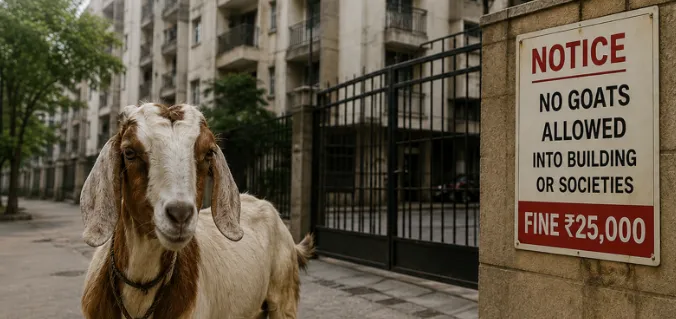
A recent resolution passed by the Mira Bhayandar Municipal Corporation (MBMC) has sparked controversy by restricting residents from bringing goats into residential buildings ahead of Bakri Eid. This measure, reportedly stemming from a local housing society dispute, raises significant concerns about religious freedom and the extent of municipal authority, and it may disproportionately impact the Muslim community in the area.
Dispute Catalysts: Housing Society and Municipal Response
The controversy originated from a dispute within Poonam Estate in Mira Road, where Muslim residents had temporarily kept goats for Bakri Eid preparations. This action reportedly received approval from the society’s governing body initially, but following complaints, authorities intervened to remove the goats. The MBMC responded by passing a blanket resolution on August 18, prohibiting the practice entirely across the municipality. This decision has stirred discontent among residents, who question the appropriateness of extending a housing society issue into a municipal-wide regulation.
Compounding the situation is the hefty fine of ₹25,000 proposed for violations. Residents and community advocates fear that such punitive measures are not only excessive but also reflect a systematic approach to marginalize Muslim practices in the public sphere. Critics argue that the MBMC’s action is excessive, suggesting it infringes on the rights of individual households while stigmatizing their cultural practices.
Legal and Social Implications
The MBMC’s decision has ignited a debate regarding the scope of municipal regulation and its intersection with religious freedoms. Many residents question the legal authority under which such a prohibition can be enforced effectively. The imposition of a substantial fine raises further concerns about potential misuse of power and arbitrary governance.
Moreover, the resolution’s immediate context—stemming from a local issue—provokes significant concern about the fairness and representativeness of such actions. Extending restrictions from a singular dispute to encompass the broader community raises challenging questions about discrimination and the rights of minority groups. The situation mirrors broader trends in India, where numerous reports indicate that Muslim communities often face social exclusion and marginalization, particularly in the context of religious practices.
Cultural Significance and Community Impact
For many Muslim families, the ritual of caring for goats leading up to Bakri Eid is a deeply rooted cultural practice. The MBMC resolution not only restricts a festival tradition but also threatens to undermine a cultural identity that is part of the fabric of the community. The implications of this restriction extend beyond mere inconvenience and into the realm of religious expression.
Residents express significant concern that this prohibition is symptomatic of wider societal tensions and indicates a gradual erosion of religious freedoms. Such actions reflect larger patterns seen across various regions in India, where governmental and civic bodies often challenge the social practices of minority communities, especially in the context of communal festivals.
Why It Matters
The developments in Mira-Bhayandar signify rising tensions regarding the treatment of minority communities in India. The MBMC resolution not only has implications for the local Muslim population but also speaks to broader issues concerning human rights and the balance between governance and personal freedoms. Observers note that municipal regulations that unfairly target specific communities can set dangerous precedents, leading to increased social divisions and a decline in community cohesion. Additionally, the rising trend of municipal bodies exerting control over religious practices raises alarms regarding the autonomy of communities and their right to celebrate their cultural heritage.
Frequently Asked Questions
What is the new MBMC resolution about?
The MBMC passed a resolution prohibiting residents from bringing goats into residential buildings ahead of Bakri Eid, which has drawn criticism for its sweeping nature and implications for religious practices.
What consequences do violators face?
Residents found in violation of the prohibition could face fines of ₹25,000, raising concerns about the legal authority and fairness of such penalties.
How does this resolution affect the Muslim community?
The decision disproportionately impacts Muslim families who traditionally keep goats for Bakri Eid, raising significant concerns about religious freedom and cultural expression.
Why is this resolution controversial?
Critics argue it extends the consequences of a local housing society dispute to the wider community, undermining individual rights and potentially fostering discrimination against the Muslim population in Mira-Bhayandar.