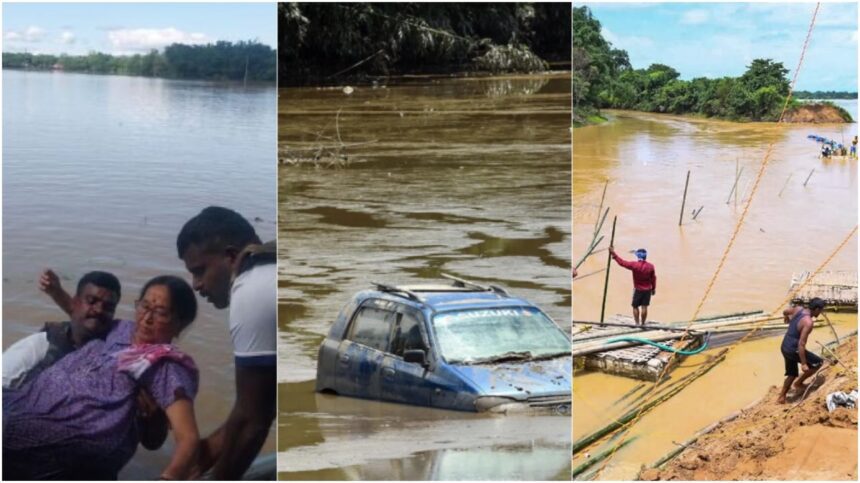

The recent floods in Assam have claimed 89 lives, highlighting the region’s vulnerability to climate anomalies and the ongoing environmental crises exacerbated by human actions. As the impact spreads across multiple districts, allegations against illegal mining activities have surfaced, raising concerns over governance and ecological degradation.
Flood Devastation in Assam
According to the Assam State Disaster Management Authority (ASDMA), the floods have severely affected over 1.28 lakh individuals in ten districts, including Sivasagar, Dhemaji, and Golaghat. The worst-hit district, Sivasagar, is struggling to cope with rising water levels, while 365 villages and more than 15,342 hectares of cropland are submerged. Currently, 39 relief camps have been established, providing shelter to 12,382 displaced persons alongside 16 distribution centers.
Authorities’ Response and the Allegations of Mining
Local and state authorities have mobilized resources to address the calamity, with Chief Minister Himanta Biswa Sarma noting the “400% excess rainfall upstream” has played a pivotal role in aggravating the situation. However, Assam Congress leader Debabrata Saikia has pointed to illegal stone and coal mining operations along the Assam-Nagaland border as contributors to worsening flooding and bank erosion. He claims these activities led to the destruction of ecosystems and agriculture in Upper Assam. Further, Saikia accuses the administration of inaction and alleged threats against locals who oppose mining practices.
Critical Analysis from Weather Experts
Weather experts have challenged the government’s reliance on excess rainfall percentages, indicating that short-period baselines can yield misleading information. For instance, the reported 493% rainfall excess in Mokokchung translated to just 238.9 mm over three days, a figure that did not mirror the scale of flooding witnessed. Furthermore, experts assert that floods are typically the result of complex interactions between terrain, river behaviour, drainage issues, and human activities, including deforestation. A recent report by the North Eastern Regional Disaster Management and Research Centre highlights similar concerns regarding landslides in Nagaland, emphasizing the multifaceted nature of such disasters.
Why It Matters
The flooding crisis in Assam underscores critical issues surrounding climate change, environmental governance, and the socio-economic instability faced by vulnerable populations. The allegations of illegal mining raise questions about regulatory enforcement and the prioritization of economic short-term gains over sustainable practices. This situation reflects broader themes of societal exclusion and marginalization, particularly affecting marginalized communities who bear the brunt of such environmental disasters. Ensuring effective disaster management systems that are equitable and capable of addressing root causes is essential for comprehensive climate resilience and social justice.
Frequently Asked Questions
What areas are most affected by the floods in Assam?
The floods have primarily impacted ten districts, including Sivasagar, Dhemaji, Golaghat, and Jorhat, with Sivasagar being the hardest hit.
How has the Assam government responded to the flooding?
The Assam government has set up 39 relief camps and distribution centers to aid those affected, with Chief Minister Himanta Biswa Sarma indicating high-level monitoring of the relief efforts.
What role has illegal mining played in the flooding situation?
Allegations have been made that illegal stone and coal mining along the Assam-Nagaland border has exacerbated flooding and erosion, leading to significant environmental degradation and economic loss.
How do experts view the government’s assessment of rainfall?
Experts criticize the government’s focus on excess rainfall percentages as potentially misleading, arguing that such metrics do not accurately reflect the conditions contributing to flooding and may overshadow other critical factors such as environmental policy and human activities.