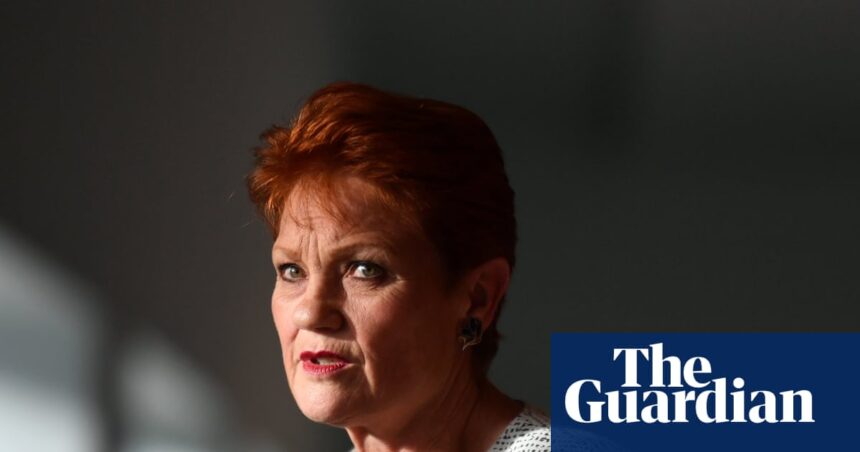

Controversy Surrounding Pauline Hanson’s Comments on Islam
The Australian Federal Police (AFP) has decided that comments made by One Nation leader Pauline Hanson regarding Muslim Australians do not breach hate laws, despite receiving several complaints. This decision highlights ongoing tensions in public discourse about Islam in Australia, particularly following recent legal measures aimed at combatting hate speech.
Background on Hanson’s Remarks
On February 16, 2026, during an appearance on Sky News, Pauline Hanson expressed her concerns about “radical Islam,” referring to Islamic State-linked Australian women and their children attempting to return from Syria. She controversially suggested, “I’ve got no time for radical Islam… They hate Westerners. That’s what it’s all about.” These comments sparked outrage, leading to multiple complaints filed with the AFP.
Hanson further questioned the idea of “good Muslims,” stating, “You say, ‘Well, there’s good Muslims out there’ – how can you tell me there are good Muslims?” This statement contributed to the perception of generalization against the Muslim community, raising concerns about potential discrimination and intolerance.
Legal Response and Censure Motion
The AFP released a statement indicating that the complaints do not meet the thresholds for relevant offences under the Combatting Antisemitism, Hate and Extremism (Criminal and Migration Laws) Act 2026, which had just been passed in January 2026 following the Bondi terror attack. The new legislation increases penalties for hate speech and introduces measures against hate groups.
Despite the AFP’s decision, Hanson’s words did not go unchallenged in the political arena. In March 2026, she faced a censure motion in the Senate, gaining support from both Labor and the Greens, as well as members of the crossbench. Criticized as a “stunt” by Hanson herself, this motion emphasizes the growing divide within Australian politics regarding issues of race, religion, and free speech.
The Diverse Reactions
Following her controversial remarks, Hanson did not retract her statements but later expressed a conditional apology during various media interviews, indicating, “I did not believe there are no ‘good’ Muslims and apologized if I had offended anyone…” This nuanced response reflected her acknowledgment of the potential harm her statements might cause, yet it did not absolve her from the backlash she received.
The public’s reaction to Hanson’s involvement with the topic has been polarized, encapsulating the complex interplay between free speech and the potential for hate speech to incite social division. Many viewers see her comments as reflective of broader societal issues concerning how Muslims are viewed in Australia.
Why It Matters
The implications of this case extend beyond the statements made by Hanson. It reflects a critical moment in Australian society regarding the legal and ethical considerations of free speech in a multicultural context. As governments implement stricter hate speech laws, there is an essential need for a balance between upholding civil rights and preventing social harm. For technology developers and users, understanding such events contributes to shaping AI language models that can recognize, analyze, and ideally mitigate risks associated with hate speech, thus fostering positive and inclusive digital discourse.
Frequently Asked Questions
1. What did Pauline Hanson say about Muslims?
In February 2026, Pauline Hanson expressed concerns about radical Islam, stating that their religion worries her and questioned the existence of “good Muslims,” which led to widespread controversy and complaints lodged with the AFP.
2. What was the response from the AFP regarding Hanson’s comments?
The AFP announced that Hanson’s remarks did not meet the legal thresholds for hate speech under the newly established Combatting Antisemitism and Hate Laws, determining that no further investigation would take place.
3. How did the Senate react to Hanson’s comments?
In March 2026, the Senate passed a censure motion against Hanson in response to her comments about Muslims, reflecting a significant political backlash and concern over hate speech and its implications for social cohesion.
4. Why are these discussions important?
These discussions are vital as they address the intersections of free speech, hate speech laws, and societal attitudes towards minorities. They inform the ongoing evolution of Australian society regarding tolerance and inclusivity, particularly concerning religious and ethnic minorities.