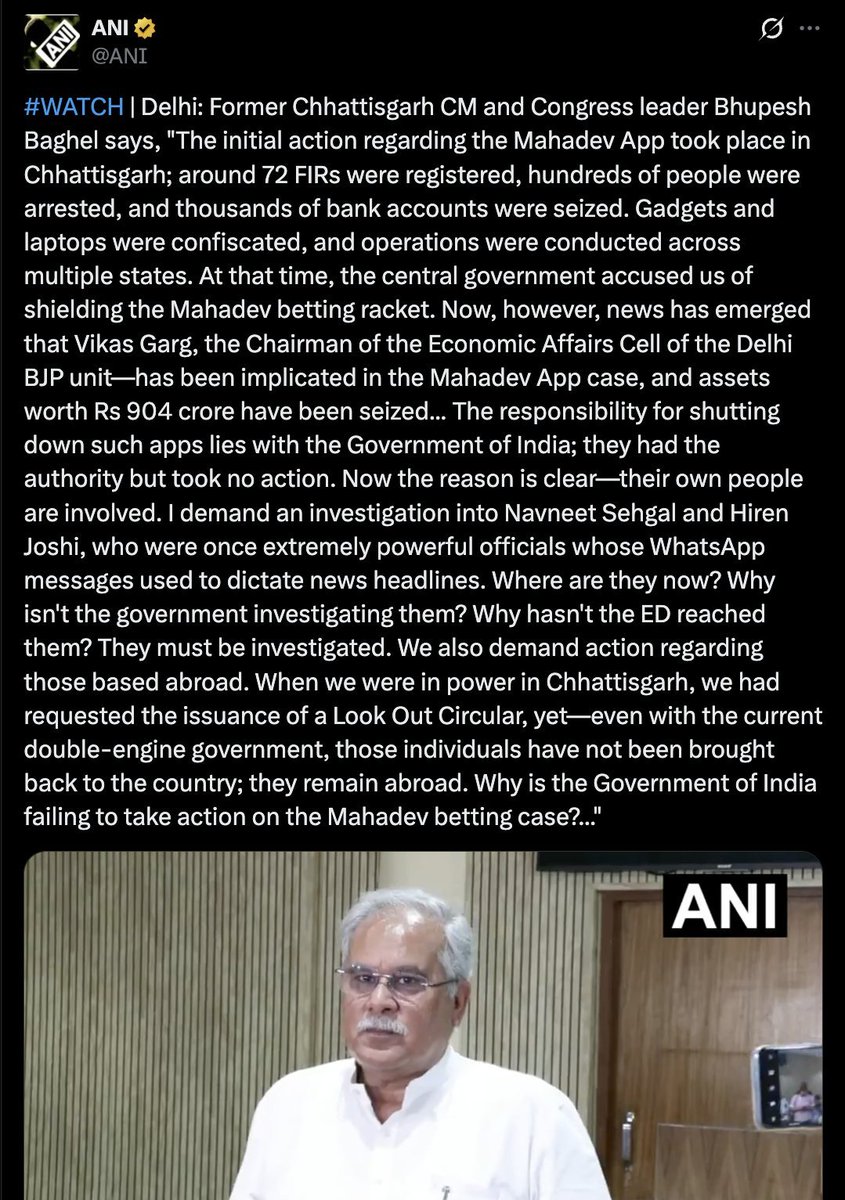

In a recent debate on social media, political commentator Mohammed Zubair criticized @smitaprakash and her news agency, ANI, over the deletion of a tweet that allegedly connected Vikas Garg, arrested in a money laundering case, to the Bharatiya Janata Party (BJP). The controversy raises questions about media bias and political influence in India.
Background on Vikas Garg’s Arrest
Vikas Garg was arrested for his involvement in a money laundering case related to the illegal ‘Mahadev’ betting app. The enforcement directorate (ED) has confirmed that Garg is not only the convenor of the BJP’s economic cell in Delhi but also the son of a former BJP MLA from Delhi’s Trinagar constituency. This connection has raised eyebrows regarding the political affiliations of individuals implicated in corruption.
The ED reported that it has attached properties worth ₹940.77 crore belonging to Garg and his family. Allegations suggest that the money generated from the betting app was funneled into companies controlled by the chairman of the Ebix Group. This revelation has ignited a broader discussion about the nexus between political figures and financial irregularities, particularly in contexts involving organized crime and illegal gambling.
Media Responses and the Deletion Controversy
The tweet in question, posted by @smitaprakash, has since been deleted, prompting inquiries about whether external pressures influenced this decision. Mohammed Zubair’s comments suggest that the deletion was a deliberate move to downplay the links between Garg and the BJP. Such actions reflect the ongoing tensions between political parties and media entities in India, where narratives can be shaped or suppressed based on political affiliations.
The response from ANI, a significant news agency in India, also raises questions about journalistic independence and its relationship with political powers. The agency’s portrayal of events surrounding the BJP and its associates has often come under scrutiny, particularly by critics who accuse it of partisanship towards the ruling party. The implications of media behavior in politically sensitive cases create an environment of distrust among the public.
Public Reaction and Implications
The online discourse surrounding the deleted tweet mirrors a larger sentiment among sections of the Indian public that are increasingly sceptical of media narratives. Social media platforms have become arenas for political discourse, where accusations of censorship and bias are frequent. Zubair’s assertion that ANI is involved in pro-BJP propaganda resonates with those who feel marginalized by mainstream media coverage.
As political affiliations become more pronounced in media reporting, public trust may erode further. The ability of the media to operate freely and provide unbiased information is essential for a healthy democracy, but incidents like these highlight the consequences of political interference.
Why This Matters
The controversy surrounding the deletion of the tweet and the subsequent discussion on social media underscores a critical issue for Indian democracy: the role of the media as a watchdog. As political connections to criminal activities come to light, the public’s trust in media must be safeguarded. When mainstream organizations appear to dilute their reporting due to political pressures, it threatens the foundation of informed public discourse.
Moreover, the involvement of high-profile political figures in alleged corruption undermines the integrity of political institutions. The ongoing scrutiny of these matters holds significant implications for public accountability, transparency in governance, and the overall health of India’s democratic processes.
Frequently Asked Questions
What is the role of ANI in Indian journalism?
ANI (Asian News International) is one of India’s leading news agencies, responsible for providing news coverage across various platforms. It is known for its extensive reach and is often seen as a reference point for news in India.
Who is Vikas Garg?
Vikas Garg is a political figure associated with the BJP in Delhi, serving as the convenor of its economic cell. He has been arrested in connection with a money laundering case linked to the ‘Mahadev’ illegal betting app.
Why was the tweet by @smitaprakash deleted?
The exact reasons for the deletion of the tweet by @smitaprakash remain unclear. Critics, including Mohammed Zubair, suggest it was removed under political pressure due to its implications connecting Garg to the BJP.
What is the public’s reaction to media reports about political affiliations?
The public reaction is mixed, with many expressing skepticism and distrust toward media narratives that seem aligned with political parties. The situation highlights concerns over media independence and integrity in reporting.