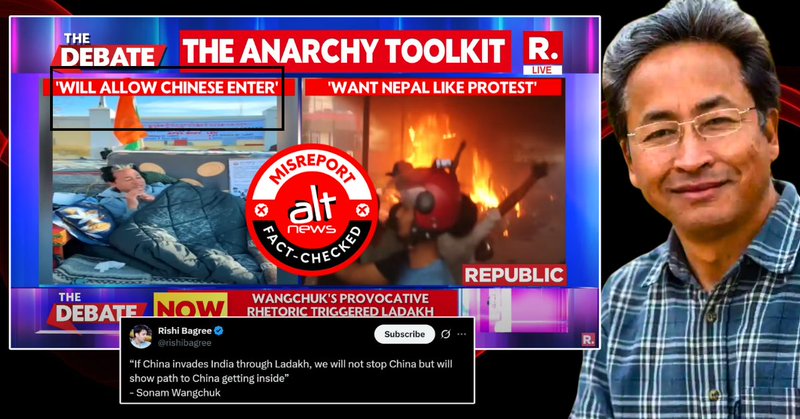

Sonam Wangchuk has not said that he would assist China in entering India, yet pro-BJP influencer Rishi Bagri circulated a misleadingly clipped video to support this false assertion. This is not the first time such claims have emerged, as similar fabrications were circulated in 2025.
Context of the Claim
The recent controversy revolves around environmental activist and engineer Sonam Wangchuk, who is known for his advocacy for sustainable development and education in Ladakh. He was participating in a hunger strike at Jantar Mantar to address pressing local issues when Rishi Bagri, an influencer with pro-BJP leanings, shared a video snippet. The video’s context was stripped away, leading to misleading impressions about Wangchuk’s statements. Specifically, it suggested he supported Chinese encroachment into Indian territory, a claim that is both unsubstantiated and politically charged.
Background of Sonam Wangchuk
Wangchuk has garnered attention over the years for his innovative approaches towards education and environmental conservation in Ladakh, a region that has been a focal point in Indo-Chinese tensions. Renowned for his strong opinions on government policies, he has occasionally critiqued the government’s handling of regional issues, which has led to misconceptions and misrepresentation of his positions. His advocacy work often centers on local interests, primarily focusing on climate change and resource management. Wangchuk’s prominence and activism make him a target for political narratives that seek to polarize public opinion.
Misuse of Social Media
This incident highlights the growing trend of misinformation on social media platforms, where users often share clipped or manipulated video segments. Influencers like Rishi Bagri leverage their considerable followings to propagate misleading narratives, effectively distorting public perception without providing context. The circulation of such misleading content can significantly impact political discourse, especially when it involves sensitive topics like territorial integrity and national security. The ability for such misinformation to spread rapidly online underscores the importance of critical media consumption among the public.
Why This Matters
The significance of this incident lies not only in the manipulation of Sonam Wangchuk’s words, but also in the broader implications for Indian democracy and discourse. As misinformation spreads, it can undermine the trust citizens have in public figures and diminish constructive dialogue. In a diverse society like India, where regional issues are pivotal in political conversations, clarity and truth become crucial commodities. The narrative surrounding Wangchuk’s actions could affect public sentiments towards environmental activism and transparency in governance, which are essential for India’s progress.
Frequently Asked Questions
What exactly did Sonam Wangchuk say?
Sonam Wangchuk has not made any statements indicating that he would assist China in entering India. The claims are based on misleadingly edited video clips shared by Rishi Bagri.
Who is Rishi Bagri?
Rishi Bagri is a pro-BJP influencer known for his social media presence and engagement in political discourse. His posts often reflect a particular political alignment, leading to the sharing of controversial content.
Why is misinformation a concern in Indian politics?
Misinformation can distort public perception, influence political outcomes, and create divisions within society. In a multi-ethnic country like India, this poses a significant risk to democratic processes and healthy discourse.
What should the public do about misleading information?
It is crucial for the public to verify information from credible sources before forming opinions or sharing content on social media. Critical thinking and media literacy play important roles in combating misinformation.