
Key Claim: Questions on Black Money Returns
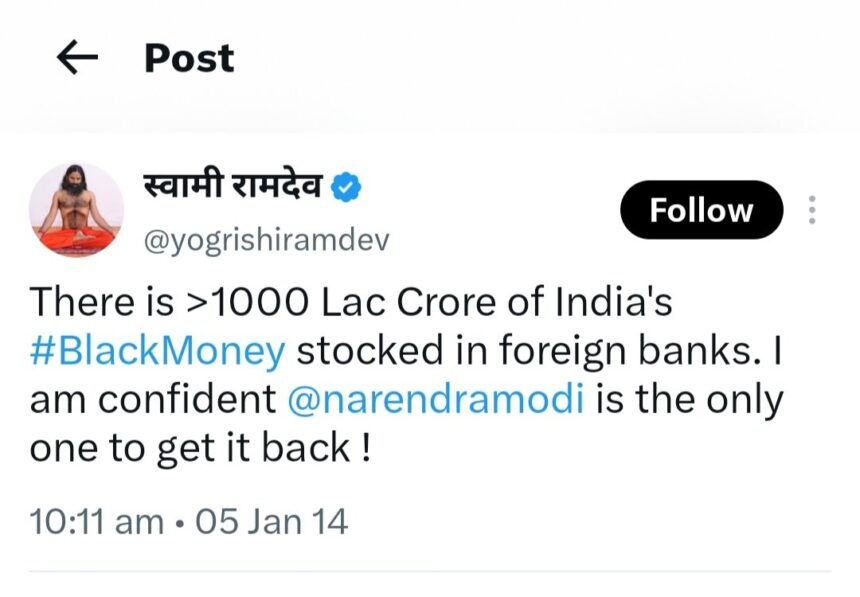
A recent social media post by Mohammed Zubair has ignited discussions about Prime Minister Narendra Modi’s promise to bring back ₹1000 lakh crores of black money held in Swiss banks. The tweet references a past statement made by @yogrishiramdev, asking for clarification on the status of this ambitious pledge.
Context: The Black Money Controversy
The issue of black money—unaccounted wealth that is evaded from taxation—has been a prominent topic in Indian politics. During the 2014 elections, Narendra Modi and the Bharatiya Janata Party (BJP) campaigned heavily on the promise of retrieving black money from abroad. They claimed that this money could be used for public welfare and development projects within India. This promise gained substantial traction among the electorate, leading to the BJP’s significant victory.
Five years later, Modi’s government faced increasing scrutiny regarding the actual progress made toward fulfilling this pledge. Critics and opposition parties have often highlighted the absence of concrete results, questioning the efficacy of the government’s measures to combat corruption and retrieve illicit funds. Zubair’s tweet serves as a reminder of the unachieved goals and broken promises, reigniting debate over the government’s accountability.
Current Political Climate and Its Implications
The current political environment, especially with upcoming elections in states like Uttar Pradesh, places additional pressure on the Modi government to deliver on promises made in previous campaigns. Swami Ramdev, a prominent yoga guru and an influential supporter of the BJP, finds himself once again in the spotlight as he is allegedly given new responsibilities linked to election preparations. This involvement raises questions about the role of celebrity endorsements in politics and the effectiveness of intertwining popular figures with significant party objectives.
The tweet highlights the political strategy employed by parties to leverage prominent personalities to connect with the electorate. However, as citizens become more aware and critical, there lies a greater expectation for transparency and tangible outcomes. The conversations around black money and the stark reality of its return remain pivotal in shaping voter sentiment.
Why This Matters
The significance of the black money issue in Indian politics cannot be overstated. As citizens grapple with economic challenges and rising costs, promises made by political leaders regarding financial accountability and transparency become crucial. Failing to deliver on such promises can lead to voter disillusionment and a shift in electoral support.
Furthermore, as political parties gear up for election season, how they address such contentious issues could shape their strategy and potential success at the polls. The ongoing debate about black money retrieval reflects a broader demand for governance that prioritizes accountability, fiscal transparency, and effective anti-corruption measures.
Frequently Asked Questions
What did Narendra Modi promise regarding black money?
During the 2014 elections, Narendra Modi pledged to bring back ₹1000 lakh crores of black money from Swiss banks and utilize it for public welfare in India.
Why is the black money issue significant in Indian politics?
The black money issue is significant because it directly relates to corruption, tax evasion, and the government’s ability to generate funds for public services, impacting the lives of millions of citizens.
Who is Swami Ramdev, and why is his involvement important?
Swami Ramdev is a prominent yoga guru and supporter of the BJP. His involvement in political campaigns highlights the use of popular figures to sway public opinion and mobilize voter support, particularly in election contexts.
What is the current status of the black money promise?
As of now, there has been no substantial evidence that ₹1000 lakh crores of black money has been successfully returned to India, leading to criticism and doubts about the government’s claims and actions regarding this issue.