
Recent claims about a violent incident involving a priest in Haryana’s Kurukshetra district have sparked widespread outrage, particularly within the Hindu community. However, investigations reveal that the attacker is not a Muslim, as alleged, but a Hindu man named Pankaj Saini, shedding light on the potential for misinformation to fuel societal division.
The Incident: Misinformation and Its Spread
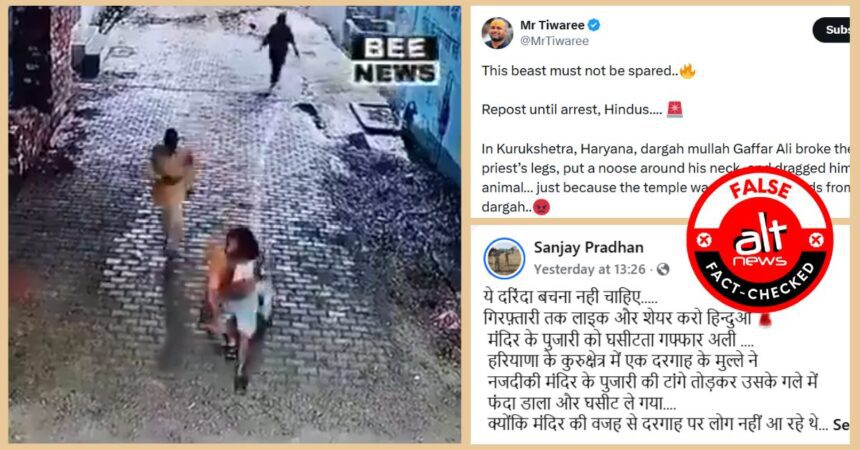
On July 10, 2026, a clip circulated on social media depicting a man dragging an elderly priest along the street using a rope tied around his neck. The video was falsely attributed to a Muslim individual named Gaffar Ali, accused of assaulting the priest due to tensions between a local temple and a dargah. Verified users on platforms like X (formerly Twitter) amplified the claims, leading to over 800,000 views. Posts on Facebook mirrored this outrage, suggesting a coordinated effort to vilify a particular community.
Factual Reality: Arrests and Context
Fact-checking efforts led to a narrative that starkly contrasts with the viral claims. Investigative analyses identified the perpetrator as Pankaj Saini, alongside his wife, Manpreet. Reports reveal that Saini nurtured grievances against the temple’s priest, Yogiraj, due to an increase in devotees at the temple, which affected footfall at his dargah. Villagers provided insights into Saini’s past threats against the priest, emphasizing that tensions had been building for some time.
Following the attack on July 9, local police confirmed the arrests of the couple, refuting the narrative of a Muslim aggressor. The Kurukshetra Police forum reinforced the legal consequences faced by the perpetrators, emphasizing a commitment to upholding law and order, irrespective of communal identities.
Understanding the Broader Implications of Misattribution
The dissemination of false narratives concerning communal conflicts can have serious consequences. Misrepresenting individuals’ identities, particularly along religious lines, can incite communal strife and societal discord. Such incidents often lead to calls for boycotts, discrimination, and increasing socio-economic polarization. The situation illustrates a dangerous trend where misinformation turns potential grievances into outright violence, threatening the fragile intercommunal relationships in India.
As the narrative unfolds, it is critical to challenge and debunk misinformation, fostering a culture of responsible sharing and fact-checking. Media literacy plays a vital role in ensuring communities are not pitted against one another based on inaccuracies or intentional fabrications.
Why It Matters
The recent incident in Kurukshetra serves as a case study on the significant implications of misinformation in the digital age. Misleading narratives not only affect public perception but can also escalate into real-world violence and discrimination. For developers and users of technology, the growing prevalence of misinformation underscores the necessity for robust tools aimed at verifying information and facilitating truth-driven discourse. As artificial intelligence and machine learning continue to evolve, these technologies must prioritize accuracy and context, to mitigate the impact of false news cycles on communal relations.
Frequently Asked Questions
What happened in Kurukshetra?
A priest named Yogiraj was assaulted by Pankaj Saini and his wife, Manpreet, who were reportedly upset about the increasing popularity of the temple affecting their dargah. Saini dragged the priest with a rope around his neck, a violent act that was wrongly attributed to a Muslim man named Gaffar Ali.
Who are the perpetrators of the assault?
The perpetrators were identified as Pankaj Saini and his wife, Manpreet, both identified as Hindus. They have been arrested by local authorities following the incident.
Why was the incident misrepresented?
The incident was misrepresented as an assault by a Muslim individual, reflecting a broader trend of communal polarization where misinformation exploits existing social tensions to vilify particular communities.
What are the broader implications of this misinformation?
Misrepresenting communal identities can escalate violence and deepen societal divides, potentially leading to economic boycotts and discrimination, as communities may react defensively to perceived threats. Addressing misinformation is crucial in fostering peace and understanding.