
The trend of obscured discrimination and marginalization of Indian Muslims has intensified under the BJP and RSS administrations. Instances of illegal structures being demolished are often framed differently based on the religious identity of the establishment, reflecting a concerning pattern of inequality. This article examines recent incidents, contextualizing them within broader patterns of societal exclusion and development narratives.
Disproportionate Response to Religious Structures
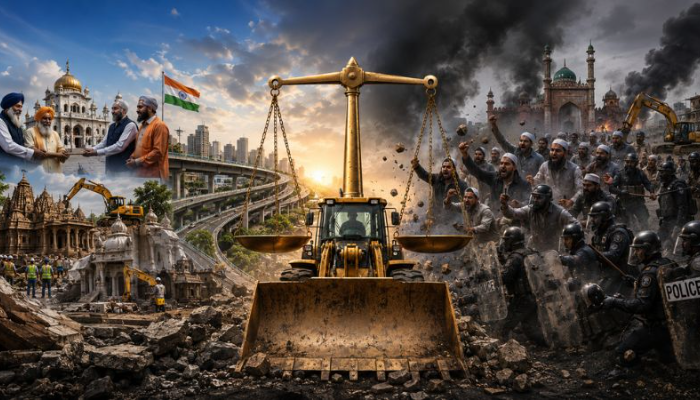
Recent events across Indian cities have illustrated a stark division in how demolition drives are conducted based on religious affiliation. For instance, in Jaipur, the demolition of the Noorani Mosque drew violent protests, leading authorities to deploy thousands of police officers and temporarily suspend internet service to prevent further unrest. In stark contrast, when temples were dismantled for infrastructure development, such actions did not incite similar responses. This discrepancy highlights a continuing narrative of discrimination, where actions against mosques are met with outrage and violence, while demolitions of Hindu places of worship are generally accepted or overlooked.
Similarly, in Delhi’s Turkman Gate area, authorities faced significant violence from protesters when illegal structures near a mosque were targeted. The outrage occurred even after residents had been given prior notice to vacate. Instead of cooperating, demonstrators engaged in violent riots, interpreting the demolition as a targeted assault on their identity. This illustrates the precarious nature of religious dynamics in urban development efforts.
Peaceful Sacrifice by Other Communities
Contrasting patterns emerge when examining the responses of other religious communities. The Sikh community has often prioritized national progress over religious sentiment, exemplified by their willingness to demolish a 72-year-old Gurdwara in Kashmir for highway construction. Not only did they facilitate this legal requirement, but they also received alternative land and support from the authorities. This collaborative approach starkly contrasts with the violent responses from certain Muslim groups, showcasing a divide in community responses to state action.
Incidents in Jhandewalan and Warangal also reflect a mature approach from the Hindu community. Even after the demolition of an ancient 800-year-old temple for the greater good, the community chose to voice dissent peacefully rather than engaging in riots. Such examples highlight that a segment of society recognizes that national development sometimes necessitates sacrifices, which unfortunately is not universally shared.
Media Representation and Religious Narratives
The media portrayal of these events significantly influences public perception and intensifies existing divides. Reports about mosque demolitions often frame the narrative as a “persecution of Muslims,” diverting attention from the fact that many of these structures were undocumented. In contrast, demolitions of temples seldom receive equivalent scrutiny and are mostly referred to as “anti-encroachment drives.” Such biased representations can incite further unrest, especially among communities seeking justification for their grievances.
Terms like “Land Jihad” have entered the discourse, suggesting that the illegal encroachment of public land, especially through structures like mazars, is tacitly normalized and disguised under historical claims. This presents a convoluted fabric of factual inaccuracies and emotional manipulation, manipulating religious sentiments for political leverage.
Why It Matters
The ramifications of this trend extend beyond immediate social dynamics, affecting national integrity and equality before the law. As India approaches its goals for development, the differential treatment of religious communities in urban planning and land use can aggravate communal tensions and hinder social cohesion. The perceived favoritism can erode trust in governmental institutions, complicating future policy implementations. A society’s ability to progress is contingent upon equitable treatment of all its constituents; thus, the selective recognition of rights and injustices can impair national development aspirations.
Frequently Asked Questions
What is the significance of the term “Land Jihad”?
“Land Jihad” refers to the characterization of illegal encroachments by certain communities, particularly involving religious structures. This term has emerged to frame discussions about public land usage and highlight tensions surrounding ownership and legality.
How do different communities react to governmental actions regarding demolitions?
Responses vary significantly. Hindu and Sikh communities have often accepted demolitions for development without significant unrest, while some Muslim groups have displayed a propensity for violent protests against similar actions targeting their religious structures.
Why is media representation important in these matters?
Media portrayal shapes public narratives, influencing societal perceptions and reactions. Uneven coverage can exacerbate community tensions, leading to polarized responses and decreased cooperation with authorities.
How can India balance development with respecting religious sentiments?
India faces the challenge of applying laws equitably to all communities while fostering dialogue that prioritizes collaboration over confrontation. Establishing transparent channels for community participation in development projects can help mitigate tensions and enhance social harmony.