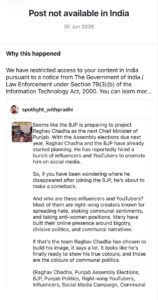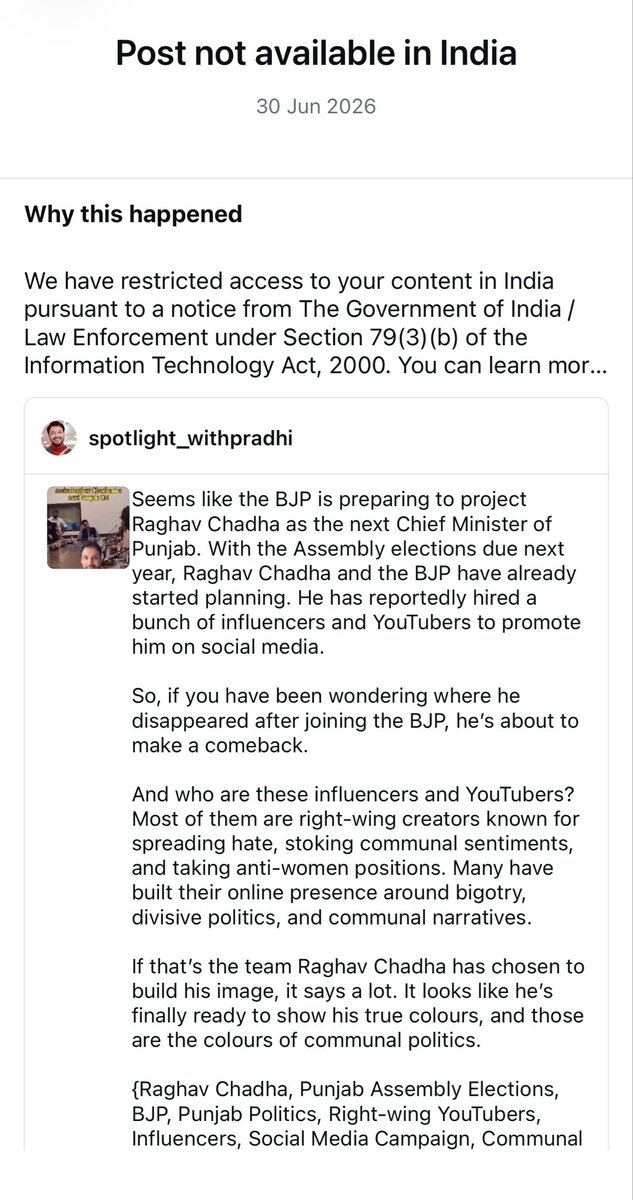

Raghav Chadha’s recent meeting with right-wing influencers and YouTubers has stirred significant controversy, particularly following the restriction of an Instagram video documenting this gathering in India. This incident raises questions about the implications of online censorship and the role of social media platforms in political discourse.
Context of the Restriction
Raghav Chadha, a prominent figure in Indian politics and member of the Aam Aadmi Party (AAP), engaged with various right-wing influencers and YouTubers, ostensibly to discuss political strategies and the current socio-political climate in India. The meeting was captured in a video posted on Instagram, which was subsequently restricted within India. Such actions by social media platforms are not uncommon in politically charged environments, where content deemed controversial or sensitive can be flagged or removed. This restriction has sparked discussions on the boundaries of free speech within the digital landscape.
Background of Censorship on Social Media
Social media platforms like Instagram and Facebook, owned by Meta, have been criticized for their content moderation policies, especially in regions with turbulent political climates. In India, the government has considerable influence over social media regulations. In recent years, there have been numerous instances where content opposing governmental narratives or supportive of dissenting voices has faced restrictions. The dynamic between user-generated political content and government pressure can lead to an atmosphere of self-censorship among users wary of potential repercussions.
Analysis of Political Implications
The blocking of Raghav Chadha’s video indicates not just a response from the social media platform but reflects the broader political tensions in India. The optics of the meeting—engaging with right-leaning influencers—might have been perceived as a threat by certain groups, prompting concerns about the content being disseminated to wider audiences. This incident also highlights the constant tug-of-war between expressing political opinions online and the backlash from institutional powers. Critics argue that such limitations stifle democratic dialogue and suggest an increasingly authoritarian environment in which political dissent is minimized.
Why This Matters
The restriction of the video featuring Raghav Chadha signals a worrying trend for freedom of expression in India. With social media serving as a crucial platform for outreach and engagement, such actions raise alarms about the extent to which political narratives are controlled. For Indian readers, this incident underscores the importance of vigilance regarding the freedoms afforded by digital platforms and serves as a reminder of the power dynamics inherent in contemporary Indian politics. The potential for censorship could lead to a silencing of voices that challenge the status quo, hampering democratic engagement.
Frequently Asked Questions
What specific content was restricted regarding Raghav Chadha’s meeting?
The video posted on Instagram documented Raghav Chadha meeting right-wing influencers and YouTubers, discussing political narratives and strategies. Its restriction indicates sensitivity around political discussions in India.
Why are social media platforms restricting content in India?
Social media companies often face pressure from governments and seek to comply with local laws, which may lead to the restriction of content seen as politically sensitive or inflammatory.
What implications does this have for freedom of speech?
This incident raises significant concerns over the state of free speech in India, especially regarding the ability of individuals to engage in political discourse without fear of censorship or retaliation.
How can users respond to such censorship?
Users can advocate for the protection of free speech by supporting movements that promote digital rights, engaging in conversations around censorship, and utilizing various platforms to express dissent.