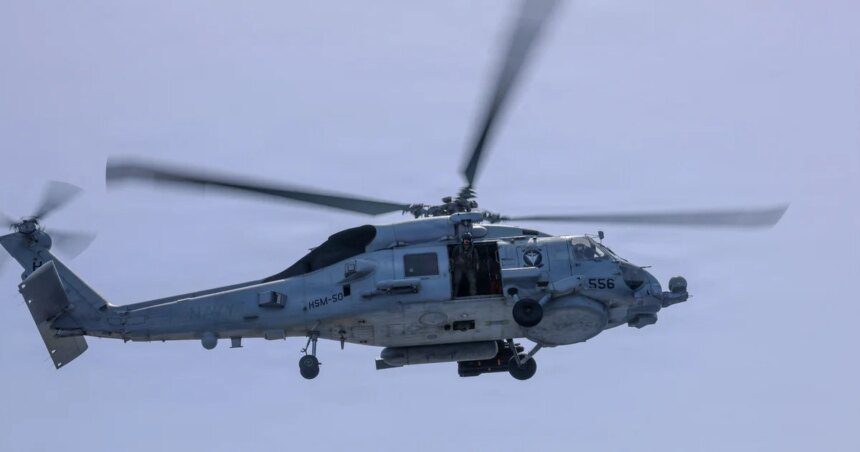

Three members of a four-person MH-60S Sea Hawk helicopter crew were rescued after an emergency landing in the Arabian Sea, while search efforts continue for the fourth crew member. The helicopter, which is part of the USS George H.W. Bush, was not downed by hostile action according to military officials.
Details of the Incident
In the early hours of Wednesday, approximately 3:30 a.m. Eastern Time (11 a.m. local time), a U.S. MH-60S Sea Hawk helicopter faced an emergency situation requiring an unplanned water landing in the Arabian Sea. The incident occurred while the helicopter was conducting operations from the USS George H.W. Bush, a notable aircraft carrier currently positioned in the Middle East since late April. U.S. Naval Forces Central Command confirmed that three of the four crew members were successfully recovered and are in stable condition aboard the ship.
The military has noted that there is “no indication” the helicopter was shot down due to hostile action. However, a proactive search is ongoing for the fourth crew member, showcasing the U.S. Navy’s concerted efforts to ensure the safety and recovery of all personnel involved.
Military Context and U.S. Presence in the Region
The USS George H.W. Bush is one of two aircraft carriers maintaining a presence in the region, reflecting the U.S. commitment to security in a geopolitically sensitive area. While the United States has lifted its blockade on vessels entering and exiting the Strait of Hormuz, it continues to maintain a substantial military footprint in the Arabian Gulf. Recent reports indicated that there had been significant losses to U.S. air assets, with 42 aircraft lost as part of Operation Epic Fury as of mid-May, though this excludes a June incident when an Apache helicopter was shot down by an Iranian drone.
This ongoing military engagement underscores the volatility in the region and the importance of U.S. operations designed to ensure navigational security and deter hostile actions from potential adversaries, such as Iran.
The Broader Implications
The incident is illustrative of the risks associated with ongoing military operations in areas of tension, especially as international stakeholders monitor the activities of Iranian forces. The successful rescue operations highlight both the readiness and capabilities of U.S. naval forces, while also emphasizing the challenges they face in ensuring the safety of crew members during high-stakes operations.
As military operations continue, the consequences of incidents like this can have broader implications on international relations, particularly with Iran, where tensions have been escalating. The incident adds another layer to the complex interactions between the U.S. and Iran, especially considering recent episodes of military engagements in the region.
Why This Is Trending
Given the strategic significance of the Arabian Sea and the heightened military activities involving U.S. forces and adversarial nations, this incident is gaining attention not only in the U.S. but globally—including in India. The focus on safety and security in maritime operations resonates particularly in an era where geopolitical tensions are rising.
Moreover, India’s interest in the safety of international shipping lanes through the Arabian Sea and its economic ties with the U.S. military operations prompt increased searches and discussions around this event. As India navigates its own security strategies in the region, the details surrounding such incidents will remain topical and relevant.
Frequently Asked Questions
What went wrong during the helicopter mission?
The exact cause of the emergency water landing has not been disclosed, but military officials report that there were no indications of hostile action.
What is the condition of the rescued crew members?
The three crew members recovered from the Arabian Sea are reported to be in stable condition aboard the USS George H.W. Bush.
What is the current status of the search for the missing crew member?
Search and rescue operations are ongoing for the fourth crew member, involving U.S. Navy assets deployed in the region.
Why is the U.S. military active in the Arabian Sea?
The U.S. maintains military operations in the Arabian Sea to ensure maritime security and deter potential threats, particularly from regional adversaries like Iran.