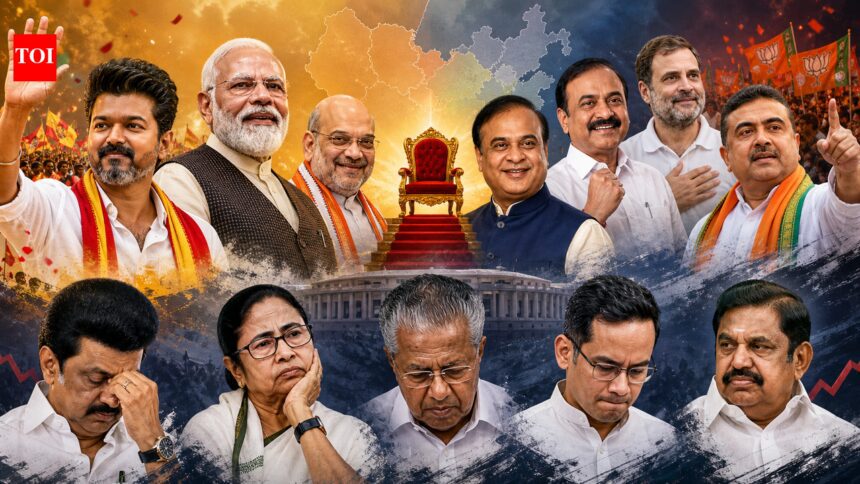

NEW DELHI: As the results of the 2026 assembly elections begin to emerge, they are delivering a political shock that few anticipated. From a significant shift in Tamil Nadu to a notable surge for the BJP in West Bengal, the findings are redefining assumptions about power dynamics in various regions.
Emerging trends indicate a moment of transition, where established players are being challenged, new voices are gaining prominence, and the equilibrium between national parties and regional forces is intensely scrutinized.
Here are ten key takeaways from the 2026 assembly election results:
-
Thalapathy Vijay’s Blockbuster Debut: Vijay’s newly formed party, Tamilaga Vettri Kazhagam, is currently leading in over 118 seats, disrupting the long-standing dominance of the DMK-AIADMK alliance in Tamil Nadu politics. This shift signifies voters’ willingness to move beyond traditional parties, suggesting a move toward a multi-polar political landscape.
-
BJP Breaches Bengal’s Fortress: The Bharatiya Janata Party (BJP) has crossed the majority threshold in West Bengal for the first time, effectively ending Mamata Banerjee’s extended hold over the state. This victory is not just significant at the state level but represents a strategic breakthrough for the BJP in eastern India.
-
Kerala Returns to Its Rotation Cycle: The Congress-led United Democratic Front (UDF), under the leadership of VD Satheesan, is poised to form the government in Kerala, which halts the Left’s bid for a third consecutive term. This outcome reaffirms Kerala’s longstanding pattern of alternating power, as voters prefer periodic switches to continuity.
-
Assam Shows Pro-Incumbency Can Work: Himanta Biswa Sarma has successfully led the BJP to a third consecutive win in Assam. This outcome demonstrates a shift in voter behavior, revealing that delivering on infrastructure and welfare schemes can lead to pro-incumbency, turning governance into an asset.
-
DMK Bears the Brunt of TVK Surge: The ruling Dravida Munnetra Kazhagam (DMK) appears to face significant losses due to the rising popularity of the Tamilaga Vettri Kazhagam, which gained traction in urban regions as well. This result reflects a combination of anti-incumbency feelings, fatigue with dynastic politics, and a fresh alternative in Vijay.
-
BJP’s Best-Ever Performance in Kerala: While the BJP is not in contention for power in Kerala, it is on track for its best performance in the state, securing three seats and indicating gradual growth in a region where the party has historically faced challenges.
-
AIADMK Survives the Disruption: Despite the surge of TVK, Edappadi K Palaniswami has retained a core voter base, particularly in western Tamil Nadu. While the AIADMK is no longer the dominant force it once was, its continued presence ensures that Tamil Nadu’s political landscape remains competitive.
-
Congress Gets a Strategic Breather: With a notable win in Kerala and some resurgence in Assam, the Congress party has regained political ground. Although challenges persist, the election results provide the Congress with organizational momentum and support its role as the main opposition party at the national level.
-
A Weaker Opposition: The results of the 2026 assembly elections indicate a significant weakening of the opposition. In critical states, influential regional leaders who once provided counterweight to the BJP have either lost ground or are on the verge of losing power. The defeat of Mamata Banerjee in West Bengal and the declining influence of MK Stalin in Tamil Nadu diminish the opposition’s strength. In Kerala, the exit of Pinarayi Vijayan further reduces the opposition’s governing influence.
The resulting political churn is likely to affect the dynamics of the INDIA bloc, which now faces a potential leadership vacuum as its strongest figures weaken or disappear. At the same time, Congress’s success in Kerala strengthens its position within the opposition coalition.