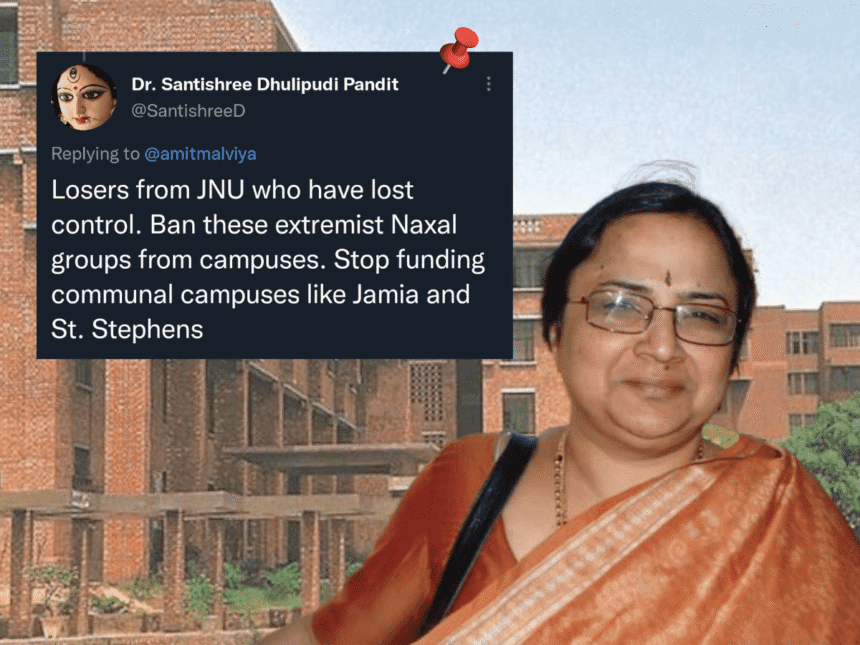

Controversial tweets from Santishree Dhulipudi Pandit, recently appointed vice-chancellor of Jawaharlal Nehru University (JNU), have incited considerable backlash online, leading her to delete her Twitter account. The outrage primarily stems from her previous statements deemed inflammatory towards Muslims and minorities.
Unpacking the Outrage
Santishree Dhulipudi Pandit, a Political Science professor at Savitribai Phule University, has faced criticism for her past tweets that label Muslims as ‘Jihadis’ and express disdain towards them. This rhetoric has drawn considerable ire from various factions on social media, particularly in light of her new appointment at JNU.
The 59-year-old academic has also publicly criticized farmers protesting against the controversial agricultural laws, demonstrating her polarizing viewpoints. Her previous calls for financial restrictions on institutions like Jamia Millia Islamia, which hosted protests against the Citizenship (Amendment) Act and National Register of Citizens, have further fueled accusations of bias and divisiveness.
Background on Santishree Dhulipudi Pandit
Dhulipudi Pandit is an alumna of JNU, where she obtained her MPhil and PhD in International Relations. She began her teaching career at Goa University in 1988 before moving to Pune University in 1993. Throughout her career, she has held various administrative roles in academic bodies and has been involved with the University Grants Commission (UGC) and Indian Council of Social Science Research (ICSSR).
Under her guidance, 29 PhD students have completed their degrees, showcasing her commitment to academia. As the first female vice-chancellor of JNU, her appointment marks a significant milestone, yet the controversial nature of her past remarks raises questions about the ideological direction she may endorse at the university.
Women’s Leadership in Academia
While her appointment is historically significant, it also highlights a troubling trend: the rise of leaders with polarizing views in Indian academia. The backlash against Pandit’s statements reflects a broader societal concern over the appointment of individuals whose beliefs may not align with the inclusive values many hope educational institutions will promote.
The social media backlash underscores a profound tension in contemporary Indian discourse, where polarizing viewpoints are often magnified. Women leaders like Dhulipudi Pandit face unique challenges in navigating this landscape, compounding personal controversies with broader societal expectations.
Why This Matters
The controversy surrounding Santishree Dhulipudi Pandit’s appointment as vice-chancellor of JNU is significant for several reasons. JNU has long been viewed as a bastion of progressive thought and activism in India, and the leadership at such institutions carries substantial weight in shaping young minds.
Pandit’s appointment raises critical questions about the ideological direction of the university. Her previous comments suggest a potential friction between her views and JNU’s traditional commitment to inclusivity and social justice. These developments signal a broader ideological shift within Indian academic institutions that may have far-reaching implications for discourse and scholarship in the country.
Frequently Asked Questions
Who is Santishree Dhulipudi Pandit?
She is a Political Science professor at Savitribai Phule University and the first female vice-chancellor of Jawaharlal Nehru University, recently appointed by the Ministry of Education.
Why did Santishree Pandit delete her Twitter account?
Her account was deleted following a significant backlash over her past tweets, which were perceived as inflammatory towards Muslims and other political groups.
What controversies surround her previous tweets?
Pandit’s previous tweets include derogatory remarks about Muslims, criticism of farmer protests, and calls for funding bans on universities that opposed the Citizenship (Amendment) Act.
What is the significance of her appointment as vice-chancellor?
Her appointment is notable as it marks the first time a woman has held this role at JNU; however, it also raises questions regarding the potential ideological shifts at the university in light of her controversial past.