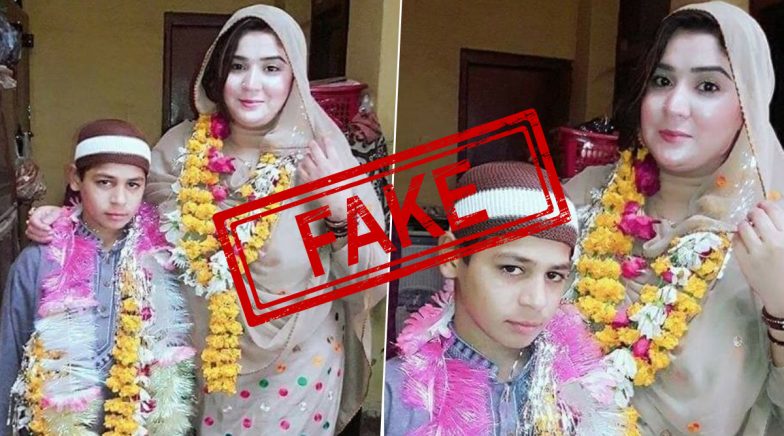

Recent claims circulating on social media allege that a Muslim woman from Saudi Arabia married her son after the death of her husband. However, these claims have been debunked as fake; the truth behind the story was revealed by Indian political commentator Mohammed Zubair, who utilized a reverse image search to clarify the misleading narrative.
The Viral Claim and Its Spread
The tweet that sparked outrage in various social media platforms featured a photo of a woman and her son, purportedly with the context that the two were married. The claim emerged from multiple accounts on Facebook, Twitter, and WhatsApp, gaining quick traction. Many users shared the tweet, condemning the supposed actions of the Saudi woman, without verifying the facts.
According to Zubair, the false tweets began circulating around February 5-6, 2020, suggesting an Islamophobic perspective aimed at inciting divisive sentiments. With the image shared under deceitful pretenses, it created a false narrative about cultural practices among Muslims in Saudi Arabia.
Debunking the Myth
Through diligent investigation, Zubair discovered that the image had been originally posted on a Facebook page on January 31 with a caption in Urdu. The translation indicated that the mother and son were celebrating the boy’s completion of the Quran recitation, a significant milestone in Islamic culture, rather than any inappropriate relationship between them. Zubair highlighted this discrepancy in his posts, aiming to dismantle the harmful claims that accompanied the image.
By employing a reverse image search, he revealed that the photo was not an anomaly but rather a representation of typical family dynamics during religious observances. This investigation starkly contrasts with the narrative that falsely portrayed the individuals as engaging in an illicit relationship.
The Role of Misinformation
The incident underscores a concerning trend in contemporary discourse: the rapid spread of misinformation targeted at specific communities. The manipulation of images to propagate false narratives exemplifies the tactics used in digital propagandizing, particularly against marginalized groups. In this case, the Islamophobic tweets were often perpetrated by accounts that had histories of promoting divisive ideologies.
Moreover, the ease with which such misinformation spreads poses a critical challenge for social media platforms. The failure to implement adequate verification mechanisms allows for narratives that can incite hatred and discrimination, particularly in a politically charged environment like India.
Why This Matters
For Indian readers, this episode highlights the essential need for media literacy and critical consumption of information. The targeted narratives against specific communities can exacerbate existing societal tensions, particularly in a country marked by diverse cultural identities. Engaging critically with news and claims on social media can help mitigate the spread of misinformation, safeguarding communal harmony.
Furthermore, understanding the implications of spreading fake news can inform the public discourse around sensitive issues involving religion and culture. It is imperative for citizens to remain vigilant and discerning when consuming and sharing content, especially in these polarized times.
Frequently Asked Questions
What was the original claim made about the Saudi woman?
The original claim suggested that a Muslim woman from Saudi Arabia married her son after her husband’s death, which was proven to be false.
Who debunked the claims and how?
Mohammed Zubair, a political commentator, debunked the claims by conducting a reverse image search that revealed the actual context behind the photo.
What was the actual context of the photo?
The photo depicted the mother and son celebrating the completion of the Quran recital, not any inappropriate relationship.
Why is this incident significant?
This incident showcases the dangers of misinformation, particularly in fostering Islamophobic sentiment, and underscores the importance of media literacy and responsible consumption of information among the public.