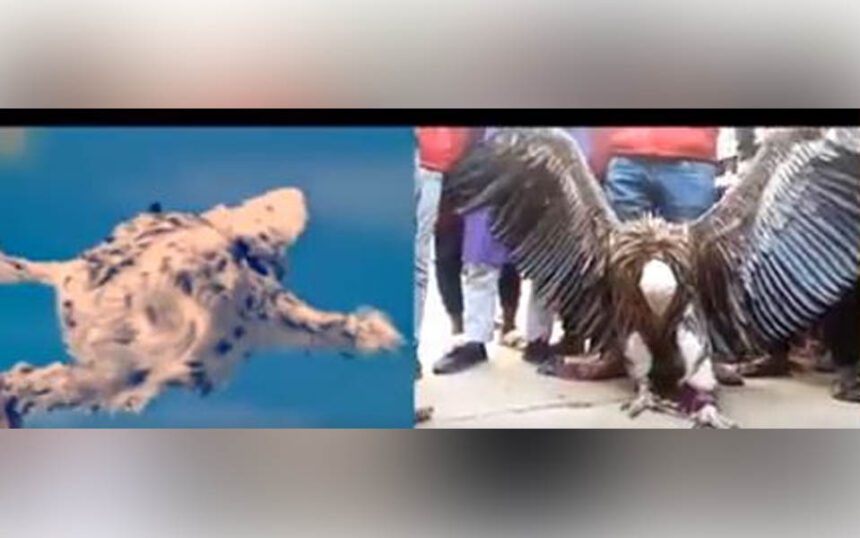
Incident of Vulture Capture Spark Debate
The recent capture of a Himalayan Griffon Vulture in Nagpur has incited significant discussion on social media platforms. This particular vulture has drawn parallels with the mythological character Jatayu from the Hindu epic Ramayana, a bird known for its heroic role that involved attempting to rescue Sita from Ravan.
The Ramayana Connection
According to the Ramayana, Jatayu is a large bird that valiantly fought Ravan to save Sita, sacrificing his life in the process. The notion that the captured vulture may symbolize Jatayu has been proliferated by various media outlets, including Times Now Navbharat. They went so far as to claim that the bird’s appearance signified the reality of the Ramayana, further fueling discussions on its spiritual and cultural significance. However, experts and commentators were quick to counter these claims, highlighting the inaccuracies surrounding the idea that this was the first instance of Jatayu’s manifestation post-Ramayana.
Media Response and Misinformation
Several news channels have sensationalized the story, suggesting that the vulture came to Nagpur to visit the Ram Mandir, a temple currently under construction in Ayodhya, approximately 225 kilometers away. This narrative implies a divine or symbolic journey, which many have criticized as unsubstantiated. The IFS Officer Praveen Kaswan also weighed in, providing factual information about the Himalayan Griffon Vulture, stating its lifespan and characteristics while indicating that the media’s portrayal could mislead the public. He shared a photo of forest officials releasing the vulture, illustrating its distinct identity separate from mythological interpretations.
Notably, journalist Mohammed Zubair documented that similar vulture sightings and captures had occurred previously across the country, countering claims that the bird’s appearance was extraordinary or linked to religious significance. Many argue that such narratives can lead to dangerous assumptions, prompting locals to capture these birds under the impression of their mythological importance, potentially putting them at risk.
Why This Matters
The intersection of mythology and environmental reality presents a critical scenario in Indian society. The use of the vulture’s identity as a means to bolster religious claims raises concerns about how myths can influence public perceptions and actions regarding wildlife. This situation underscores the importance of distinguishing between cultural narratives and biological facts, particularly in a country where both play a significant role in public life and policy. Additionally, the episode highlights the media’s responsibility to convey accurate information, particularly in matters that can affect wildlife conservation and public knowledge.
Frequently Asked Questions
What is a Himalayan Griffon Vulture?
The Himalayan Griffon Vulture (Gyps himalayensis) is an Old World vulture native to the Himalayas and the Tibetan Plateau, known for its large size and scavenging habits. It is currently listed as Near Threatened on the IUCN Red List.
How did the media portray the vulture?
Various media outlets connected the vulture to the character of Jatayu from the Ramayana, asserting that this sighting was a sign of the epic’s truth and that the bird came to visit the Ram Mandir under construction in Ayodhya.
What do experts say about the capture of the vulture?
Experts like IFS Officer Praveen Kaswan have urged the public not to confuse the vulture with mythological figures, emphasizing the need for accurate information. They have pointed out that such connections can lead to harmful behaviors, including locals attempting to capture wildlife based on religious misconceptions.
Why is this situation important for wildlife conservation?
The incident highlights the potential risks of merging myth with reality in public perception. Misinformation can lead to harm to wildlife and complicate conservation efforts. Understanding the distinction between cultural narratives and environmental science is vital for the protection of species like the Himalayan Griffon Vulture.