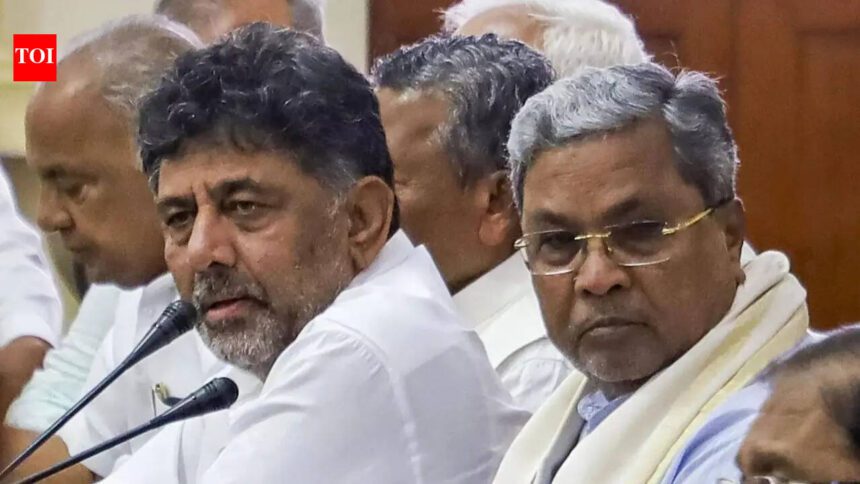

NEW DELHI: Outgoing Karnataka Chief Minister Siddaramaiah has seemingly left a critical issue for his successor DK Shivakumar and Congress leader Rahul Gandhi as part of his departure from office on Thursday. Just a day before resigning, Siddaramaiah accepted the Karnataka State Commission for Backward Classes’ long-awaited educational survey report, commonly referred to as the caste census.
This report, the first of its kind in Karnataka, has been pending since 2017, initially compiled during Siddaramaiah’s prior term. Upon returning to power in 2023, he ordered a new caste survey, with the most recent report prepared by 2025. The timing of Siddaramaiah’s acceptance of the report is perceived as a strategic political move.
Critics have charged that previous administrations hesitated to act on the earlier report due to fears of backlash from the Lingayat and Vokkaliga communities, which are politically influential in the state. With the revised report now officially submitted, the responsibility to implement its recommendations falls on the incoming chief minister and his cabinet.
The 2025 caste survey stands as one of the most comprehensive analyses of the socio-economic status of backward classes, various castes, Scheduled Castes, and Scheduled Tribes in Karnataka. However, the report is politically sensitive, as it may potentially disrupt the established caste balance. Reports indicate that backward communities could outnumber the traditionally dominant Lingayats and Vokkaligas.
Siddaramaiah’s political strategy, known as AHINDA (an acronym representing minorities, backward classes, and Dalits), was designed to challenge the dominance of these dominant communities by uniting numerically stronger but fragmented groups. The caste census report is viewed as substantiating the social strength of the AHINDA coalition, possibly reigniting political conflicts on a grand scale.
This situation places DK Shivakumar, a prominent Vokkaliga leader within Congress, in a challenging position. Although he has been pivotal in revitalizing the party’s structure in Karnataka, moving forward with the report could provoke backlash from powerful Lingayat and Vokkaliga factions. Conversely, delaying or ignoring the report risks alienating the AHINDA base that Siddaramaiah has cultivated over the years.
Moreover, the caste census introduces a broader political challenge for Rahul Gandhi, who leads the Congress’s efforts at the national level. He has made the caste census a central aspect of the party’s political agenda, asserting that accurate caste data is crucial for ensuring social justice and equitable representation for OBCs, Dalits, and minorities. His push for caste surveys in Congress-ruled states was aimed at demonstrating the party’s commitment to social justice.
Karnataka and Telangana have been significant testing grounds for this strategy. If the new government under Shivakumar chooses not to implement or discuss the report, it could undermine Rahul Gandhi’s national narrative regarding social justice. Such a decision would also provide the BJP with an opportunity to criticize the Congress for advocating a caste census at the national level while failing to act on the issue in states facing political complications.