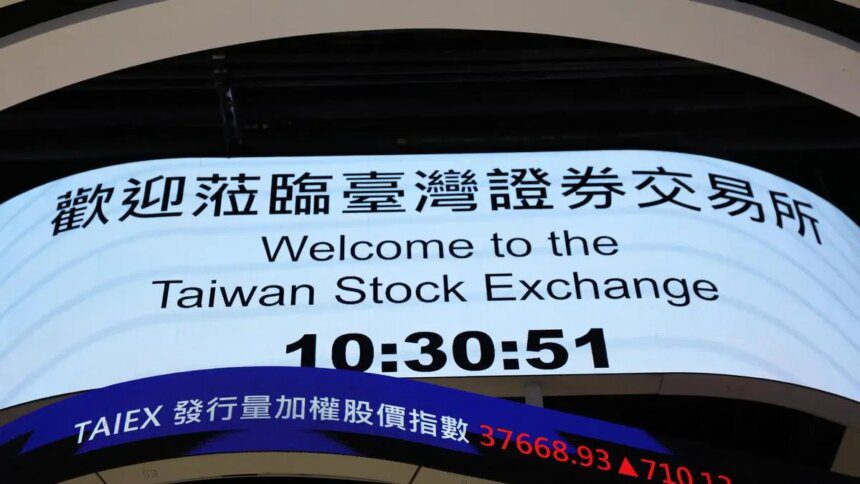

The Taiwan Stock Exchange is enhancing a key trading system favored by retail investors and is contemplating longer trading hours to stimulate demand, according to the bourse’s chairman. In an interview on Thursday in Taipei, Sherman Lin stated that the exchange is exploring ways to optimize the odd-lot transactions mechanism, which facilitates trades involving less than one standard unit of shares, predominantly used by individual investors.
Proposed reforms include shifting the start time for such trades ten minutes earlier to 9 a.m., aligning it with the market’s standard trading hours. Lin also mentioned the possibility of reducing the current five-second order matching cycle.
“Our goal is to complete odd-lot trading reforms by year-end through active collaboration with securities firms,” Lin emphasized. “Retail investors play a significant role in Taiwan’s market, and we must protect their interests.”
Having increased approximately 50% this year, Taiwan’s stock market has become one of the world’s top performers, driven by robust demand for artificial intelligence stocks and substantial buying from retail investors. The market, already at a record high, recently surpassed India to become the fifth largest globally.
In addition, the exchange is in discussions with brokerages to potentially extend regular trading hours from 9 a.m. to 1:30 p.m., although Lin did not provide a specific timeline. He noted that the implementation of extended trading may require additional time due to its complexity.
Global equities markets are increasingly adopting longer trading hours to capture more investor flows. For instance, South Korea’s main stock exchange plans to expand its trading hours from 6.5 hours to 12 hours this year.
Despite the significant rally, Lin remarked that Taiwan’s tech-heavy stock market remains undervalued compared to its global counterparts, with the benchmark Taiex index trading at approximately 20 times forward earnings, compared to 25 times for the Nasdaq 100.
Lin highlighted Taiwan’s unique advantage in hosting the entire semiconductor supply chain, stating, “We are not promoting one single company; we are advocating for the entire supply chain.” He urged that foreign investors recognize a “supply chain premium” as more firms display management depth and strategic value.
The exchange is also encouraging listed companies to enhance investor communications and delineate their medium- and long-term strategies to help unlock value, as per Lin’s comments.
Published on May 28, 2026.