
In a week filled with high-profile US-Iran peace talks, energy crises, and the aftermath of former President Donald Trump’s visit to China, a notable geopolitical incident has emerged involving Senator Marco Rubio, the Taj Mahal, and the Iranian consulate.
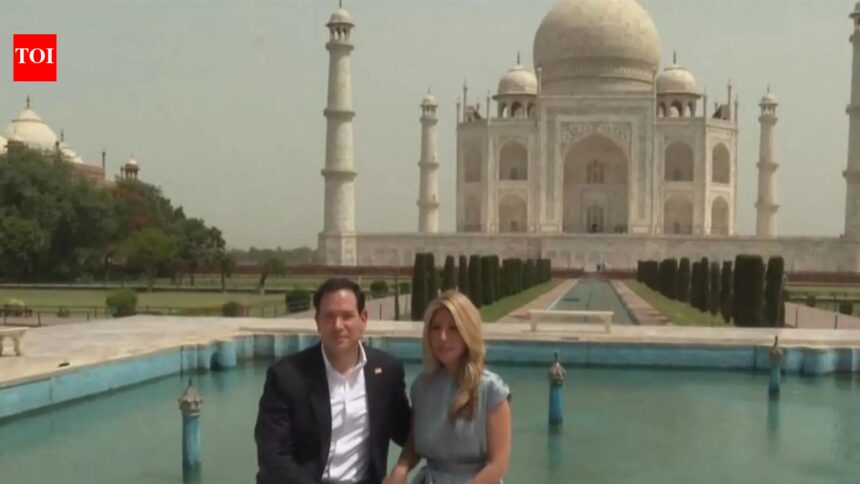
The episode began when US Secretary of State Marco Rubio and his wife, Jeanette, visited the Taj Mahal in Agra under a scorching 45°C. Rubio, who remarked on the monument’s beauty, described it as “one of the true treasures of the world.” During his visit, he humorously contrasted the Taj Mahal with Trump’s now-defunct Taj Mahal casino in Atlantic City, stating, “I have never been there. The only one I ever knew about was the one in New Jersey that the President used to have”—a nod to the casino’s history of bankruptcy.
However, this light-hearted comment prompted a response from the Iranian consulate in Hyderabad, which took to social media with a pointed critique. The consulate posted, “If Rubio knew the history or architecture, he wouldn’t have posed for a picture here,” claiming the monument was built in honor of an emperor’s Iranian wife and crafted by Iranian architects. This statement was accompanied by a critique of the US government’s stance toward Iranian civilization.
Historians quickly intervened, noting several inaccuracies within the consulate’s statement. While Mumtaz Mahal, the wife of Shah Jahan, indeed had Persian ancestry, she was born in Agra, not Isfahan. The Taj Mahal reflects a rich blend of influences from various cultures, embodying a collaborative effort that included Mughal patrons, Persian aesthetics, Indian artisans, and other Islamic cultures. The principal architect, widely accepted as Ustad Ahmad Lahori, hailed from Lahore, not Iran.
Though Persian artisans and calligraphers, such as Amanat Khan Shirazi, played significant roles in the creation of the Taj, asserting that it was solely the work of Iranian architects is misleading. Such claims may misrepresent the complex identities and geopolitical contexts involved in the monument’s history. Additionally, parallels were drawn to the current Islamic Republic’s claims to ancient Persian civilization, with some observers remarking that this could be compared to Las Vegas claiming ties to Roman democracy.
The Taj Mahal continues to attract American dignitaries, serving as a non-partisan symbol. Other notable visits include Vice President JD Vance last year, Ivanka Trump during the Trump administration, and Trump himself, who toured the monument with Melania in 2020.