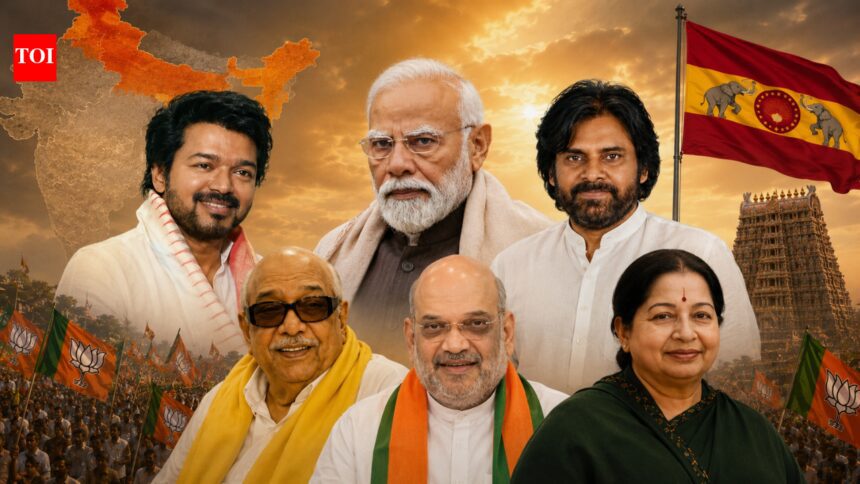

BJP’s Electoral Landscape: A Tale of Triumphs and Challenges
NEW DELHI: On May 4, the Bharatiya Janata Party (BJP) marked a significant political milestone in eastern India. In West Bengal, the BJP ended Mamata Banerjee’s Trinamool Congress dominance, reshaping the state’s political environment. The party’s victory was celebrated in Kolkata, with Prime Minister Narendra Modi exclaiming, “From Ganga to Gangasagar, BJP’s victory journey has created a new history.”
That same day, the BJP-led National Democratic Alliance (NDA) secured a third consecutive win in Assam, further solidifying its influence in the Northeast. Modi took to X, stating, “Assam blesses BJP-NDA once again!”
However, amid the celebrations, the electoral landscape in southern India told a different story. In Tamil Nadu and Kerala, the BJP’s aggressive campaigning and outreach, led by Modi and Union Home Minister Amit Shah, did not translate into substantial electoral gains. The party struggled to achieve double-digit victories in the southern states, seen as its most challenging political frontier. In Tamil Nadu, hopes of anti-incumbency against the ruling DMK and favorable alliance dynamics faltered, particularly with the rise of actor Vijay and his newly formed Tamil Nadu Thalaivar Katchi (TVK).
The outcomes in southern India reiterated a consistent political reality: while the BJP has successfully broadened its geographical reach across much of India, the South maintains a distinct political character. Factors like regional identity, linguistic pride, welfare politics, and the strong influence of cinema dominate Southern elections.
Post-elections, BJP President Nitin Nabin projected optimism about the party’s future in the South, asserting, “South India will also bloom with BJP’s lotus.” Nevertheless, the 2026 assembly elections raised critical questions about why a party that dominates large regions of India struggles to penetrate southern political contexts.
Despite impressive electoral growth in northern, western, and some eastern Indian states, the BJP continues to face robust resistance in the South, with Karnataka being its only sustainable success. Karnataka’s support has been cultivated through decades of groundwork by the Rashtriya Swayamsevak Sangh (RSS), securing broad support from the Lingayat community and urban centers.
In Tamil Nadu, the party has repeatedly failed to establish itself independently, despite extensive efforts to increase its presence. In Kerala, the BJP only secured its first Lok Sabha seat in 2024 due to actor-politician Suresh Gopi’s win in Thrissur, while it still grapples with assembly elections dominated by the Congress-led United Democratic Front (UDF) and the CPI(M)-led Left Democratic Front (LDF).
The BJP’s approach in the South has also been framed as disconnected from local sensitivities. While PM Modi has made efforts to connect with Tamil culture, including acknowledging its historical significance and endorsing Tamil symbols in national discourse, the electoral impact remains limited.
In southern politics, regional identity and state autonomy often eclipse national narratives. This was particularly evident in Tamil Nadu, where the Dravidian movement heavily influenced political values, emphasizing social justice and resisting perceived centralization from Delhi.
Further complicating the BJP’s electoral strategies are concerns surrounding the proposed delimitation exercise, which regional parties argue could diminish representation, prompting apprehensions about the North-South political divide. Economic grievances have also emerged, with Tamil Nadu leaders contending that the state receives inequitable financial returns from national revenue contributions.
Cinema plays a significant role in shaping the political landscape in the South, with notable actors transitioning into pivotal political figures. Historical figures like M Karunanidhi and M G Ramachandran have demonstrated that cinematic fame can convert into lasting political influence. Currently, Vijay’s emergence via TVK showcases how fan associations can mobilize support and reshape electoral dynamics.
In the 2026 Tamil Nadu assembly elections, the BJP faced significant setbacks, winning just one out of the 27 constituencies contested, down from four seats previously held. Contrary to expectations within BJP circles, Vijay’s TVK attracted younger voters and a portion of the traditional support base, suggesting potential fragmentation of the long-standing DMK-AIADMK political dichotomy.
Moreover, the region’s entrenched welfare politics greatly influences electoral behavior. For decades, political loyalty has been cultivated through comprehensive welfare programs and targeted social schemes that prioritize state interests over national ideologies.
In southern India, the BJP’s challenges are compounded by the complex, state-specific political ecosystems. In Kerala, the party faces stiff competition from the UDF and LDF, winning merely three assembly seats in 2026, while in Telangana, momentum slowed after Congress regained power in 2023. In Andhra Pradesh, the BJP has been unable to recover from dissatisfaction over promises made during the state’s bifurcation, relying heavily on alliances with regional parties.
Karnataka remains the BJP’s most successful initiative in the South, developed through prolonged organizational effort and community support, particularly within urban areas. Even so, regional identity and linguistic sensitivity have surfaced as potent forces, evidenced by ongoing protests against perceived linguistic imposition.
Ultimately, the BJP’s southern challenge reflects a larger contest against entrenched political cultures that prize local identity, welfare politics, and cultural connection over national narratives. While the party effectively built a broad national political identity in northern India, southern voters often favor parties promoting regional autonomy and identity. The question remains whether the BJP can transition from being perceived as a dominant national force to one that resonates culturally with southern electorates, as success in this region is determined by deeper emotional and political connections rather than solely ideological alignment.