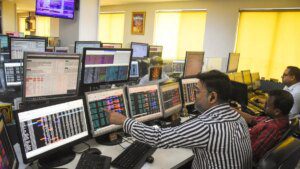

Benchmark indices opened significantly lower on Monday morning, impacted by rising crude oil prices, a weakening rupee, and escalating geopolitical tensions in the Middle East. The Bombay Stock Exchange (BSE) Sensex plunged more than 790 points, while the National Stock Exchange (NSE) Nifty experienced a breach of critical support levels early in the trading session.
The BSE Sensex, which concluded trading on Friday at 75,237.99, opened at 74,807.97 and was recorded at 74,447.73, down 790.26 points or 1.05 percent by 9:18 AM. The NSE Nifty50, which finished the previous session at 23,643.50, opened at 23,482.20 and fell further to 23,393.45, representing a decline of 250.05 points or 1.06 percent at the same time.
Gaurav Udani, Founder of ThinCredBlu Securities Ltd., indicated that the index “remains under pressure after slipping below important support zones,” further adding that “a sustained move below 23,400 could trigger additional selling pressure, potentially dragging the Nifty toward the 23,100 mark.”
The primary catalyst for Monday’s downturn is the spike in crude oil prices. Brent crude futures rose to $111.28 per barrel, an increase of 1.85 percent, while West Texas Intermediate (WTI) crude climbed to $103.22, up 2.18 percent, following reports of drone attacks on targets in the UAE and Saudi Arabia. On India’s Multi Commodity Exchange, May crude futures soared 2.81 percent to ₹10,363, whereas June futures increased by 2.86 percent to ₹9,962.
Ponmudi R, CEO of Enrich Money, noted that the rupee has now “breached the 96 mark against the U.S. dollar, reflecting ongoing weakness amid elevated crude oil prices, strong dollar demand, and cautious global sentiment.” He emphasized that “high crude prices continue to be a major macro concern for India due to their effect on inflation, import expenses, and rupee stability.”
Among the Nifty50 lossmakers, Tata Steel emerged as the largest decliner, dropping 3.80 percent to ₹208.60 from a prior close of ₹216.84. Power Grid Corporation fell 3.33 percent to ₹295.65, down from ₹305.85, while HDFC Life Insurance saw a decrease of 2.15 percent to ₹595.60 from ₹608.70. Shriram Finance decreased by 2.12 percent to ₹918.05 from ₹937.90, and Titan Company slipped by 1.94 percent to ₹4,088.40 from ₹4,169.10.
Dr. VK Vijayakumar, Chief Investment Strategist at Geojit Investments Limited, warned that “elevated crude may necessitate another round of price hikes in petrol and diesel, potentially leading to adverse implications for inflation,” noting that “the rupee may further decline, exacerbating the harmful cycle of rupee depreciation and foreign portfolio investor selling.”
Notably, information technology stocks exhibited resilience against broader market weakness. Infosys led the gainers, rising 0.79 percent to ₹1,127.80 from a previous close of ₹1,119. Tata Consultancy Services (TCS) gained 0.39 percent to ₹2,272.90 from ₹2,264, while Wipro climbed 0.26 percent to ₹190.50 from ₹190. Tech Mahindra added 0.15 percent, trading at ₹1,372.50. JSW Steel was the sole metal stock defying the trend, rising 0.52 percent to ₹1,285.50 from ₹1,278.80.
Shrikant Chouhan, Head of Equity Research at Kotak Securities, pointed out that last week “the real estate sector declined by 8.45 percent, and IT fell by 5.80 percent, while healthcare and pharmaceuticals outperformed, buoying over 2 percent.” He highlighted IT’s relative strength, noting that “export-oriented sectors like pharmaceuticals are likely to remain resilient,” a sentiment echoed by other analysts.
Saurav Ghosh, Co-founder of Jiraaf, remarked that “Indian bond markets have experienced pressure for over a month now, with the 10-year G-Sec yield remaining elevated and recently surpassing 7 percent amid increasing global uncertainty,” explicitly referencing the Iran–US conflict as a significant factor. He added that “persistently high crude prices raise risks of imported inflation, curtailing the Reserve Bank of India’s flexibility on interest rate cuts.”
Wall Street closed sharply lower on Friday, with the S&P 500 dropping 1.24 percent, the Dow Jones falling by 537 points, and the Nasdaq declining 1.54 percent. Asian markets opened broadly negative on Monday, with South Korea’s Kospi down over 3 percent and Japan’s Nikkei declining over 200 points. The US 10-year Treasury yield rose to 4.62 percent, adding pressure on emerging market equities. Gold traded near $1,450, silver was below $17.70, and copper stood at $6.
Rajesh Palviya, Head of Research at Axis Direct, pointed out that “bulls need a daily close above 23,700 to maintain the recovery towards 24,000, while 23,500 serves as a crucial support level.” He cautioned that “failure to hold the opening zone could quickly bring the 23,400–23,350 range into focus.”