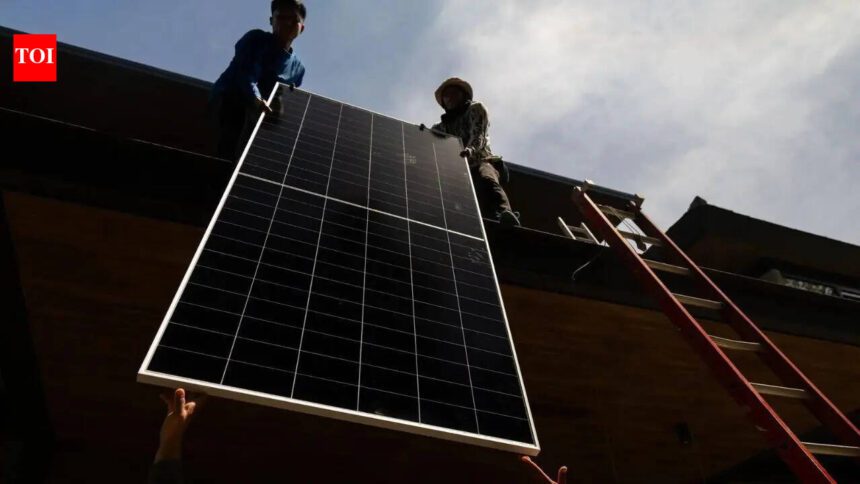

The Indian government has approved the installation of over 1.3 million rooftop solar systems under the utility-led aggregation (ULA) model in ten states and Union Territories (UTs) to promote the adoption of renewable energy among low-income and vulnerable households. This initiative is part of the Centre’s broader strategy to enhance solar energy capacity as a cleaner alternative to fossil fuel-based power generation.
Officials have indicated that several states, including Andhra Pradesh, Odisha, Telangana, and the Union Territory of Dadra and Nagar Haveli and Daman and Diu, have already begun installations. Other states such as Bihar, Kerala, Jammu and Kashmir, Tripura, Rajasthan, Chhattisgarh, Karnataka, Maharashtra, and Delhi have submitted proposals to the Centre for participation in the program.
The Ministry of New and Renewable Energy (MNRE) has set a target to install one crore (10 million) rooftop solar systems nationwide by March 2027 under the PM Surya Ghar Muft Bijli Yojana. Of this total, 3 million systems are planned to be implemented through the ULA model. Currently, more than 60% of the rooftop installations fall within the 3-4 kW capacity range, underscoring a lower engagement from poorer households that have less electricity demand. The ULA model aims to address this discrepancy by facilitating utility-led deployment along with necessary financing support.
To date, over 3.1 million rooftop solar systems, with a cumulative capacity of 11.4 GW, have been installed under the PM Surya Ghar Muft Bijli Yojana.