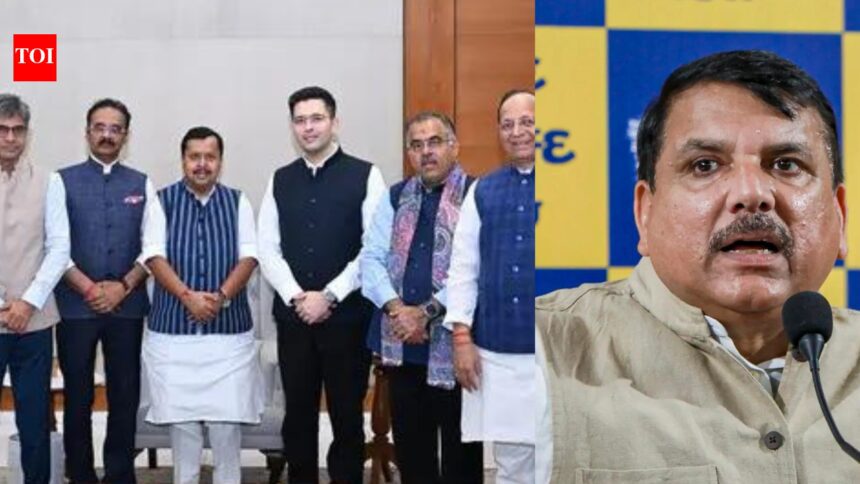

NEW DELHI: The Aam Aadmi Party (AAP) has formally requested Vice President of India and Rajya Sabha Chairman CP Radhakrishnan to disqualify all seven Members of Parliament who resigned from the party to join the Bharatiya Janata Party. This announcement came from AAP leader Sanjay Singh on Sunday.
According to Singh, AAP has consulted constitutional experts, among them senior advocate Kapil Sibal and former Lok Sabha Secretary-General PDT Achary, who opined that the MPs are “liable for disqualification under the law.” The political crisis intensified within AAP after the seven Rajya Sabha MPs declared their departures on Friday, prompting a complex legal and political debate regarding the legitimacy of their actions and the repercussions under anti-defection laws.
The MPs involved include Raghav Chadha, Sandeep Pathak, Ashok Mittal, Harbhajan Singh, Rajinder Gupta, Swati Maliwal, and Vikramjit Sahney. Chadha indicated that the exits were driven by “disappointment, disengagement, and disgust” within the party. In contrast, Sahney pointed to governance challenges in Punjab, such as debt issues, agrarian distress, and drug abuse, coupled with a perceived lack of access to party leadership.
Inside the party, sources revealed that the leadership was aware of potential defections and had made last-minute attempts to retain some MPs, amid claims of political pressure and internal dissatisfaction. Reports suggest that Punjab Chief Minister Bhagwant Mann had sought an audience with President Droupadi Murmu along with party MLAs to advocate for the “recall” of the MPs, although the Indian Constitution does not provide for a recall mechanism for Members of Parliament or state legislators.
AAP has strongly contested the recent developments. Earlier, Sanjay Singh referred to the Tenth Schedule of the Indian Constitution, arguing that such defections are unconstitutional and should initiate disqualification procedures.
However, legal opinions on the matter are mixed. While AAP leaders maintain that the splits are invalid, several legal experts point out that the anti-defection law permits mergers if supported by two-thirds of a legislative party, raising questions about the potential for disqualification in this case.
Singh also refuted claims that Punjab MLAs were negotiating with Raghav Chadha, labeling such narratives as “false propaganda” designed to sow confusion. He alleged that these narratives were being circulated by the BJP and others, asserting that the leaders involved were facing public discontent in Punjab. Singh noted that there were protests against them, which he argued has weakened their political standing, suggesting that with their party memberships nearing expiration, it is improbable that any MLA would align with them.